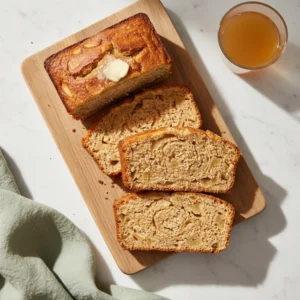
Apple Bread
Learn how to make moist, delicious apple bread with warm spices and fresh apples. This easy quick bread recipe is perfect for breakfast or gifting.
Ingredients
- 2 cups all-purpose flour
- 1 teaspoon baking soda
- 1/2 teaspoon baking powder
- 1/2 teaspoon salt
- 1 teaspoon ground cinnamon
- 1/4 teaspoon ground nutmeg
- 1/4 teaspoon ground cloves
- 1/2 cup unsalted butter softened
- 1 cup granulated sugar
- 2 large eggs room temperature
- 1/2 cup sour cream
- 1/4 cup fresh apple juice or milk
- 1 teaspoon vanilla extract
- 2 cups Granny Smith apples peeled and finely diced
- 1/2 cup chopped walnuts or pecans optional
Instructions
- Prep the pan: Preheat your oven to 350°F (175°C). Grease a 9x5-inch loaf pan with butter or non-stick spray, then line the bottom with parchment paper so the bread doesn't stick. This takes 2 minutes and prevents frustration when removing the cooled bread.
- Mix dry ingredients: In a small bowl, combine 2 cups all-purpose flour, 1 teaspoon baking soda, 1/2 teaspoon baking powder, 1/2 teaspoon salt, 1 teaspoon ground cinnamon, 1/4 teaspoon ground nutmeg, and 1/4 teaspoon ground cloves. Whisk for 30 seconds until evenly mixed. Set this bowl aside. Checkpoint: You should see no clumps of baking soda and the mixture should smell fragrant and spiced.
- Cream butter and sugar: In a large mixing bowl, combine 1/2 cup softened unsalted butter (cut into small pieces) and 1 cup granulated sugar. Using an electric mixer on medium speed, beat for 2–3 minutes until the mixture looks pale, fluffy, and resembles wet sand. Scrape down the bowl with a spatula halfway through. Checkpoint: The mixture should be noticeably lighter in color and airy.
- Add eggs: Add 2 large room-temperature eggs to the butter mixture, one at a time. After adding the first egg, beat on medium speed for 1 minute until fully combined and no streaks remain. Repeat with the second egg, beating for another minute. Checkpoint: The batter should be smooth and homogeneous with no visible egg white streaks.
- Add vanilla: Pour in 1 teaspoon vanilla extract and beat on low speed for 15 seconds to combine evenly.
- Mix wet and dry (part 1): In a small measuring cup or bowl, stir together 1/2 cup sour cream and 1/4 cup fresh apple juice (or milk) with a spoon until combined. Now, reduce mixer speed to low.
- Combine wet and dry (part 2): Add 1/3 of the dry ingredient mixture to the butter-egg mixture and beat on low speed for 20 seconds until just combined. Add 1/2 of the wet ingredient mixture (sour cream mixture) and beat for 15 seconds on low. Repeat: add another 1/3 of dry ingredients, beat 20 seconds on low, add remaining wet ingredients, beat 15 seconds on low. Finally, add the last 1/3 of dry ingredients and beat on low for 20 seconds until just combined. Do not overmix. Checkpoint: No visible streaks of dry flour should remain, and the batter should look thick and uniform.
- Prepare and add apples: Peel 2 cups Granny Smith apples (about 3–4 medium apples), cut them in half, remove cores, and dice finely into 1/4-inch pieces. You should have about 2 cups. Using a rubber spatula, gently fold the diced apples into the batter with 10–15 slow strokes until evenly distributed throughout. If using nuts, fold in 1/2 cup chopped walnuts or pecans at the same time. Checkpoint: Apple pieces should be visible throughout the batter, not clumped at the bottom.
- Transfer to pan: Pour the apple batter into your prepared loaf pan. Use the spatula to smooth the top into an even surface. This takes 1 minute and helps the bread bake evenly.
- Bake: Place the loaf pan in the preheated 350°F oven on the middle rack. Bake for 55–65 minutes. At the 55-minute mark, insert a toothpick or thin skewer into the very center of the loaf. It should come out clean or with just a few moist crumbs clinging to it (not wet batter). If batter is still visible, bake for another 5 minutes and test again. The top should be golden brown and springy to the touch. Checkpoint: A toothpick inserted in the center comes out clean or nearly clean. The top is deep golden brown. The bread smells sweet, spiced, and baked.
- Cool in pan: Remove the loaf from the oven and place it on a heat-safe surface or trivet. Let it sit in the pan for exactly 15 minutes. This allows the crumb to set so it doesn't fall apart when removed.
- Remove from pan: After 15 minutes, run a thin knife around all four edges of the pan to loosen the bread. Place a wire cooling rack upside-down over the top of the pan, then flip both together so the bread falls onto the rack. Carefully peel away the parchment paper from the bottom.
- Cool completely: Allow the apple bread to cool on the wire rack for at least 45 minutes to 1 hour before slicing. The interior continues to set as it cools, and warm bread crumbles easily. Once completely cool, you can slice it with a serrated bread knife using a gentle sawing motion. Checkpoint: The bread is no longer warm to the touch, and slices hold together without crumbling.