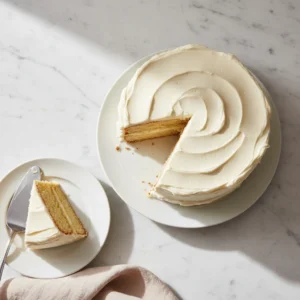
Best Buttermilk Birthday Cake
Learn how to make the best buttermilk birthday cake with tender crumb and silky frosting. Step-by-step recipe with expert tips for perfect results every time.
Ingredients
- 2 3/4 cups all-purpose flour
- 1 1/2 teaspoons baking soda
- 1/2 teaspoon salt
- 1/2 cup unsalted butter softened
- 1 1/2 cups granulated sugar
- 3 large eggs room temperature
- 1 teaspoon vanilla extract
- 1 cup buttermilk room temperature
- 1/2 cup unsalted butter softened
- 3 cups powdered sugar
- 1/4 cup heavy cream
- 2 teaspoons vanilla extract
- Pinch of salt
Instructions
- Prepare pans: Preheat oven to 350°F (176°C). Grease the inside of two 9-inch round cake pans with butter or cooking spray. Cut parchment paper to fit the bottoms, press into place, then grease the parchment too. This ensures the cakes release cleanly. Set aside.
- Mix dry ingredients: In a medium bowl, whisk together 2 3/4 cups all-purpose flour, 1 1/2 teaspoons baking soda, and 1/2 teaspoon salt. Use a whisk or fork to break up any small lumps in the flour and evenly distribute the leavening agents. Set aside.
- Cream butter and sugar: In a large mixing bowl, add 1/2 cup softened unsalted butter (cut into small cubes) and 1 1/2 cups granulated sugar. Using an electric mixer on medium speed, beat for 3–4 minutes until the mixture is pale yellow, fluffy, and noticeably lighter in color. Scrape down the bowl halfway through. Checkpoint: The mixture should look like fluffy sand and hold soft peaks when you lift the beaters.
- Add eggs one at a time: With the mixer on medium speed, add 3 room-temperature eggs one at a time, beating for about 30 seconds after each egg. Make sure each egg is fully incorporated before adding the next—the mixture should look smooth and creamy after each addition. Overbeating at this stage can incorporate too much air.
- Add vanilla: Pour in 1 teaspoon vanilla extract and beat on medium speed for 30 seconds until fully mixed.
- Alternate dry and wet ingredients: Reduce mixer speed to low. Add 1/3 of the flour mixture and beat for 15–20 seconds until just combined. Pour in 1/2 of the buttermilk and beat for 15–20 seconds. Add another 1/3 of the flour mixture and beat briefly. Add the remaining buttermilk and beat briefly. Finally, add the last 1/3 of flour and beat until just combined. Do not overmix—stop as soon as no white streaks of flour remain. Checkpoint: The batter should look smooth and slightly thick, resembling thick pancake batter. Overmixing develops gluten and creates a tough, dense cake.
- Divide batter between pans: Pour half the batter into the first prepared pan and use a spatula to spread it evenly to the edges. Pour the remaining batter into the second pan and smooth the top. The pans should be about 3/4 full.
- Bake the cakes: Place both pans on the center oven rack. Bake at 350°F for 28–32 minutes. The cakes are done when a wooden toothpick inserted into the center comes out with just a few moist crumbs (not wet batter). The tops should spring back when lightly touched, and the edges should pull away slightly from the pan sides. Do not open the oven before 25 minutes.
- Cool in pans: Remove both pans from the oven and place on wire cooling racks. Let the cakes rest in the pans for 15 minutes—this allows them to set and firm up without cracking. You may hear gentle crackling; this is normal.
- Turn out cakes: After 15 minutes, run a thin knife around the edge of each pan to loosen the cake. Place a cooling rack upside down over one pan, grip both the pan and rack, then flip the cake onto the rack. Gently lift the pan away and peel off the parchment paper. Repeat with the second cake. Checkpoint: Both cakes should be completely turned out and the parchment removed. Let them cool at room temperature for at least 1 hour until fully cooled to the touch before frosting. If cakes are still warm, the frosting will melt.
- Prepare frosting—beat butter: In a clean mixing bowl, add 1/2 cup softened unsalted butter (cubed). Using an electric mixer on medium speed, beat for 1–2 minutes until creamy and pale yellow. Scrape down the bowl. The butter should have no lumps.
- Add powdered sugar gradually: With the mixer on low speed, slowly add 3 cups powdered sugar, 1 cup at a time. Pause after each addition to let the sugar combine before adding more. This prevents a cloud of powdered sugar from escaping the bowl. Beat on low speed for about 1 minute after all sugar is added.
- Add cream and vanilla: Pour in 1/4 cup heavy cream and 2 teaspoons vanilla extract. Increase mixer speed to medium-high and beat for 2–3 minutes until the frosting is light, fluffy, and pale. The frosting should increase in volume slightly and look like thick, whipped mousse. Scrape down the bowl as needed.
- Spread frosting between layers: Place the first cooled cake layer on a serving plate or cake board. Using a spatula or butter knife, spread a generous 1/2-inch layer of frosting evenly over the top of the first cake. Leave about 1/2 inch from the edge bare to prevent frosting from squishing out when you stack the second layer.
- Stack second layer: Carefully lift the second cake layer and place it flat-side down on top of the frosted first layer. Press gently and evenly. The cake should look level and stable.
- Frost top and sides: Spread a layer of frosting over the top of the cake, smoothing it toward the edges. Then frost the sides with a spatula, using gentle upward strokes. For a rustic look, leave some texture; for a smooth finish, dip the spatula in warm water and smooth the frosting. Use about 2 1/2 to 3 cups of frosting total (reserve any extra for piping or taste-testing).
- Chill if needed: If decorating further (piping borders, adding sprinkles, etc.), refrigerate the frosted cake for 15–20 minutes until the frosting is firm enough to hold decorations. If serving plain, allow the cake to sit at room temperature for 20 minutes before slicing so the frosting softens slightly.