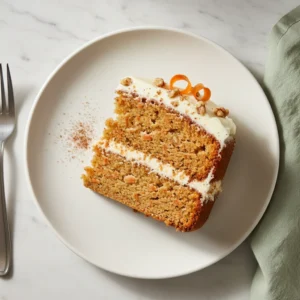
Carrot Cake Supreme
Learn to make carrot cake supreme with shredded carrots, pineapple, coconut, and walnuts. Includes cream cheese frosting. Perfect for spring celebrations.
Ingredients
- 2 cups all-purpose flour
- 2 teaspoons baking soda
- 1 teaspoon baking powder
- 1 teaspoon ground cinnamon
- 1/2 teaspoon ground nutmeg
- 1/4 teaspoon ground ginger
- 1/4 teaspoon ground cloves
- 1/2 teaspoon salt
- 1 3/4 cups granulated sugar
- 3/4 cup vegetable oil
- 3 large eggs
- 1 teaspoon vanilla extract
- 2 cups grated carrots about 4 medium carrots
- 1 cup crushed pineapple with juice
- 1/2 cup shredded coconut unsweetened
- 1/2 cup chopped walnuts
- 8 ounces cream cheese softened
- 1/2 cup butter softened
- 3 cups powdered sugar
- 1 teaspoon vanilla extract
- 2 tablespoons cream or milk
Instructions
- Prep the pans: Preheat your oven to 350°F (175°C). Grease two 9-inch round cake pans well with butter or cooking spray, then line the bottoms with parchment paper circles—this prevents sticking. If you prefer, use one 9x13-inch rectangular pan instead. Let the pans sit at room temperature while you prepare the batter. Checkpoint: Your oven should be fully preheated and your pans ready to fill.
- Combine dry ingredients: In a medium mixing bowl, add 2 cups all-purpose flour, 2 teaspoons baking soda, 1 teaspoon baking powder, 1 teaspoon ground cinnamon, 1/2 teaspoon ground nutmeg, 1/4 teaspoon ground ginger, 1/4 teaspoon ground cloves, and 1/2 teaspoon salt. Whisk these together with a wire whisk for about 30 seconds, breaking up any lumps and fully incorporating the spices. This ensures even distribution throughout the cake. Checkpoint: Your dry mixture should be light and uniform in color with no visible lumps.
- Combine wet ingredients: In a large mixing bowl, whisk together 1 3/4 cups granulated sugar and 3/4 cup vegetable oil for about 1 minute until slightly combined—the mixture doesn't need to be perfectly smooth, just blended. Add 3 large eggs one at a time, whisking vigorously after each addition for about 20 seconds. The mixture should lighten slightly and become slightly pale. Stir in 1 teaspoon vanilla extract with a spatula. Checkpoint: Your mixture should look creamy and slightly thickened, with no visible egg streaks.
- Combine wet and dry: Pour the dry ingredient mixture into the wet ingredients. Using a rubber spatula or wooden spoon, gently fold the ingredients together using a scooping and turning motion—avoid vigorous stirring, which develops gluten and makes the cake tough. Fold until just a few streaks of flour remain visible (about 15–20 folds). Do not overmix. Checkpoint: You should see no dry flour streaks, and the batter should look lumpy but combined.
- Add mix-ins: Fold in 2 cups grated carrots (measure after shredding; use about 4 medium carrots), 1 cup crushed pineapple with its juice, 1/2 cup shredded unsweetened coconut, and 1/2 cup chopped walnuts using gentle folding motions. The batter will be thick and studded with ingredients. Checkpoint: All ingredients should be evenly distributed throughout, and the batter should smell warm and fragrant.
- Fill pans and level: Pour the batter into your prepared pans, dividing evenly between two round pans or spreading into the rectangular pan. Use an offset spatula or the back of a spoon to gently smooth the tops, creating an even surface. For round pans, the batter should reach about 3/4 inch up the sides. Checkpoint: Your pans are ready to bake with level, evenly distributed batter.
- Bake the cake: Place the pans in the preheated 350°F oven on the middle rack. Bake for 35–40 minutes if using 9-inch round pans, or 45–50 minutes if using a 9x13-inch rectangular pan. The cake is done when a toothpick inserted into the center comes out with just a few moist crumbs clinging to it (not wet batter, but not completely dry either). The top should spring back lightly when touched, and the edges should pull slightly away from the pan sides. Checkpoint: The cake should smell rich and spiced, and the toothpick test confirms doneness.
- Cool in pan: Remove the pans from the oven and place on wire cooling racks. Let the cakes rest in their pans for exactly 15 minutes—this allows the structure to set. The cakes should still feel warm but not hot. Checkpoint: The cakes have pulled slightly from the pan edges and feel firm enough to turn out.
- Turn out to cool: Run a thin knife around the edges of each cake to loosen it from the pan sides. Place a wire cooling rack on top of the cake, then flip the pan and rack together so the cake falls onto the rack. Remove the pan and peel off the parchment paper from the bottom. If the paper sticks, spray it lightly with water first. Let the cakes cool completely on the racks at room temperature—this takes 1–2 hours. The cakes should feel room temperature to the touch before frosting. Checkpoint: Both cake layers are cool, level, and ready for frosting.
- Prepare frosting (while cakes cool): In a medium mixing bowl, combine 8 ounces softened cream cheese and 1/2 cup softened butter (cut into chunks). Beat with an electric mixer on medium speed for 2–3 minutes, scraping down the bowl occasionally, until the mixture is light, fluffy, and pale (it should lighten by about one shade). The mixture should resemble fluffy clouds. Checkpoint: The cream cheese and butter are fully combined and fluffy with no visible lumps.
- Add sugar and flavorings: Gradually add 3 cups powdered sugar, 1 teaspoon vanilla extract, and 2 tablespoons cream or milk to the frosting. Start on low speed, then increase to medium speed, beating for 2–3 minutes total. Add the milk or cream only 1 tablespoon at a time—you want the frosting thick enough to spread but not runny. If it's too thick, add a splash more milk; if it's too thin, add a bit more powdered sugar. The frosting should be creamy, spreadable, and hold gentle peaks. Checkpoint: Your frosting is smooth, creamy, and the right consistency to spread on the cake.
- Assemble two-layer cake: Place the first completely cooled cake layer on your serving plate, cake board, or pedestal cake stand. Using an offset spatula or the back of a spoon, spread about 3/4 cup of frosting evenly over the top of this layer, leaving about a 1/2-inch border. Carefully place the second cake layer on top, centering it. Checkpoint: Your two layers are stacked, centered, and level.
- Frost the exterior: Spread a thin layer of frosting (the crumb coat) over the top and sides of the stacked cake using long, smooth strokes—this prevents cake crumbs from showing in the final layer. Refrigerate the cake for 15 minutes so this layer sets. Then add a thicker frosting layer on top and sides, smoothing it with an offset spatula dipped in warm water for a polished finish. Checkpoint: The cake is fully frosted with a smooth, professional appearance.
- For single-layer rectangular cake: If using a 9x13-inch rectangular pan, frost the top and sides of the cake once it's completely cooled. Use an offset spatula to create decorative swirls or keep it smooth, depending on your preference. Checkpoint: Your cake is fully frosted and ready to serve or refrigerate.
- Chill and serve: Refrigerate the frosted cake for at least 30 minutes (up to 24 hours) before serving. This allows flavors to meld and makes slicing cleaner. Cut slices with a long, sharp knife dipped in hot water and wiped clean between cuts. Serve chilled or at room temperature.