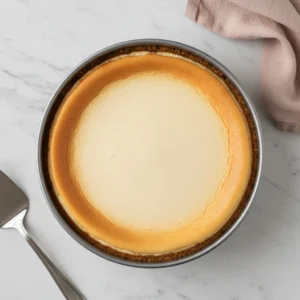
Cream Cheese Cheesecake
Learn how to make cream cheese cheesecake at home with this foolproof recipe. Includes step-by-step instructions, tips to prevent cracking, and make-ahead storage guidance.
Ingredients
- 2 cups graham cracker crumbs
- 1/2 cup granulated sugar
- 6 tablespoons unsalted butter melted
- 32 ounces cream cheese room temperature
- 1 cup granulated sugar
- 1/4 cup all-purpose flour
- 1 tablespoon cornstarch
- 1 teaspoon vanilla extract
- 1/2 teaspoon salt
- 4 large eggs room temperature
- 1/2 cup sour cream
- 2 tablespoons lemon juice
Instructions
- Prep the pan: Preheat your oven to 325°F. Wrap the outside of a 9-inch springform pan completely with aluminum foil, covering all sides and the bottom. This prevents water from seeping in during the water bath. Set aside.
- Make the crust: In a medium bowl, combine 2 cups graham cracker crumbs, 1/2 cup granulated sugar, and 6 tablespoons melted unsalted butter. Stir until the mixture looks like wet sand with no dry crumbs remaining, about 1–2 minutes.
- Press and bake the crust: Pour the crumb mixture into the prepared springform pan. Using the bottom of a measuring cup, press firmly and evenly across the entire bottom to create a compact layer. Bake for 8 minutes at 325°F until the crust is light golden and fragrant. Remove and place on the counter to cool while you make the filling.
- Soften cream cheese: Remove 32 ounces cream cheese from the refrigerator and let it sit at room temperature for 30–45 minutes. It should be soft enough to press your finger into easily. Room temperature cream cheese is critical — cold cheese will create lumps in your filling.
- Beat cream cheese: Place the room temperature cream cheese in a large bowl and beat on medium speed with an electric mixer for 2–3 minutes until completely creamy and smooth with no lumps. Scrape down the bowl and beaters halfway through. Checkpoint: Your cream cheese should look like soft frosting with no visible chunks.
- Add dry ingredients: In a small bowl, whisk together 1 cup granulated sugar, 1/4 cup all-purpose flour, 1 tablespoon cornstarch, 1 teaspoon vanilla extract, and 1/2 teaspoon salt. Add this mixture to the beaten cream cheese and mix on low speed for 1–2 minutes until just combined. Do not overmix or the filling will incorporate too much air and may crack. Checkpoint: The mixture should be smooth and pale yellow.
- Add eggs carefully: Crack 1 large room temperature egg into a small bowl and whisk gently. Pour into the cream cheese mixture and beat on low speed for about 30 seconds until the egg is incorporated with no white streaks visible. Repeat this process with the remaining 3 eggs, adding one at a time. Low speed and minimal mixing prevents air bubbles that cause cracks. Checkpoint: All eggs are fully incorporated with a smooth, creamy texture.
- Fold in sour cream and lemon: Add 1/2 cup sour cream and 2 tablespoons lemon juice to the filling. Using a silicone spatula, gently fold these ingredients in with 8–10 slow, deliberate strokes until just combined. Do not overmix. The lemon juice adds subtle brightness and helps prevent a dense texture.
- Pour filling: Pour the filling over your cooled crust, smoothing the top gently with a spatula. Try to create an even surface with no air pockets visible on top.
- Prepare water bath: Place your filled springform pan inside a larger roasting pan. Pour hot water into the roasting pan until it reaches halfway up the outside of the springform pan, about 1–2 inches deep. The water bath ensures gentle, even cooking and prevents cracking. If you don't have a large roasting pan, wrap a towel around the foil-covered springform pan to insulate it.
- Bake low and slow: Carefully place the roasting pan (with the cheesecake and water inside) on the center oven rack. Bake at 325°F for 55–65 minutes. At 55 minutes, gently shake the pan — the edges should be set and firm, but the center (about a 2-inch circle in the middle) should jiggle slightly like set Jell-O when moved. This means the carryover cooking will finish it perfectly. Checkpoint: The top is light golden, edges are pulling slightly from the pan sides, and center jiggles.
- Cool gradually in oven: Turn off the oven and crack the door open exactly 4 inches. Let the cheesecake sit in the cooling oven for exactly 1 hour. This gradual cooling is essential — rapid temperature changes cause cracks. Set a timer to remind yourself.
- Remove from water bath: After 1 hour, carefully remove the cheesecake (still in its springform pan) from the water bath and place it on a wire cooling rack at room temperature. Let it cool for another 15–20 minutes.
- Refrigerate overnight: Run a thin knife around the edge of the cheesecake to loosen it from the pan sides (this prevents cracking when you release the springform). Do not remove the springform yet. Wrap the entire pan loosely with plastic wrap and place in the refrigerator for at least 8 hours, preferably overnight (12–24 hours). Cold cheesecake is easier to slice cleanly and has better texture.
- Release and serve: When ready to serve, remove the cheesecake from the refrigerator and let it sit at room temperature for 15–20 minutes to take the chill off. Run a warm knife around the edge again, then unlock and carefully remove the springform pan sides. Wipe your knife with a warm, damp cloth and dip it in hot water between each slice for clean cuts.
- Troubleshooting: If your cheesecake cracks on top, don't worry — you can cover it with a fruit topping, sour cream layer, or chocolate ganache. If the filling is not set in the center after baking, return it to a 200°F oven for 10–15 minutes. If the crust is soggy, it may have absorbed water from the bath — ensure your foil seal is complete next time.