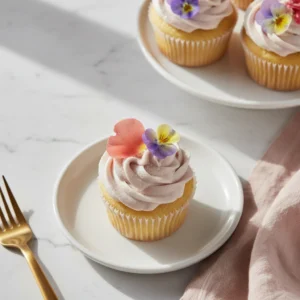
Floral Cupcakes
Make stunning floral cupcakes with lavender, lemon, and rose water frosting. Perfect for spring celebrations. Detailed recipe with edible flower decoration ideas.
Ingredients
- 1 3/4 cups all-purpose flour
- 1 1/2 teaspoons baking powder
- 1/2 teaspoon baking soda
- 1/4 teaspoon salt
- 1/2 cup unsalted butter softened
- 1 cup granulated sugar
- 2 large eggs
- 1/2 cup sour cream
- 1/4 cup whole milk
- 2 tablespoons fresh lemon juice
- 1 tablespoon culinary lavender buds finely ground
- 1 teaspoon vanilla extract
- 1/2 teaspoon almond extract
- 3/4 cup unsalted butter softened (for frosting)
- 3 cups powdered sugar
- 2 tablespoons heavy cream
- 1 tablespoon fresh lemon juice for frosting
- 1/2 teaspoon vanilla extract for frosting
- 1/4 teaspoon culinary rose water
- Edible flower petals for garnish rose petals, violets, pansies
- Edible pearl dust or shimmer dust for decoration
Instructions
- Prep the pan: Preheat oven to 350°F (175°C) for 10–15 minutes. Line two 12-cup muffin tins with paper liners. The oven should be fully preheated and steady at temperature.
- Mix dry ingredients: In a medium bowl, whisk together 1 3/4 cups all-purpose flour, 1 1/2 teaspoons baking powder, 1/2 teaspoon baking soda, 1/4 teaspoon salt, and 1 tablespoon finely ground culinary lavender buds. Whisk for 30 seconds until evenly combined. Checkpoint: You should see flecks of lavender throughout the flour mixture with no clumps.
- Cream butter and sugar: In a large bowl, add 1/2 cup softened unsalted butter (cut into chunks for faster mixing) and 1 cup granulated sugar. Using an electric mixer on medium speed, beat for 3–4 minutes until the mixture is pale, fluffy, and resembles wet sand. It should look much lighter in color than when you started. Checkpoint: The mixture should be noticeably lighter and airier; scrape down the sides of the bowl with a spatula.
- Add eggs one at a time: Crack 2 large eggs into a small bowl. Add the first egg to the butter mixture and beat on medium speed for 45 seconds until fully combined and no streaks of yellow remain. Repeat with the second egg. The mixture will look slightly curdled at first but will come together. Checkpoint: After both eggs are added, the batter should be smooth with no visible egg streaks.
- Add extracts: Pour in 1 teaspoon vanilla extract and 1/2 teaspoon almond extract. Beat on medium speed for 15–20 seconds until combined. The almond extract adds a subtle depth that enhances the floral notes.
- Prepare wet mixture: In a separate small bowl, whisk together 1/2 cup sour cream, 1/4 cup whole milk, and 2 tablespoons fresh lemon juice. Stir for 10 seconds until the sour cream is smooth and no lumps remain. The mixture will be thinner than sour cream alone. Checkpoint: The mixture should be smooth, pourable, and pale.
- Combine wet and dry in alternating steps: Add one-third of the dry flour mixture to the butter-egg mixture. Beat on low speed for 10–15 seconds until just barely combined; a few streaks of flour are fine. Then add half of the wet sour cream mixture and beat on low speed for 10–15 seconds. Add another one-third of the dry mixture, beat briefly. Add the remaining wet mixture, beat briefly. Finally, add the last one-third of dry mixture and beat for 15–20 seconds until just combined. Do not overmix; lumps in the batter are normal and will result in more tender cupcakes. Checkpoint: The batter should be smooth, thick, and pourable with minimal flour streaks. Scrape down the bowl with a spatula to ensure no pockets of dry ingredients remain at the bottom.
- Fill liners: Using an ice cream scoop or a 1/4 cup measuring cup, divide the batter evenly among the 24 prepared cupcake liners, filling each about two-thirds full. If using a scoop, level the top of each scoop before releasing into the liner. Uneven filling will result in inconsistent cupcake heights. Checkpoint: All liners should have roughly the same amount of batter; the batter should not reach the top of the liner.
- Bake cupcakes: Place both muffin tins in the preheated 350°F (175°C) oven on the center rack (if using two racks, place one on the middle rack and one slightly higher, swapping halfway through). Bake for 18–22 minutes. The cupcakes are done when a toothpick inserted into the center of one comes out clean or with just a few moist crumbs; the tops should spring back when lightly touched. The edges should look set but the tops should still be tender-looking. Checkpoint: The cupcakes should be pale golden on top, the toothpick should come out nearly clean, and they should smell fragrant and slightly sweet with a hint of lavender.
- Cool in pan: Remove both muffin tins from the oven and set on a cool wire rack or trivet for 10 minutes. Do not remove the cupcakes yet; they are still too fragile. The residual heat will finish cooking the interior. Checkpoint: The cupcakes should be cool enough to handle but still warm to the touch.
- Remove from pan: Working carefully, remove each cupcake from the muffin tin by gently pressing the bottom of the liner upward while supporting the cupcake with your other hand. Place on a wire cooling rack in a single layer. Let cool to room temperature, about 30–45 minutes. Do not frost until completely cooled or the frosting will melt and slide off. Checkpoint: The cupcakes should feel cool to the touch with no warmth remaining.
- Prepare frosting base: In a clean large mixing bowl, add 3/4 cup softened unsalted butter (cut into tablespoon-sized chunks). Using an electric mixer on medium speed, beat for 2–3 minutes until the butter is pale, creamy, and almost doubled in volume. Stop and scrape down the sides frequently. The butter should look light and fluffy, almost mousse-like. Checkpoint: The butter should be pale yellow, fluffy, and increased in volume; no small chunks should remain.
- Add powdered sugar gradually: Reduce mixer speed to low. Slowly add 3 cups sifted powdered sugar (sifting prevents lumps) in three additions, beating on low speed after each addition for 10–15 seconds. Add 2 tablespoons heavy cream, 1 tablespoon fresh lemon juice, 1/2 teaspoon vanilla extract, and 1/4 teaspoon culinary rose water. Beat on low speed for 15–20 seconds to combine. Checkpoint: Stop the mixer and scrape down the bowl after adding sugar. The mixture should still look thick and slightly grainy.
- Whip frosting to fluffy consistency: Increase mixer speed to medium-high and beat the frosting for 2–3 minutes, scraping down the sides halfway through. The frosting will transform from thick and grainy to light, fluffy, and spreadable. It should look pale and airy. Checkpoint: The frosting should be pale pink-white, fluffy, and hold peaks when the beaters are lifted; it should be smooth and easy to spread or pipe.
- Frost the cupcakes: Using a piping bag fitted with a large closed-star tip (or a simple butter knife for a more rustic look), pipe or spread frosting onto each cooled cupcake in a generous mound or swirl. Work quickly but gently; if the frosting gets too soft, refrigerate it for 10–15 minutes. Each cupcake should have about 2–3 tablespoons of frosting. Checkpoint: The frosting should look smooth and peaked; the cupcake liners should be mostly hidden under the frosting.
- Add fresh edible flowers: While the frosting is still soft (within 5–10 minutes of frosting), gently press 2–3 edible flower petals (rose petals, violets, or pansies) into the center of each frosted cupcake. Press gently so the petals adhere to the frosting but do not sink deep into it. Choose flowers that are pesticide-free and specifically culinary-grade. Checkpoint: The petals should be partially embedded in the frosting and arranged in an attractive, natural-looking way.
- Add shimmer dust: Using a small, fine pastry brush or dusting brush, very lightly brush or dust the top of each cupcake with edible pearl dust or shimmer dust. Use a light hand—a little goes a long way. The dust should create a delicate sparkle without coating the entire cupcake. Checkpoint: The cupcakes should have a subtle, elegant shimmer; the flowers should still be clearly visible.
- Chill before serving: Transfer the frosted and decorated cupcakes to a serving platter or storage container and refrigerate for at least 30 minutes before serving. This allows the frosting to set firmly and makes the cupcakes easier to handle and serve. Checkpoint: The frosting should be firm to the touch but not rock-hard; the cupcakes should feel cold but not frozen.