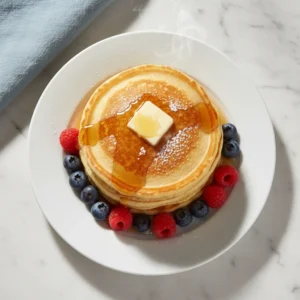
Homemade Buttermilk Pancakes
Easy homemade buttermilk pancakes recipe makes fluffy, tender pancakes from simple pantry staples. Perfect for weekends.
Ingredients
- all-purpose flour
- baking powder
- baking soda
- granulated sugar
- kosher salt
- buttermilk
- butter
- eggs
- vanilla extract
Instructions
- Gather and measure all ingredients. Have your flour, baking powder, baking soda, sugar, salt, buttermilk, butter, eggs, and vanilla extract ready. This takes about 5 minutes and prevents scrambling later.
- Preheat your griddle or skillet. Set it to medium-high heat and let it warm for 2–3 minutes. You'll know it's ready when a drop of water sizzles immediately on the surface. This ensures even cooking and proper browning.
- Combine dry ingredients. In a large mixing bowl, whisk together 2 cups all-purpose flour, 2 teaspoons baking powder, 2 teaspoons baking soda, 3 tablespoons granulated sugar, and 1 teaspoon kosher salt. Whisk for about 30 seconds until evenly distributed. Checkpoint: You are ready to move on when the mixture is uniform in color with no visible clumps of baking soda.
- Mix wet ingredients separately. In another bowl, combine 1 cup buttermilk, 2 tablespoons melted and cooled butter, and 2 large eggs. Stir with a fork for about 1 minute until well combined. Add 1 teaspoon vanilla extract and stir 15 seconds more.
- Combine wet and dry ingredients. Pour the buttermilk mixture into the flour mixture. Using a spatula or wooden spoon, gently fold together for about 30–45 seconds. Stop while small lumps remain—do not stir until smooth. Overmixing creates tough pancakes. Checkpoint: You are ready to move on when you see lumpy batter that's thick enough to hold its shape but loose enough to pour slowly.
- Adjust batter consistency if needed. If the batter is too thick, add 1–2 tablespoons more buttermilk and fold gently. If too thin, let it rest 2 minutes—it will thicken slightly. Proper consistency pours like cake batter but holds its shape on the griddle.
- Prepare the griddle. Once hot, add 1 tablespoon butter, non-stick spray, or cooking oil to the surface and swirl to coat evenly. It should sizzle immediately. This takes about 30 seconds.
- Pour the first batch. Using a one-third cup measure or ladle, pour batter onto the hot griddle, leaving at least half an inch between each pancake. Pour slowly to avoid splashing. You should fit 3–4 pancakes per griddle depending on size. This takes about 1 minute total.
- Monitor for bubbles. Watch the pancakes for 2–3 minutes. When bubbles form across the surface and the edges look dry or slightly browned, the pancake is ready to flip. If you flip too early, the center won't cook through. Checkpoint: You are ready to flip when you see at least 5–10 bubbles broken across the surface and the edges appear set.
- Flip and cook the second side. Using a thin spatula, slide under each pancake and flip quickly in one motion. Cook the second side for 1–2 minutes until golden brown. The second side cooks faster than the first, so watch carefully.
- Transfer to a plate. Once the second side is golden and pancake springs back slightly when touched, transfer to a serving plate. Keep warm in a 200°F oven or serve immediately. This takes about 30 seconds per pancake.
- Repeat with remaining batter. Add another small amount of butter to the griddle and repeat steps 8–11 with the remaining batter. The recipe makes about 16 pancakes total, depending on size.
- Serve immediately. Homemade pancakes are best enjoyed fresh and warm. Top with butter (which melts into the warm surface), warmed maple syrup, fresh fruit, whipped cream, or your favorite toppings. Plate and serve within 5 minutes of cooking for the best texture.