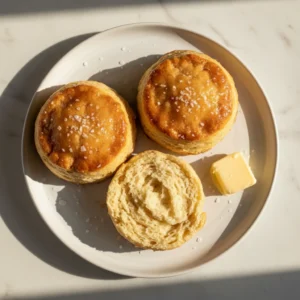
Honey Butter Biscuits
Easy honey butter biscuits recipe with flaky, tender interiors and a sweet glaze. Perfect for breakfast, brunch, or alongside any meal. Try our step-by-step instructions today.
Ingredients
- 2 cups all-purpose flour
- 1 tablespoon baking powder
- 1 teaspoon salt
- 1/2 teaspoon baking soda
- 6 tablespoons unsalted butter cold and cubed
- 3/4 cup whole milk cold
- 3 tablespoons honey
- 4 tablespoons unsalted butter melted
- 2 tablespoons honey for brushing
- 1/4 teaspoon fleur de sel or finishing salt
Instructions
- Preheat your oven to 425°F (220°C). Line a baking sheet with parchment paper and set aside. Checkpoint: Your oven is ready when the temperature indicator shows 425°F.
- In a large mixing bowl, whisk together 2 cups all-purpose flour, 1 tablespoon baking powder, 1 teaspoon salt, and 1/2 teaspoon baking soda for about 30 seconds until evenly combined. Checkpoint: The dry mixture should look uniformly pale and have no lumps.
- Cut 6 tablespoons of cold unsalted butter into small cubes directly into the flour mixture. Using a pastry cutter, two knives, or your fingertips, work the cold butter into the flour by breaking it down into smaller and smaller pieces. Continue for about 3–4 minutes until the mixture resembles coarse breadcrumbs with some pea-sized pieces of butter still visible. This creates pockets of butter that will steam during baking and create flakiness. Checkpoint: The texture should resemble sand with small gravel—some pieces of butter should still be visible.
- In a small bowl, pour 3/4 cup cold whole milk and add 3 tablespoons honey. Whisk them together for about 30 seconds until the honey is mostly dissolved and the mixture is smooth. Checkpoint: The wet mixture should be uniform and honey should be well-incorporated.
- Make a well in the center of the dry ingredients by pushing the flour to the sides. Pour the milk-honey mixture into the well. Using a fork, gently stir the ingredients together, bringing some dry mixture from the sides into the wet center. Stir for about 1 minute until the dough just comes together—there should be no dry flour remaining, but the dough will be slightly shaggy. Do not overmix or the biscuits will become tough. Checkpoint: No dry flour should be visible when you look into the bowl, but the dough should not look smooth or overworked.
- Lightly dust your work surface with about 1 tablespoon of all-purpose flour. Turn the dough out onto the floured surface. Using your hands, gently fold the dough over itself 3–4 times, being careful not to compress it too much. This gentle folding helps create layers without toughening the dough. After folding, the dough should hold together loosely but still have a rustic, slightly shaggy appearance. Checkpoint: The dough should be cohesive enough to handle but should not be smooth or dense.
- Using a rolling pin or your hands, gently pat the dough down to approximately 1 inch thick. Try to keep the thickness as even as possible—this ensures all biscuits bake at the same rate. Checkpoint: Your dough should be about 1 inch tall when measured with a ruler.
- Using a 2.5-inch round biscuit cutter (or a glass of similar diameter), press straight down into the dough to cut out biscuits. Press firmly so you cut all the way through, but do not twist the cutter—twisting seals the edges and prevents the biscuits from rising properly. You should be able to cut about 8–10 biscuits. Gently gather any dough scraps, re-pat to 1 inch thick, and cut additional biscuits (these will be slightly less fluffy). Checkpoint: Your biscuits should be clean-cut circles with no twisted or sealed edges.
- Arrange the cut biscuits on your prepared baking sheet, leaving about 2 inches of space between each one. If you prefer extra-tall, fluffy biscuits, place them so they're almost touching—the steam from one biscuit will help another rise higher. Checkpoint: All biscuits should be evenly spaced and sitting flat on the baking sheet.
- Place the baking sheet on the middle rack of your preheated 425°F oven. Bake for 12–14 minutes until the tops of the biscuits are light golden brown and the sides are set. The biscuits should not be deeply browned—a pale to medium gold is perfect. Do not open the oven door during the first 10 minutes of baking or you may cause them to collapse. Checkpoint: The biscuit tops should be golden and springy to the touch when you lightly press the center of one.
- While the biscuits are baking, prepare the honey-butter glaze: In a small bowl, combine 4 tablespoons melted unsalted butter and 2 tablespoons honey. Whisk them together for about 30 seconds until smooth and well-combined. The mixture should be liquid and pour easily. Checkpoint: The glaze should be smooth, warm, and golden with no visible separation.
- Remove the biscuits from the oven immediately after they turn golden. Using a pastry brush, generously brush the warm honey-butter glaze over the top of each biscuit while they're still hot—the heat helps the glaze absorb and creates a beautiful sheen. Checkpoint: All biscuit tops should be glistening and evenly coated with the glaze.
- Sprinkle 1/4 teaspoon of fleur de sel (or regular finishing salt) evenly over the tops of all the biscuits while the glaze is still wet. The salt will stick to the glaze and create a subtle salty-sweet contrast. Checkpoint: Each biscuit should have a light dusting of salt crystals.
- Allow the biscuits to cool on the baking sheet for 3–5 minutes before serving. This allows the glaze to set slightly while the biscuits remain warm and soft. Transfer to a bread basket or serving plate. Serve warm and enjoy within 2–3 hours for the best texture and flavor.