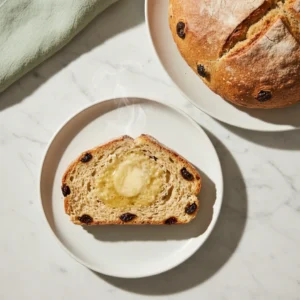
Irish Soda Bread
Make Irish Soda Bread at home with this easy recipe. No yeast needed! Tender crumb, plump raisins, and golden crust in just over 1 hour.
Ingredients
- flour
- sugar
- baking soda
- baking powder
- salt
- egg
- butter
- raisins
- buttermilk
Instructions
- Preheat your oven to 350°F (175°C). Grease a cast iron skillet or round baking pan with butter, making sure to coat the bottom and sides well. This prevents sticking. Checkpoint: Your pan should look shiny and evenly coated with no dry spots.
- In a large mixing bowl, measure out 4 cups of all-purpose flour. Add 1 cup sugar, 1 teaspoon baking soda, 1 teaspoon baking powder, and 1 teaspoon salt to the flour. Whisk everything together for 1–2 minutes until the dry ingredients are evenly mixed and no lumps of baking soda remain. Checkpoint: The mixture should look like slightly sweet flour with no visible clumps.
- In a separate medium bowl, crack 1 egg and beat it with a fork for 30 seconds until the yolk and white are blended. Pour in 1/2 cup melted butter and 2 cups buttermilk. Stir with a spoon or whisk for 30 seconds until combined. The mixture will look slightly curdled—this is normal and expected. Checkpoint: All ingredients should be mixed together, even if the appearance looks uneven.
- Pour the wet mixture into the bowl with the dry ingredients. Using a wooden spoon or silicone spatula, fold the wet and dry ingredients together gently for 1–2 minutes, stirring just until no visible dry flour remains. Be careful not to overmix; the dough should look slightly lumpy and shaggy, not smooth. Checkpoint: You should see no streaks of dry flour, but the dough will look rough and rustic.
- Prepare your raisins: if they have been soaking in warm water for 10–15 minutes, drain them well using a fine mesh strainer. Fold the drained raisins into the dough by gently stirring for 30 seconds until they are evenly distributed. Checkpoint: The raisins should be scattered throughout and not all clumped in one area.
- Carefully transfer the dough to the prepared cast iron skillet. Use a spatula to gently press the dough so it fills the pan evenly. Lightly smooth the top surface with your fingertips or a damp rubber spatula. The top does not need to be perfectly smooth. Checkpoint: The dough should fill the skillet and look rustic, not polished.
- Place the skillet on the middle rack of your preheated 350°F oven. Bake for 50–60 minutes. The bread is done when the top is golden brown and a wooden skewer or toothpick inserted into the center comes out clean or with just a few crumbs. If the top browns too quickly before 50 minutes, you can loosely tent it with foil. Checkpoint: The top should be a deep golden-brown color, and the skewer should not have wet batter clinging to it.
- Remove the skillet from the oven using oven mitts. Let the bread cool in the skillet for 10 minutes. You will hear the bread settle and may see steam. This resting time allows the structure to set. Checkpoint: The bread should feel firm to the touch and should not jiggle when you gently shake the pan.
- After 10 minutes, carefully turn the bread out onto a wire cooling rack by placing the rack over the skillet, holding both together, and flipping. If using parchment paper under the bread, it should come out easily. Let cool for at least 30–45 minutes before slicing. The bread will continue to firm up as it cools. Checkpoint: The bread should feel set and only slightly warm to the touch before slicing.
- Once cooled to room temperature, slice with a serrated bread knife using a gentle sawing motion. Serve warm or at room temperature with butter and jam, or alongside soups and stews.