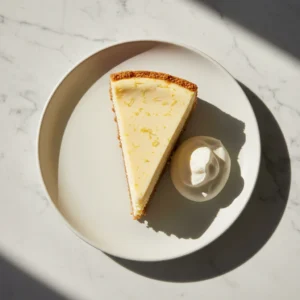
Keto Cheesecake
Easy keto cheesecake recipe with almond flour crust and cream cheese filling. Only 4g net carbs per slice. Perfect for ketogenic diets. Make ahead friendly.
Ingredients
- 2 cups almond flour
- 1/2 cup melted butter
- 1/4 cup erythritol or monk fruit sweetener
- 1/4 teaspoon sea salt
- 32 ounces cream cheese at room temperature
- 1 cup heavy whipping cream
- 3/4 cup erythritol or monk fruit sweetener
- 4 large eggs at room temperature
- 2 teaspoons vanilla extract
- 2 tablespoons fresh lemon juice
- 1 teaspoon lemon zest
- 1/4 teaspoon sea salt
- Butter for greasing the springform pan
Instructions
- Prep the pan (5 minutes): Preheat oven to 325°F. Grease a 9-inch springform pan thoroughly with butter and line the bottom with parchment paper. This prevents sticking and makes removal easier. Set aside.
- Make the crust (10 minutes): In a bowl, combine 2 cups almond flour, 1/2 cup melted butter, 1/4 cup erythritol, and 1/4 teaspoon sea salt. Stir until the mixture looks like damp sand with no dry flour visible. Press firmly and evenly into the bottom of the prepared pan, using the bottom of a measuring cup to compress it into a compact layer about 1/4 inch thick.
- Bake the crust (12 minutes at 325°F): Place the pan in the oven and bake for 10–12 minutes until the crust is pale golden and smells toasted. The edges may brown slightly—this is fine. Remove from the oven and set aside to cool while you prepare the filling. Checkpoint: The crust should feel firm to the touch and have a light golden color.
- Soften cream cheese (5 minutes, room temperature): Remove 32 ounces of cream cheese from the refrigerator and let it sit on the counter for 20–30 minutes until completely soft. This is critical—cold cream cheese will create lumps. Test by pressing your finger into it; it should feel soft without being oily.
- Beat cream cheese (3 minutes, medium speed): Using an electric mixer on medium speed, beat the softened cream cheese for 2–3 minutes until smooth, creamy, and pale. Stop and scrape down the sides of the bowl with a spatula halfway through. The mixture should look like frosting with no lumps visible. Checkpoint: The cream cheese should be completely lump-free and fluffy.
- Add cream and sweetener (3 minutes, medium speed): Pour in 1 cup heavy whipping cream and 3/4 cup erythritol (or monk fruit sweetener). Beat on medium speed for 2–3 minutes until the mixture is light, fluffy, and pale. Stop and scrape the bowl once during beating. The texture should resemble mousse.
- Add eggs one at a time (5 minutes, low speed): With the mixer on low speed, add the 4 room-temperature eggs one at a time, mixing for about 30 seconds after each egg. After each addition, stop and scrape the bowl. Add eggs slowly—this prevents overmixing, which can incorporate too much air and cause cracks. Do not beat on high speed. Checkpoint: The batter should be smooth and homogeneous with no streaks of egg white visible.
- Add flavorings (2 minutes, low speed): Add 2 teaspoons vanilla extract, 2 tablespoons fresh lemon juice, 1 teaspoon lemon zest, and 1/4 teaspoon sea salt. Fold gently with a spatula by hand rather than using the mixer—this prevents overmixing and ensures even distribution. Stir just until the yellow zest is evenly dispersed throughout the batter.
- Prepare water bath (5 minutes): Place a large roasting pan on the oven rack. Pour the cheesecake filling into the springform pan over the cooled crust, smoothing the top with a spatula. Carefully place the springform pan inside the roasting pan on the oven rack. Pour hot water (from a kettle) into the roasting pan until the water level reaches halfway up the outside of the springform pan. The water bath prevents cracks and ensures even, gentle baking.
- Bake the cheesecake (55 minutes at 325°F): Bake for 45–55 minutes. The cheesecake is done when the edges are set and pull away slightly from the sides of the pan, but the center (about a 3-inch circle in the middle) still jiggles slightly when you gently shake the pan. The top should look slightly matte, not shiny or wet. Do not overbake—overdone cheesecake will crack. Checkpoint: The outer 2 inches should feel firm when lightly touched, but the very center should jiggle like gelatin.
- Cool gradually (60 minutes): Turn off the oven and crack the door open 4–6 inches (use a wooden spoon as a wedge). Leave the cheesecake inside the warm oven for 1 full hour. This gradual cooling process is essential—it prevents the sudden temperature change that causes cracks to form. The residual heat gently sets the interior.
- Cool completely (30 minutes): Remove the cheesecake from the oven and water bath. Set it on the counter to cool to room temperature, about 30 minutes. Do not touch or move it during this time.
- Chill thoroughly (8 hours or overnight, refrigerator at 40°F or below): Refrigerate the cheesecake in the springform pan for at least 8 hours, or preferably overnight. This allows the filling to fully set and the flavors to develop. The cheesecake will be firm and sliceable only after complete chilling. You can prepare this step in advance—it actually tastes better after sitting overnight.
- Release from pan (5 minutes): When ready to serve, run a thin-bladed knife around the inside edge of the springform pan, pressing gently against the pan to avoid cutting the cheesecake. Release the springform latch slowly and carefully lift the ring straight up. If using parchment paper on the bottom, slide a thin offset spatula underneath and carefully transfer to a serving plate, or leave on the metal base.
- Slice and serve (5 minutes): Use a sharp knife dipped in hot water and wiped clean between cuts. This produces clean slices without dragging the filling. Cut into 8–12 slices depending on desired portion size. Each slice should be creamy throughout with an almond crust base visible.