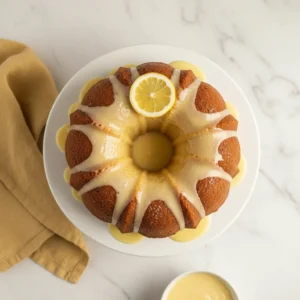
Lemon Bundt Cake
Easy lemon Bundt cake recipe with fresh juice and zest, sour cream for moisture, and a simple glaze. Bake this elegant citrus dessert today.
Ingredients
- 2 cups all-purpose flour
- 1/2 teaspoon baking powder
- 1/4 teaspoon baking soda
- 1/2 teaspoon salt
- 3/4 cup unsalted butter softened
- 1 1/2 cups granulated sugar
- 3 large eggs
- 1/2 cup sour cream
- 1/4 cup fresh lemon juice
- 2 tablespoons lemon zest
- 1/2 teaspoon vanilla extract
- 1/3 cup powdered sugar
- 2 tablespoons fresh lemon juice for glaze
- 1 tablespoon water
Instructions
- Preheat oven to 350°F (175°C). Take 10 minutes. Grease a 10-inch Bundt pan generously with butter or nonstick cooking spray, making sure to coat all the ridges. Use your fingers or a pastry brush to reach into every groove so the cake releases cleanly.
- In a medium bowl, whisk together 2 cups all-purpose flour, 1/2 teaspoon baking powder, 1/4 teaspoon baking soda, and 1/2 teaspoon salt. Mix until evenly combined. Set aside. Checkpoint: You are ready to move on when the dry ingredients are well mixed with no lumps.
- In a large bowl, add 3/4 cup softened unsalted butter and 1 1/2 cups granulated sugar. Using an electric mixer on medium speed, beat for 3–4 minutes until the mixture is pale yellow, fluffy, and light in texture. Scrape down the bowl halfway through. Checkpoint: You are ready to move on when the butter-sugar mixture resembles fluffy whipped cream and has increased in volume.
- Add 3 large eggs one at a time to the butter mixture, beating on medium speed for 30 seconds after each egg. This takes about 2 minutes total. Scrape down the bowl after adding each egg to ensure even mixing.
- Add 2 tablespoons lemon zest and 1/2 teaspoon vanilla extract to the egg mixture. Beat on medium speed for 30 seconds until combined and the zest is evenly distributed throughout. Checkpoint: You are ready to move on when the mixture is smooth and the lemon zest is visible throughout.
- In a small bowl, combine 1/2 cup sour cream and 1/4 cup fresh lemon juice. Stir together gently until smooth.
- Now add the dry ingredients and sour cream mixture to the egg mixture in three stages: Start by adding 1/3 of the dry mixture (flour mixture) on low speed for 30 seconds and mix until just barely combined. Stop the mixer. Add half of the sour cream mixture, mix for 30 seconds on low speed until just combined. Add another 1/3 of the dry mixture, mix for 30 seconds until just combined. Add the remaining sour cream mixture, mix for 30 seconds until just combined. Finish by adding the final 1/3 of dry mixture and mix for 30 seconds on low speed until smooth. Do not overmix—stop as soon as everything is combined. Checkpoint: You are ready to move on when the batter is smooth, creamy, and pale yellow with no visible dry flour streaks.
- Pour the batter into your prepared Bundt pan. Use a rubber spatula to spread it evenly and smooth the top. Make sure batter reaches into all the ridges of the pan. Takes about 1 minute.
- Place the Bundt pan on the middle rack of the preheated 350°F oven. Bake for 40–50 minutes. The cake is done when a wooden toothpick inserted into the thickest part of the cake (avoid the bottom ridge) comes out clean or with just 1–2 moist crumbs clinging to it. The top should be golden brown and spring back when lightly touched. Checkpoint: You are ready to move on when the toothpick test shows doneness and the cake is golden brown on top.
- Remove the cake from the oven and let it cool in the pan for exactly 15 minutes at room temperature. This allows the cake to set slightly but remain warm enough to release cleanly. After 15 minutes, run a thin knife around the outer and inner edges of the Bundt pan to loosen the cake.
- Place a wire cooling rack upside down on top of the Bundt pan. Hold both the pan and rack firmly and flip them together in one quick motion so the cake falls onto the rack. Gently lift off the pan. If the cake sticks, tap the bottom of the pan gently or use a thin knife to help release it. Let the cake cool completely on the wire rack for at least 1 hour at room temperature before glazing.
- While the cake cools, prepare the glaze. In a small bowl, whisk together 1/3 cup powdered sugar, 2 tablespoons fresh lemon juice, and 1 tablespoon water. Whisk for about 1 minute until smooth and pourable but thick enough to coat a spoon. The glaze should flow slowly, not run off immediately. Checkpoint: You are ready to move on when the glaze is smooth, creamy, and pourable.
- Once the cake is completely cool, drizzle the glaze over the top, allowing it to pool in the center and drip down the sides. Let the glaze set for 15–20 minutes at room temperature before serving.
- Troubleshooting:
- • If the cake doesn't release from the pan, let it cool for 20 minutes instead of 15, then run a thinner knife around the edges. If still stuck, place the pan in a 200°F oven for 2 minutes to warm the pan slightly, then try again.
- • If the cake is dry, you may have overbaked it. Check your oven temperature with an oven thermometer—ovens often run hot. Next time, start checking at 38 minutes.
- • If the cake is sunken in the middle, the oven temperature may have been too high at the start, causing the outside to cook faster than the inside. Verify your oven temperature.
- • If the glaze is too thick and won't drizzle, add water one teaspoon at a time until it reaches the right consistency.
- • If the glaze is too thin and runs off the cake, whisk in more powdered sugar one tablespoon at a time until thicker.