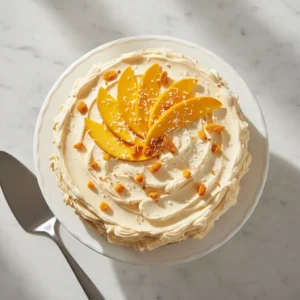
Mango Cake
Make this delicious mango cake with fresh mango puree, yogurt frosting & tropical flair. Perfect for summer celebrations. Step-by-step recipe inside.
Ingredients
- 2 cups all-purpose flour
- 1 teaspoon baking powder
- 0.5 teaspoon baking soda
- 0.25 teaspoon salt
- 0.75 cup unsalted butter softened
- 1 cup granulated sugar
- 3 large eggs room temperature
- 1 cup fresh mango puree
- 0.5 cup plain Greek yogurt
- 2 teaspoons vanilla extract
- 0.5 teaspoon cardamom powder
- 1 tablespoon fresh lemon juice
- 0.5 cup diced fresh mango
- 1.5 cups heavy whipping cream
- 0.5 cup powdered sugar
- 0.25 cup mango puree for frosting
- 1 teaspoon vanilla extract for frosting
- Fresh mango slices for garnish
- Dried mango pieces for garnish
- Shredded coconut for garnish
Instructions
- Prep: Preheat oven to 350°F. Line two 8-inch round cake pans with parchment paper, then spray with cooking spray. Ensure all ingredients, especially eggs and yogurt, are at room temperature (about 70–75°F) for the best cake texture. This takes 20–30 minutes if you set them out now.
- Mix dry ingredients: In a medium bowl, whisk together 2 cups all-purpose flour, 1 teaspoon baking powder, 0.5 teaspoon baking soda, 0.25 teaspoon salt, and 0.5 teaspoon cardamom powder. Set aside. Checkpoint: Dry mix should be light and evenly blended with no lumps.
- Cream butter and sugar: In a large mixing bowl, beat 0.75 cup softened unsalted butter with 1 cup granulated sugar on medium-high speed for 3–4 minutes, scraping bowl halfway through. The mixture should look pale, fluffy, and almost doubled in volume. Checkpoint: Mixture should be light cream-colored and hold its shape when you lift the beaters.
- Add eggs: Add 3 large room-temperature eggs one at a time, beating on medium speed for 30–45 seconds after each egg. Scrape the bowl between additions. The mixture may look slightly curdled—this is normal and will smooth out when you add the wet ingredients. Checkpoint: Eggs should be fully incorporated with no visible whites or yellows; mixture should be creamy.
- Mix wet ingredients: In a separate bowl, combine 1 cup fresh mango puree, 0.5 cup plain Greek yogurt, 2 teaspoons vanilla extract, and 1 tablespoon fresh lemon juice. Whisk until smooth. Checkpoint: Mixture should be uniform in color with no yogurt streaks.
- Alternate wet and dry: On medium speed, add one-third of the flour mixture to the butter mixture, beat for 20–30 seconds. Add half of the mango mixture, beat for 20 seconds. Repeat: one-third flour, remaining mango mixture, beat 20 seconds. Finish with remaining flour. Do not overmix—stop as soon as you see no dry streaks (about 1–2 minutes total). Checkpoint: Batter should be smooth and thick with no visible dry flour; it should fall off a spoon slowly, not run.
- Fold in fresh mango: Gently fold in 0.5 cup diced fresh mango using a spatula with 10–15 strokes. Do not overmix. Checkpoint: Mango pieces should be evenly distributed but not crushed; batter should still look smooth.
- Divide batter: Divide the batter evenly between the two prepared pans. Use an offset spatula to smooth the top of each layer so it bakes evenly. Checkpoint: Both pans should have equal amounts of batter; the surface should be level.
- Bake: Place pans on the middle oven rack. Bake at 350°F for 28–32 minutes. The cakes are done when a toothpick inserted in the center comes out clean or with just a few moist crumbs (not wet batter), and the tops spring back lightly when touched. The edges should pull slightly away from the sides of the pan. Checkpoint: Cakes should be golden-brown on top, smell fragrant, and feel springy to a light touch.
- Cool in pans: Remove from oven and let cool in the pans for exactly 10 minutes on a wire rack. This allows the cake to set enough to remove without breaking but stays warm enough to turn out easily. Checkpoint: Cakes should feel firm enough to turn out but still warm to the touch.
- Turn out cakes: Run a thin knife around the edges of each cake to loosen it. Place a wire rack over each pan, flip upside down, and gently tap the bottom of the pan. The cake should release cleanly. If stuck, let cool 2 more minutes and try again. Let cakes cool completely on the racks for 45–60 minutes at room temperature (or 20–30 minutes in a cool kitchen). Checkpoint: Cakes should be completely cool to the touch before frosting; they should feel light and springy.
- Chill bowl for frosting: While cakes cool, place a metal mixing bowl and the beaters of an electric mixer in the freezer for 10 minutes. This ensures the frosting will whip properly and hold its shape. Checkpoint: Bowl and beaters should be very cold to the touch.
- Whip cream: Pour 1.5 cups of cold heavy whipping cream into the chilled bowl. Using chilled beaters, whip on medium-high speed for 1–2 minutes until soft peaks form—this means peaks curl over when you lift the beaters. Checkpoint: Cream should be fluffy and doubled in volume; peaks should just barely hold their shape.
- Add frosting ingredients: With the mixer still running on medium speed, add 0.5 cup powdered sugar, 0.25 cup mango puree, and 1 teaspoon vanilla extract. Continue whipping for 1–2 minutes more, scraping the bowl once, until stiff peaks form—peaks should stand straight up without curling. Do not overmix or the frosting will turn grainy. Checkpoint: Frosting should be thick, spreadable, and hold its shape; it should look pale yellow or peachy from the mango.
- Assemble cake: Place the first cooled cake layer on a serving plate or cake board. Using an offset spatula or knife, spread about 0.75 cup of frosting evenly over the top, leaving a 0.5-inch border from the edge. Place the second cake layer on top, pressing gently. Checkpoint: Layers should sit evenly with no gaps or sliding.
- Frost outside: Spread the remaining frosting over the top and sides of the cake with an offset spatula or knife. Use smooth, even strokes; don't worry about perfection—rustic swirls look beautiful. Let frosting set for 15–20 minutes at room temperature. Checkpoint: All surfaces should be covered with a thin, even layer of frosting; frosting should feel slightly firm to the touch.
- Garnish: Top with fresh mango slices arranged in a pattern, dried mango pieces, and 2–3 tablespoons of shredded coconut scattered over the top. Serve immediately or refrigerate until ready to serve. Checkpoint: Cake should look tropical and inviting with garnish showing vibrant colors.