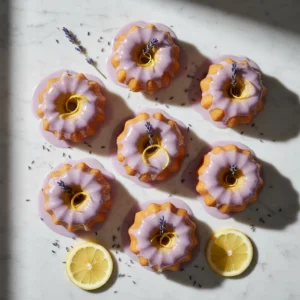
Mini Lemon Cakes with Lavender Glaze
Make these elegant mini lemon cakes with lavender glaze — moist, citrusy, and topped with a floral glaze. Perfect for tea parties, showers, and spring gatherings.
Ingredients
- 1 ½ cups all-purpose flour
- 1 ½ teaspoons baking powder
- ¼ teaspoon salt
- ½ cup unsalted butter softened
- ¾ cup granulated sugar
- 2 large eggs room temperature
- 2 tablespoons fresh lemon juice
- 1 tablespoon lemon zest
- 1 teaspoon pure vanilla extract
- ½ cup whole milk room temperature
- For the Lavender Glaze:
- 1 cup powdered sugar sifted
- 2 tablespoons whole milk
- 1 teaspoon dried culinary lavender
- 1 tablespoon fresh lemon juice
- 1 –2 drops purple or violet food coloring optional
Instructions
- Preheat your oven to 350°F (175°C). Place the rack in the center position. Grease a 12-cavity mini bundt pan (or a standard 12-cup muffin pan) thoroughly with butter or nonstick spray, then dust lightly with flour, tapping out any excess. Checkpoint: You are ready to move on when every cavity is evenly coated and there are no bare spots.
- In a medium bowl, whisk together 1 ½ cups all-purpose flour, 1 ½ teaspoons baking powder, and ¼ teaspoon salt for about 30 seconds until fully combined. Set aside.
- In a large bowl using a hand mixer or stand mixer on medium speed, beat ½ cup softened butter and ¾ cup granulated sugar together for 3–4 minutes until the mixture is pale, fluffy, and noticeably increased in volume. It should look almost white and feel airy. Checkpoint: You are ready to move on when the mixture is light and fluffy, not dense or greasy.
- Add 2 eggs one at a time, beating well after each addition (about 30 seconds per egg) on medium speed. The batter should look smooth and creamy after each egg is incorporated.
- Add 2 tablespoons fresh lemon juice, 1 tablespoon lemon zest, and 1 teaspoon vanilla extract. Mix on low speed for about 20 seconds until just combined. The batter may look slightly curdled — this is normal.
- With the mixer on the lowest speed, add one-third of the flour mixture and stir until just incorporated. Pour in half of the ½ cup milk and mix briefly. Repeat, alternating flour and milk, ending with the last third of flour. Mix only until no dry streaks remain — do not overmix or the cakes will be tough. Checkpoint: You are ready to move on when the batter is smooth and lump-free with no visible flour streaks.
- Spoon or pour the batter evenly into the prepared pan cavities, filling each about two-thirds full. Tap the pan gently on the counter 2–3 times to release any air bubbles.
- Bake at 350°F (175°C) for 16–20 minutes. Do not open the oven before 15 minutes. The cakes are done when a toothpick inserted into the thickest part comes out clean and the tops spring back lightly when touched. The edges will just begin to pull away from the pan. Checkpoint: You are ready to move on when the toothpick is clean and the cake tops are lightly golden.
- Remove the pan from the oven and let the cakes cool in the pan for 8–10 minutes on a wire rack. Then gently invert the pan onto the rack and lift it away. If using a muffin pan, use a thin spatula or butter knife to loosen the edges before removing. Let the cakes cool completely — at least 30 minutes — before glazing. Checkpoint: You are ready to move on when the cakes feel cool to the touch on the bottom.
- While the cakes cool, make the lavender glaze. In a small saucepan over low heat, warm 2 tablespoons of milk for 1–2 minutes until it is just steaming, not boiling. Remove from heat, add 1 teaspoon dried culinary lavender, and let it steep for 8–10 minutes. Strain through a fine mesh strainer into a small bowl, pressing on the lavender to extract as much flavor as possible. Discard the lavender. Checkpoint: You are ready to move on when the milk smells gently floral and is no longer hot.
- To the strained lavender milk, add 1 cup sifted powdered sugar and 1 tablespoon fresh lemon juice. Whisk vigorously for 1–2 minutes until completely smooth and pourable. The glaze should coat the back of a spoon but still flow easily. If it is too thick, add ½ teaspoon of milk at a time. If too thin, add a tablespoon more powdered sugar. Add 1–2 drops of purple food coloring if desired and stir to combine.
- Place the cooled cakes on the wire rack with a sheet of parchment or a baking sheet underneath to catch drips. Spoon or pour the lavender glaze over each cake, letting it drip down the sides naturally. Allow the glaze to set at room temperature for 10–15 minutes until it is no longer tacky before serving or transferring.