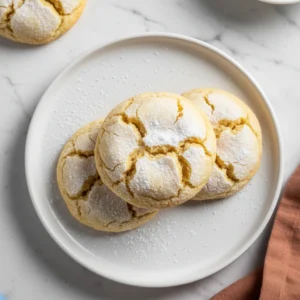
Orange Crinkles
Learn how to make Orange Crinkles—soft, chewy citrus cookies with a signature crackled sugar surface. Easy recipe with fresh orange juice and zest.
Ingredients
- 2 1/4 cups all-purpose flour
- 1 teaspoon baking soda
- 1/2 teaspoon salt
- 1/2 cup unsalted butter softened
- 1 cup granulated sugar
- 1 large egg
- 2 tablespoons fresh orange juice
- 1 tablespoon fresh orange zest
- 1/2 teaspoon vanilla extract
- 1/4 cup confectioners' sugar for rolling
Instructions
- Preheat your oven to 350°F (175°C). Line two baking sheets with parchment paper so the cookies won't stick. Take about 5 minutes.
- In a small bowl, whisk together 2 1/4 cups all-purpose flour, 1 teaspoon baking soda, and 1/2 teaspoon salt. Mix for about 1 minute until evenly combined. Checkpoint: The mixture should be pale yellow and have no lumps.
- In a large bowl, add 1/2 cup softened unsalted butter and 1 cup granulated sugar. Using an electric mixer on medium speed, beat for 2–3 minutes until the mixture looks light, fluffy, and pale. It should almost double in volume. Checkpoint: The mixture should look like fluffy clouds and hold peaks when you lift the beaters.
- Crack 1 large egg into the bowl. Add 2 tablespoons fresh orange juice, 1 tablespoon fresh orange zest, and 1/2 teaspoon vanilla extract. Beat on medium speed for about 1–2 minutes until everything is well combined and the mixture is smooth. Checkpoint: The batter should be thick, smooth, and evenly colored with no streaks of butter.
- Pour the flour mixture into the wet ingredients. Using a spatula or wooden spoon, gently fold the dry ingredients into the wet ingredients. Fold slowly, scraping from the bottom of the bowl and folding over the top. Do this for about 1–2 minutes until you just can't see any white streaks of flour. Stop as soon as the flour is incorporated—do not overmix or the cookies will be tough. Checkpoint: The dough should be smooth, slightly thick, and no dry flour should be visible.
- Cover the bowl with plastic wrap and place it in your refrigerator for at least 30 minutes. (You can chill it for up to 2 hours if you prefer.) The dough needs to be firm so the balls hold their shape. If your kitchen is warm, chill closer to 40 minutes. Checkpoint: When you touch the dough, it should feel firm and not sticky.
- While the dough chills, pour 1/4 cup confectioners' sugar (powdered sugar) into a small shallow bowl. You'll use this to coat each cookie ball.
- Remove the dough from the refrigerator. Using a spoon or small cookie scoop (about 1 tablespoon size), scoop out a ball of dough. Roll it gently between your palms to form a smooth 1-inch ball. This takes about 30 seconds per ball. Checkpoint: Each ball should be smooth, round, and about the size of a walnut.
- Drop each dough ball into the bowl of confectioners' sugar. Using a spoon or your fingers, roll it gently to coat all sides with the white sugar. Make sure it's fully covered. Place the sugar-coated ball on a prepared baking sheet. Space each ball about 2 inches apart so they have room to spread and crinkle. Checkpoint: Each cookie should be completely white and puffy-looking from the sugar coating.
- Once all cookies are on the baking sheets, place them in your preheated 350°F (175°C) oven. Bake for 11–13 minutes. The cookies are done when the edges look set (they'll look slightly firmer than the center) and the tops have beautiful deep cracks in the sugar coating. The centers will still look a bit soft. This is correct—they'll firm up as they cool. Checkpoint: The edges should be pale golden, the sugar coating should have pronounced cracks, and a light touch on top should feel slightly soft in the center.
- Remove the baking sheet from the oven using oven mitts. Let the cookies cool on the baking sheet for exactly 5 minutes—this is important because they'll firm up just enough to be moved without breaking. After 5 minutes, use a thin spatula to gently transfer each cookie to a wire cooling rack. Let them cool completely for about 15–20 minutes until they're completely firm. Checkpoint: The cookies should be completely set and crispy on the outside while remaining chewy inside.
- Troubleshooting bullet points: If the cookies spread too thin and flatten completely, your dough was too warm or the oven was too hot. Chill dough longer next time and verify your oven temperature with an oven thermometer.
- If the cookies don't crinkle, the confectioners' sugar coating may have been too thin. Coat each ball thoroughly and ensure every ball is completely white before baking.
- If the cookies are cakey and dry, you likely overbaked them. They should have soft centers—pull them out when the edges are set but tops still look slightly underbaked.
- If the orange flavor is too faint, use fresh orange juice and zest only. Bottled juice or concentrate won't deliver the same brightness.
- If cookies are too cake-like, check that you didn't overmix the dough after adding the flour. Mix only until combined.