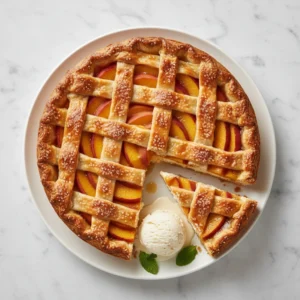
Peaches and Cream Pie
Make homemade peaches and cream pie with a flaky all-butter crust, silky cream cheese filling, and fresh peach topping. Complete recipe with instructions.
Ingredients
- 2 cups all-purpose flour
- 1 teaspoon salt
- 1 tablespoon granulated sugar
- 1 cup cold unsalted butter cubed
- 6 to 8 tablespoons ice water
- 6 medium fresh peaches about 2.5 pounds
- 3 tablespoons fresh lemon juice
- 1 teaspoon vanilla extract
- 0.75 cup granulated sugar
- 0.25 cup light brown sugar
- 3 tablespoons cornstarch
- 0.25 teaspoon ground nutmeg
- 0.125 teaspoon ground ginger
- 1 pinch salt
- 8 ounces cream cheese softened
- 0.5 cup heavy whipping cream
- 0.25 cup powdered sugar
- 1 teaspoon vanilla extract
- 1 large egg
- 1 tablespoon water
- 1 tablespoon coarse sugar for topping
Instructions
- Make the pie crust: In a large bowl, whisk together 2 cups all-purpose flour, 1 teaspoon salt, and 1 tablespoon granulated sugar. Add 1 cup cold cubed unsalted butter. Using a pastry cutter or your fingertips, cut the butter into the flour until the mixture resembles coarse breadcrumbs with some pea-sized pieces remaining, about 5–7 minutes. This creates the flaky texture. Checkpoint: The mixture should look like coarse sand with small butter pieces visible.
- Add ice water slowly: Sprinkle 6 to 8 tablespoons of ice water over the flour mixture, 1 tablespoon at a time. Gently stir with a fork after each addition until the dough just begins to come together. Do not overwork. Stop as soon as the dough holds together when squeezed, about 2–3 minutes. Checkpoint: The dough should be moist but not wet, and it should hold together without being sticky.
- Chill the dough: Divide the dough in half. Flatten each half into a disk about 1 inch thick, wrap tightly in plastic wrap, and refrigerate for at least 1 hour. If preparing ahead, the dough can rest overnight in the fridge or be frozen for up to 1 month. Checkpoint: The dough should be cold and firm to the touch before rolling.
- Prepare the peaches: Bring a large pot of water to a boil over high heat, about 5 minutes. Score the bottom of each peach with a shallow X using a small knife. Carefully lower 6 medium fresh peaches into the boiling water for exactly 1 minute—this loosens the skin for easy peeling. Checkpoint: The skin should appear slightly cracked at the X mark.
- Ice bath the peaches: Using a slotted spoon, immediately transfer the blanched peaches to a bowl of ice water. Let them cool for 2–3 minutes until they are cool enough to handle. Checkpoint: The peaches should feel cool to the touch.
- Peel and pit: Starting at the X mark, gently peel away the skin from each peach—it should slide off easily. Cut each peach in half along the natural seam, remove the pit, and cut the flesh into 0.5-inch-thick wedges. Discard the skin and pits. You should have about 6 cups of peach slices. Checkpoint: All peach slices should be uniform in thickness for even cooking.
- Make the peach filling: In a large bowl, combine the peach slices with 3 tablespoons fresh lemon juice and 1 teaspoon vanilla extract. Toss gently to coat, about 1 minute. Checkpoint: The peaches should be evenly coated with lemon juice.
- Add sugar and spices: Sprinkle 0.75 cup granulated sugar, 0.25 cup light brown sugar, 3 tablespoons cornstarch, 0.25 teaspoon ground nutmeg, 0.125 teaspoon ground ginger, and 1 pinch of salt over the peaches. Gently fold and stir until all peaches are evenly coated with the sugar mixture, about 2–3 minutes. The brown sugar adds depth of flavor. Checkpoint: You should see no dry sugar at the bottom of the bowl.
- Rest the filling: Let the peach mixture sit at room temperature for 15 minutes. During this time, the peaches will release their natural juices, creating a delicious syrup. Stir gently once halfway through. Checkpoint: You should see visible liquid pooling at the bottom of the bowl.
- Make the cream cheese layer: Remove 8 ounces of cream cheese from the refrigerator 20 minutes before using to let it soften. Place the softened cream cheese in a medium bowl. Using an electric mixer on medium speed, beat the cream cheese for 2–3 minutes until it is completely smooth and creamy with no lumps. Checkpoint: The cream cheese should be light and fluffy, like soft butter.
- Whip the cream: In a separate bowl, pour 0.5 cup of heavy whipping cream. Using clean beaters or a whisk, whip the cream on medium-high speed for 2–4 minutes until soft peaks form (peaks that gently fold over when the beater is lifted). Do not overbeat or the cream will become butter. Checkpoint: When you lift the beater, the cream should form peaks that slowly collapse.
- Fold together the cream mixture: Add 0.25 cup powdered sugar and 1 teaspoon vanilla extract to the whipped cream. Gently fold with a rubber spatula 2–3 times. Now fold the whipped cream mixture into the beaten cream cheese in 2 additions, folding gently until no streaks remain, about 1–2 minutes total. Do not overmix or the cream will deflate. Checkpoint: The mixture should be pale, fluffy, and uniform in color with no white streaks.
- Preheat the oven: Place an oven rack in the middle position. Set a large baking sheet on this rack. Preheat the oven to 425°F. The preheated baking sheet helps cook the bottom crust evenly and prevents a soggy bottom. Allow 15–20 minutes for the oven to reach temperature. Checkpoint: The oven should display 425°F on the dial or digital screen, and you should feel heat when you open the door.
- Roll out the bottom crust: Remove one chilled dough disk from the refrigerator. Place it between two sheets of parchment paper. Using a rolling pin, roll the dough from the center outward, rotating the parchment between rolls, until the dough is about 0.125 inches thick and 11 inches in diameter—about 2 inches larger than your 9-inch pie dish. This gives you enough dough to line the dish and create a border. Checkpoint: The dough should be thin and even with no thick spots, and it should not tear when moved.
- Transfer to pie dish: Peel off the top sheet of parchment. Carefully flip the dough onto your 9-inch pie dish (or gently slide it in). Press the dough gently into the bottom and up the sides of the dish. Allow the excess dough to overhang the rim by about 1 inch all around. This overhang will be sealed to the top crust. If the dough tears, pinch it back together or patch it with a small piece of dough. Checkpoint: The crust should fit snugly in the dish with no gaps or air bubbles, and the overhang should be even.
- Spread the cream cheese layer: Spoon the cream cheese mixture into the bottom crust, spreading it evenly with an offset spatula or the back of a spoon. Leave a 0.5-inch border around the edge—this prevents the cream from bubbling out the sides. The cream layer should be about 0.25 inches thick. Checkpoint: The cream layer should be smooth, even, and not touching the crust edge.
- Arrange the peaches: Using a slotted spoon, transfer the peach slices from their liquid to the pie, arranging them in overlapping concentric circles or a casual pattern, starting from the outside and working toward the center. Layer them so they are snug but not packed. Reserve any remaining juice in the bowl. Pour about half of the reserved peach juice over the arranged peaches. Save the remaining juice in case the pie dries during baking. Checkpoint: The peaches should cover the cream layer completely and be arranged in a single layer.
- Roll out the top crust: Remove the second chilled dough disk from the refrigerator. Place it between two sheets of parchment paper and roll it to about 10 inches in diameter and 0.125 inches thick, about 2–3 minutes. Checkpoint: The dough should be uniform in thickness with no tears.
- Place the top crust: Peel off the top parchment sheet. Carefully flip the dough onto the filled pie. Gently press it onto the peaches. Trim both crusts to a 1-inch overhang all around using a sharp knife. Checkpoint: The top crust should cover all the filling with no gaps.
- Seal the edges: Fold the overhanging dough edges under themselves, creating a rim that stands slightly above the edge of the pie dish. Using the tines of a fork or your fingertips, press the tines or create a fluted pattern all around the rim to seal the top and bottom crusts together and create a decorative edge, about 2–3 minutes. Checkpoint: The edges should be firmly sealed and uniform all around.
- Make the egg wash: In a small bowl, whisk together 1 large egg and 1 tablespoon of water until completely combined and uniform in color. This egg wash will be brushed onto the crust to create a glossy, golden-brown finish. Checkpoint: The egg wash should be thin, smooth, and pale yellow.
- Brush and top the crust: Using a pastry brush or clean kitchen brush, brush the entire top crust (but not the sealed rim, which should be slightly less shiny) with the egg wash. Sprinkle 1 tablespoon of coarse sugar (such as sanding sugar) evenly over the top. The sugar creates a sparkling, crunchy texture. Checkpoint: The entire top should glisten with egg wash and be sprinkled with visible sugar crystals.
- Cut steam vents: Using a small sharp knife, cut 4–5 small slits (about 0.5 inches long) into the top crust in a circular or decorative pattern. These vents allow steam to escape during baking, preventing the crust from puffing up and bursting. Checkpoint: The slits should be shallow and evenly distributed across the top.
- Bake at high heat (first stage): Carefully place the pie on the preheated baking sheet in the oven (the baking sheet should already be hot on the middle rack). Set a timer for 20 minutes. The pie will bake at 425°F during this first stage. You should hear the pie sizzle slightly as it hits the hot pan—this is good. The high heat initially sets the crust and prevents a soggy bottom. Checkpoint: After 20 minutes, the crust should begin to turn light golden brown.
- Reduce heat and continue baking (second stage): After 20 minutes, reduce the oven temperature to 375°F. Set a timer for 25–35 minutes more. If the crust edges are browning too quickly, cover them with a pie shield or strips of aluminum foil to prevent burning while the filling continues to cook. Bake until the crust is deep golden brown all over and you can see the peach filling gently bubbling at the steam vents and around the edge, indicating the filling is at the right temperature. Checkpoint: The crust should be deep golden brown (not pale), and you should see small bubbles of peach juice at the vents.
- Cool on the counter (critical step): Remove the pie from the oven and place it on a wire cooling rack or a trivet on the counter. Do not move or slice it yet. The pie must cool for at least 3 hours at room temperature. During cooling, the filling will set and firm up because of the cornstarch and cream cheese. If you slice it too early, the filling will be runny. Checkpoint: The pie should be completely cool to the touch and firm to a gentle press on top before slicing.
- Optional chilling: For easier slicing and a firmer texture, refrigerate the cooled pie for 2–4 hours or overnight before serving. This is optional but recommended for a cleaner slice. Checkpoint: The pie should feel firm and cold when ready to slice.
- Slice and serve: Using a long, sharp knife, wipe the blade with a warm, damp cloth after each slice to create clean cuts through the crust and filling. Serve at room temperature or chilled, with vanilla ice cream, fresh whipped cream, or on its own. A single slice is your portion.