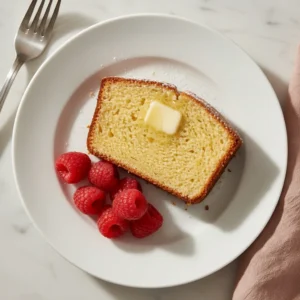
Sour Cream Pound Cake
Learn how to make the perfect sour cream pound cake with tender crumb and rich vanilla flavor. Easy recipe with step-by-step instructions and expert tips.
Ingredients
- 3 cups all-purpose flour
- 1 teaspoon baking soda
- 1 teaspoon salt
- 1 cup unsalted butter softened
- 3 cups granulated sugar
- 6 large eggs room temperature
- 1 cup sour cream room temperature
- 2 teaspoons vanilla extract
- 1 teaspoon almond extract
- Zest of 1 lemon
Instructions
- Preheat your oven to 325°F (160°C) for 10–15 minutes. Position the oven rack in the lower third, where heat circulates evenly. Grease a loaf pan (9x5 inches) or bundt pan thoroughly with butter, then dust it with flour and tap out the excess. This prevents sticking. Checkpoint: Your pan should be fully coated and your oven should be preheated.
- In a small bowl, whisk together 3 cups all-purpose flour, 1 teaspoon baking soda, and 1 teaspoon salt. Mix for 20–30 seconds until evenly combined with no lumps. Set this dry mixture aside. Checkpoint: Your dry ingredients should be uniform and light in color.
- In a large mixing bowl, add 1 cup unsalted butter (softened to room temperature, which should feel like soft clay) and 3 cups granulated sugar. Beat on medium-high speed with an electric mixer for 3–5 minutes, stopping to scrape down the bowl sides with a spatula every minute. The mixture should turn pale yellow, fluffy, and increase in volume by about 50%. This step is critical — it incorporates air that helps the cake rise. Checkpoint: The butter-sugar mixture should be light, airy, and pale, with no visible sugar crystals.
- Add 6 large eggs (at room temperature) one at a time. After adding each egg, beat on medium speed for 30–45 seconds, scraping the bowl, until the egg is fully incorporated and the mixture looks smooth. If the batter looks slightly curdled after adding eggs, this is normal — it will come together. Checkpoint: After all eggs are added, the batter should be glossy and smooth.
- Add 2 teaspoons vanilla extract, 1 teaspoon almond extract, and the zest of 1 lemon (about 1 tablespoon of finely grated zest). Beat on low speed for 20–30 seconds until the extracts and zest are evenly distributed throughout the batter. You should see small yellow flecks of lemon zest throughout. Checkpoint: The batter should smell fragrant and have visible lemon zest.
- Now alternate adding the dry flour mixture and 1 cup sour cream (at room temperature) to the batter in three additions. Start with dry ingredients: add one-third of the flour mixture and beat on low speed for 15–20 seconds until just combined. Stop as soon as you don't see white streaks. Checkpoint: White streaks of flour should be mostly gone.
- Add half of the sour cream (1/2 cup) and beat on low speed for 15–20 seconds until just combined. Again, stop when you don't see white streaks. Checkpoint: The batter should look smooth with no white streaks.
- Add another third of the flour mixture and beat on low speed for 15–20 seconds until just combined. Checkpoint: Batter should be smooth and uniform.
- Add the remaining sour cream (1/2 cup) and beat on low speed for 15–20 seconds until just combined. Checkpoint: Batter should be smooth.
- Add the final third of the flour mixture and beat on low speed for 15–20 seconds until just combined. Stop mixing as soon as you don't see any white streaks — do not over-mix, as this can make the cake tough. Checkpoint: Your batter should be smooth, thick, and uniform in color with no visible flour streaks.
- Pour the entire batter into your prepared pan, filling it about two-thirds to three-quarters full. Use a spatula to gently smooth the top of the batter, but do not press down hard. Checkpoint: The batter should be level and the pan properly filled.
- Place the pan in the preheated 325°F oven on the lower-third rack. Bake for 60–75 minutes. The cake will rise and a thin golden-brown crust will form on top. Halfway through baking (around 30 minutes), quickly open the oven door and look at the cake — it should be rising and the top should be starting to turn light golden. Close the door gently. Checkpoint: At 30 minutes, the cake should be rising and light golden on top.
- At 55–60 minutes, insert a wooden toothpick into the center of the cake. The cake is done when the toothpick comes out clean or with just 1–2 small moist crumbs clinging to it. If the toothpick comes out with wet batter, bake for 5 more minutes and test again. The top should be deep golden brown, not dark brown or burnt. Checkpoint: Toothpick comes out clean or nearly clean, and the top is deep golden brown.
- Once done, remove the cake from the oven and place it on a cooling rack or heat-safe counter surface. Let the cake rest in the pan for 15 minutes — this allows the structure to set. During this time, the cake will pull away slightly from the sides of the pan. Checkpoint: The cake should feel slightly firm and pull away from the pan edges.
- After 15 minutes, carefully run a thin knife around the inside edges of the pan to loosen the cake. Place a cooling rack or serving plate on top of the pan, then flip the pan and rack together so the cake falls out onto the rack. Gently lift off the pan. If using a loaf pan, the cake may be turned out onto a cooling rack. Checkpoint: The cake should release cleanly from the pan with no pieces stuck inside.
- Let the cake cool completely on the rack at room temperature for 1–2 hours. Do not slice it while warm, as it will crumble. The cake should reach room temperature before serving or storing. Checkpoint: The cake should feel cool to the touch and be firm enough to slice cleanly.