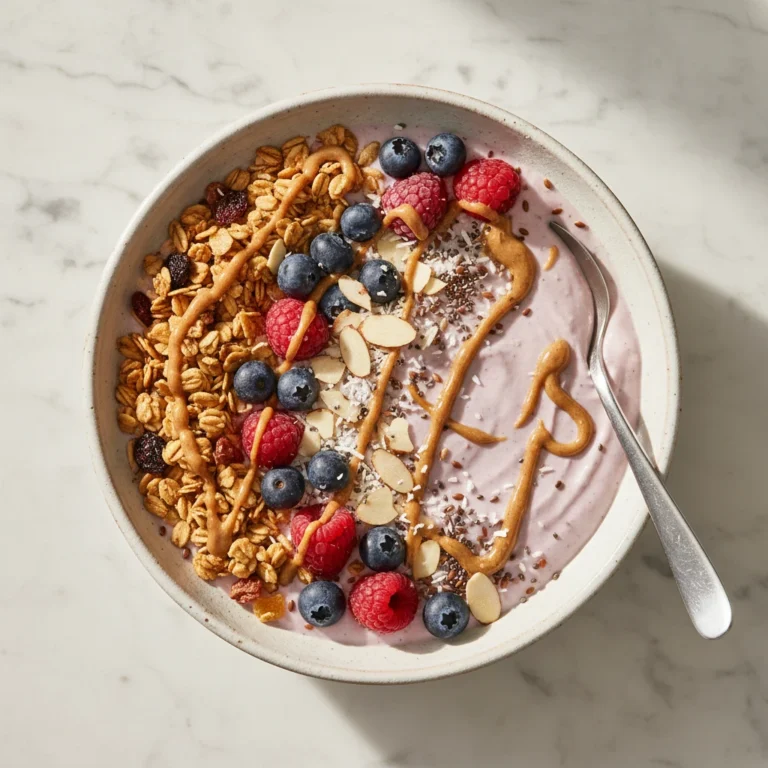
A cottage cheese protein smoothie bowl is the perfect marriage of nutrition and indulgence—creamy, satisfying, and packed with muscle-building protein. This nutrient-dense bowl combines the subtle tang of cottage cheese with the richness of Greek yogurt, creating a thick, creamy base that feels more like dessert than a healthy breakfast. Topped with crunchy granola, fresh berries, and wholesome seeds, it delivers sustained energy and keeps you full for hours. Whether you’re fueling a morning workout or seeking a balanced post-workout recovery meal, this smoothie bowl is your answer to guilt-free indulgence.
Reasons to Try Cottage Cheese Protein Smoothie Bowl
High Protein Content: Cottage cheese and Greek yogurt combine to deliver approximately 30 grams of complete protein per serving, making this bowl ideal for muscle recovery and satiety. The amino acid profile supports lean muscle growth and keeps hunger at bay for hours.
Creamy Without Heavy Dairy: The pairing of cottage cheese (often overlooked in smoothie recipes) with Greek yogurt creates an incredibly smooth, custard-like texture that feels indulgent without requiring ice cream or heavy cream. Cottage cheese adds depth and creaminess while keeping the fat content reasonable.
Slow Carbs and Sustained Energy: The combination of frozen berries, banana, and complex carbs from granola provides natural sweetness while delivering fiber and antioxidants. Unlike sugary smoothies, this bowl stabilizes blood sugar and provides lasting energy through your morning.
Customizable and Quick: With just five minutes of blending and assembly, this bowl adapts to whatever protein toppings and fruits you have on hand. It’s meal-prep friendly, visually stunning, and perfect for those mornings when you need nutrition but can’t sacrifice taste.
Gut-Friendly Probiotics: Both cottage cheese and Greek yogurt contain beneficial probiotics that support digestive health, improve nutrient absorption, and strengthen your microbiome—making this more than just a delicious breakfast.
 Save
SaveIngredients Notes
- Cottage cheese – Use full-fat or 2% for creamiest texture; small-curd varieties blend smoother than large-curd
- Greek yogurt – Strained Greek yogurt ensures maximum protein and thickness; non-Greek yogurt will result in a runnier base
- Frozen mixed berries – Keeps the bowl cold and thick without watering it down; thaw briefly if your blender struggles
- Banana – Adds natural sweetness and creaminess; frozen banana works best for an ice cream-like texture
- Unsweetened almond milk – Use the minimum amount needed; too much liquid results in a drinkable smoothie instead of a spoonable bowl
- Raw honey – Adjust sweetness to taste; pure maple syrup or dates work as alternatives
- Vanilla extract – One teaspoon provides subtle sweetness without artificial flavor
- Ground cinnamon – Enhances sweetness perception and provides anti-inflammatory benefits
- Sea salt – A pinch elevates all flavors and balances sweetness
- Granola – Choose lower-sugar varieties (5g sugar or less per serving) for balanced nutrition
- Raw almonds – Sliced almonds provide heart-healthy fats and satisfying crunch
- Fresh berries – Top immediately before serving to maintain texture contrast
- Coconut flakes – Unsweetened prevents excess sugar; adds tropical flavor and healthy fats
- Flaxseed – Ground flaxseed offers omega-3s and soluble fiber for gut health
- Chia seeds – Absorb liquid and expand in the digestive system, promoting fullness
- Almond butter – Drizzled on top for creamy, protein-rich richness
How to Make Cottage Cheese Protein Smoothie Bowl
- Add cottage cheese, Greek yogurt, frozen berries, banana, almond milk, honey, vanilla extract, cinnamon, and sea salt to a high-powered blender.
- Blend on high speed for 60–90 seconds until smooth and creamy, scraping down sides as needed. Consistency should be thick enough to hold a spoon but pourable into a bowl.
- Pour the smoothie base into a wide bowl, filling it about three-quarters full.
- Arrange granola in a section around the bowl’s rim for crunch.
- Add fresh blueberries and raspberries in clusters across the top.
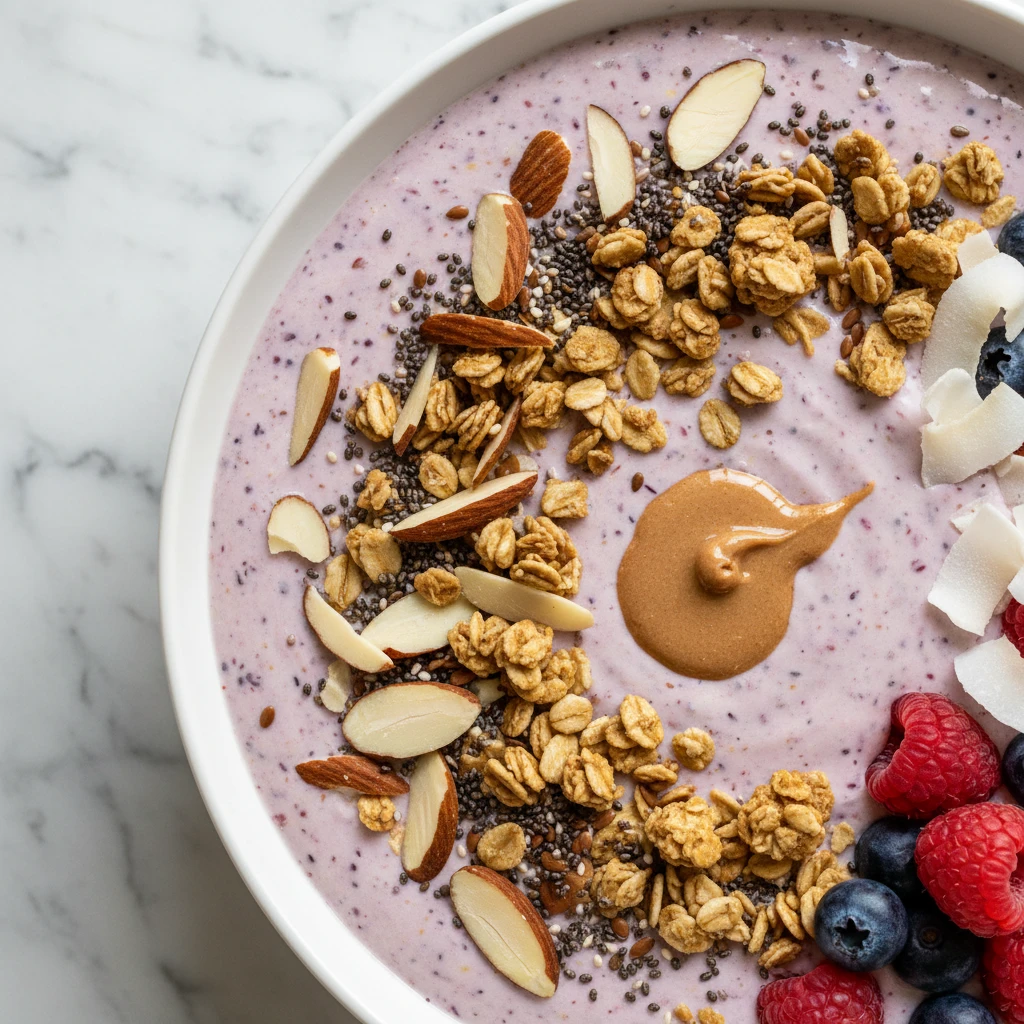
- Sprinkle sliced almonds, coconut flakes, ground flaxseed, and chia seeds over the surface.
- Drizzle almond butter in thin lines across the top and serve immediately with a spoon.
What You Must Know About Cottage Cheese Protein Smoothie Bowl
Blending Cottage Cheese Properly: Cottage cheese has a grainy texture that can remain lumpy if not blended thoroughly. Start with cottage cheese and Greek yogurt first in the blender to create a smooth base before adding frozen fruits. A high-powered blender (Vitamix, Ninja, or Blendtec) is strongly recommended; standard blenders may leave an unpleasant grainy texture. If you see persistent lumps after 90 seconds of blending, stop, scrape the sides, and blend again for 30 seconds on high.
Liquid-to-Base Ratio is Critical: The almond milk amount is intentionally minimal (only 0.5 cup) because cottage cheese and Greek yogurt are already quite wet. Too much liquid will result in a drinkable smoothie instead of a spoonable bowl. If your cottage cheese and yogurt are particularly liquidy, reduce almond milk to 0.25 cup and increase only if the mixture won’t blend. This is the most common mistake—starting with too much liquid.
Timing Matters—Eat Immediately: Unlike thick smoothies that hold well for hours, smoothie bowls are best eaten within 5 minutes of assembly. After 10 minutes, granola absorbs moisture and softens, fresh berries may break down, and nuts lose their crunch. If you need to prep ahead, blend the base and store it separately from toppings. Assemble only when ready to eat.
Frozen vs. Fresh Berries: Frozen berries are mandatory in the blended base because they chill the mixture and prevent it from becoming warm and watery. Never use fresh berries in the base—they don’t provide the same cooling effect and will result in a thin, room-temperature bowl. Save fresh berries for the topping only.
Temperature Control: If your kitchen is warm or your blender generates heat during blending, your smoothie base may warm up and become runnier. To prevent this, chill your blender container and blades in the freezer for 5 minutes before blending. You can also add 1–2 ice cubes to the base (beyond the frozen berries) if needed, though this will dilute flavor slightly.
Sugar Content Awareness: While this recipe uses natural sweeteners (honey and banana), the total sugar content is around 28–32 grams per serving. If you’re monitoring sugar intake, reduce honey to 0.5 tablespoon, choose low-sugar granola, and select toppings like nuts and seeds instead of dried fruit. The fiber from berries, flaxseed, and chia seeds helps slow sugar absorption.
Helpful Tips:
Prep Your Toppings in Advance: Measure all toppings into small bowls before blending. Once the base is blended and poured, you have only 5 minutes to top and eat. Having everything ready prevents waste and ensures a beautiful presentation.
Use Full-Fat or 2% Cottage Cheese: Fat-free cottage cheese will result in a grainy, less creamy texture. Full-fat or 2% provides the best mouthfeel and blends more smoothly. The fat content is balanced by the protein and fiber in the bowl, so don’t fear it.
Make It Overnight by Separating Components: If you want to prep the night before, blend the smoothie base and refrigerate it in an airtight container for up to 24 hours. In the morning, pour the chilled base into a bowl and add fresh toppings. The base may separate slightly (liquid on top)—simply stir before pouring.
Customize Based on Pantry Inventory: Substitute frozen mango or frozen peaches for berries, swap almond butter for peanut butter or tahini, use regular yogurt if Greek yogurt isn’t available (though it will be less thick and higher in liquid), or replace granola with crushed nuts, oats, or seeds. The core formula remains: 1 cup cottage cheese + 1 cup yogurt + 1 cup frozen fruit + 0.5 cup liquid = creamy, spoonable base.
Add Protein Powder (Optional): If you want an extra protein boost beyond the 30g already present, add 0.5 scoop vanilla protein powder to the blender. This boosts protein to 35–40g per serving but may slightly thicken the base, so reduce almond milk to 0.25 cup if adding powder.
Variations and Substitutions
Tropical Paradise Bowl: Replace mixed berries with 1 cup frozen mango chunks and frozen pineapple. Add 0.5 teaspoon coconut extract to the base. Top with toasted coconut flakes, macadamia nuts, and fresh pineapple. The result is bright, refreshing, and reminiscent of a beach vacation.
Chocolate PB Protein Bowl: Add 1 tablespoon unsweetened cocoa powder and 1 tablespoon natural peanut butter to the blender base (reduce almond milk to 0.25 cup to compensate for thicker additives). Replace berries with 1 cup frozen banana for a smoother texture. Top with chocolate granola, crushed peanut butter cups, sliced banana, and a drizzle of natural peanut butter. This tastes like a healthy dessert bowl.
Green Detox Bowl: Add 0.5 cup fresh spinach or kale (don’t use frozen—it’s too wet) to the blender base. Replace half the mixed berries with 0.5 cup frozen pineapple or mango for sweetness. Add 0.5 teaspoon fresh ginger or a squeeze of fresh lemon juice for brightness. Top with pumpkin seeds, almonds, and fresh kiwi slices. The green hides beautifully when blended with berries.
Maple Pecan Fall Bowl: Replace honey with 1 tablespoon pure maple syrup. Use 1 cup frozen peaches and blackberries (canned frozen peaches work perfectly). Add 0.5 teaspoon vanilla extract and 0.5 teaspoon pumpkin pie spice to the base. Top with pecan granola, toasted pecans, fresh raspberries, a drizzle of maple syrup, and a pinch of cinnamon. This celebrates autumn flavors.
Vanilla Bean Lavender Bowl: Scrape the seeds from 0.5 vanilla bean into the blender base and add 0.25 teaspoon culinary lavender powder for a floral, elegant twist. Use mild berries like blueberries and raspberries so floral notes shine. Top with coconut flakes, toasted almonds, fresh blueberries, and a light honey drizzle. This variation is sophisticated and feels spa-like.
Higher Protein Muscle-Building Bowl: Add 0.5 scoop vanilla whey protein powder to the base (reduces almond milk to 0.25 cup). Increase toppings of nuts and seeds by 50% for additional protein and calories. This variation targets athletes and post-workout recovery, boosting protein to 40+ grams.
Dairy-Free Version: Replace cottage cheese with 1 cup silken tofu (blends very smooth) and Greek yogurt with 1 cup dairy-free Greek-style yogurt (coconut or almond-based). Use plant-based milk (almond, oat, or coconut). Ensure all toppings are vegan certified. The result is creamy and protein-rich while completely plant-based.
Ingredient Substitutions for Toppings:
- Granola → Use unsweetened muesli, crushed nuts, or homemade granola for sugar control
- Almonds → Substitute walnuts, pecans, pumpkin seeds, or hemp seeds for variety
- Almond butter → Try tahini, sunflower seed butter, or natural peanut butter
- Fresh berries → Any in-season berries work; frozen berries also work but thaw slightly before topping for texture
- Chia seeds → Use ground flaxseed, hemp seeds, or pumpkin seeds in the same quantity
- Coconut flakes → Swap for toasted chopped hazelnuts, dried unsweetened coconut, or nothing at all
Serving Suggestions for Cottage Cheese Protein Smoothie Bowl
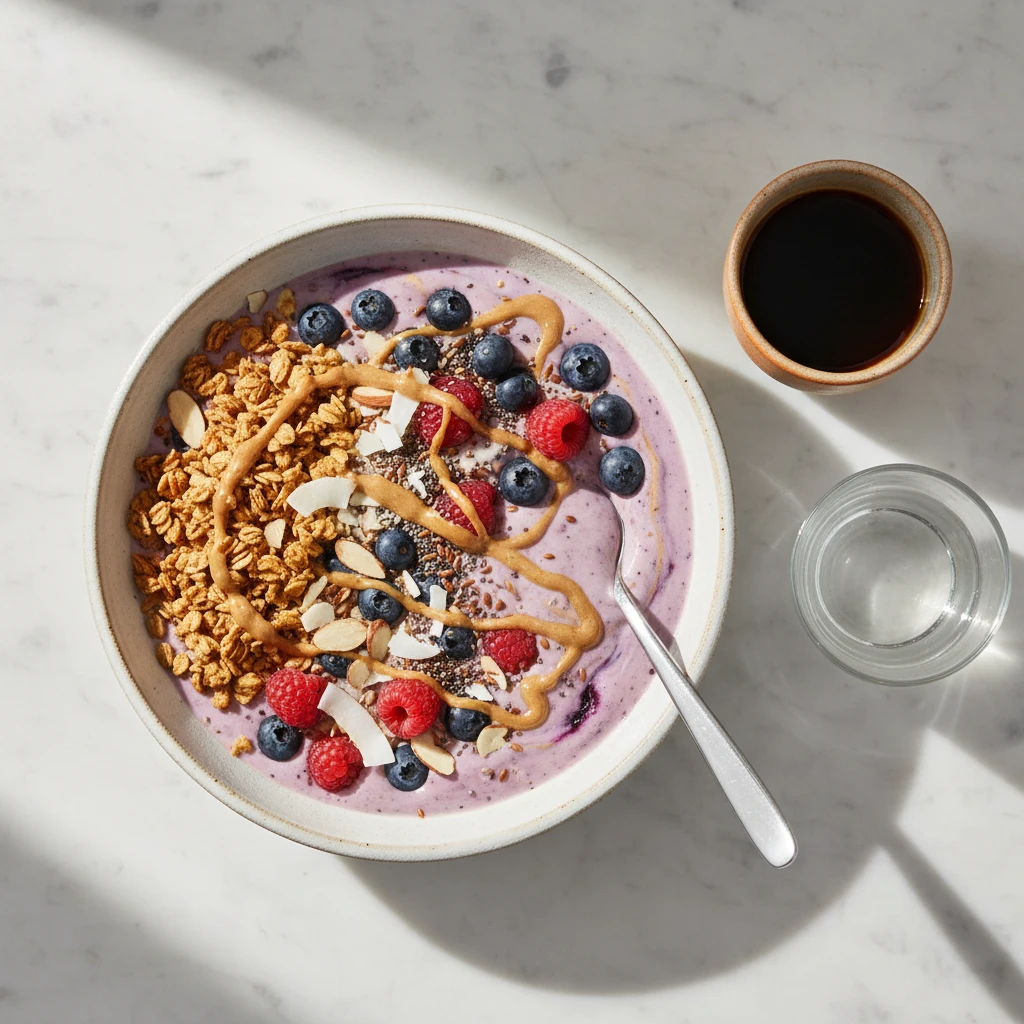
Classic Breakfast Presentation: Serve the bowl in a wide, shallow ceramic or glass dish for maximum visual appeal. Arrange toppings in distinct sections around the bowl so each spoonful contains a different texture and flavor. Pair with a warm cup of herbal tea, black coffee, or fresh-squeezed juice on the side. The contrast between the cold, creamy bowl and warm beverage creates a comforting, balanced breakfast.
Smoothie Bowl Board: For entertaining or meal prep, arrange multiple individual smoothie bowls on a wooden cutting board or slate platter. Place each bowl in a small ceramic dish, then artfully arrange additional fresh berries, nuts, and seeds around them in small bowls as a topping bar. Guests or family members can customize their own toppings. This presentation is Instagram-worthy and interactive.
Post-Workout Recovery Setting: Serve immediately after exercise in a large bowl alongside a protein-rich side (hard-boiled eggs, Greek yogurt, or a piece of whole-grain toast with almond butter). The quick carbs from the fruit and the high protein from cottage cheese and yogurt optimize muscle recovery. Position the bowl on a cool surface to keep it from warming too quickly.
Desk Breakfast Option: If eating at your desk or on the go, use a portable bowl with a tight-fitting lid and eat with a sturdy spoon. Pack toppings in separate small containers and add them just before eating to preserve texture. However, this bowl is best enjoyed fresh, so minimize transport time if possible.
Brunch Entertaining: Serve family-style on a buffet table with multiple toppings arranged in small bowls: extra granola, fresh berries, various nut butters, seed blends, and coconut flakes. Each guest builds their own bowl to their preference, making it interactive and personalized.
Garnish and Presentation Tips:
- Add a light dusting of cinnamon on top for visual warmth and spice perception
- Place a mint sprig on the side for freshness and color contrast
- Arrange berries in a circular pattern for a professional look
- Use edible flowers (pansies, violas) as a luxury garnish for special occasions
- Drizzle honey or nut butter in artistic zigzags rather than plain dribbles
- Include a small measuring spoon or demitasse spoon for an elegant touch
 Save
SaveStorage and Reheating
Smoothie Base Storage (Best Practice): The blended smoothie base stores best when separated from toppings. Transfer the blended base to an airtight glass container and refrigerate for up to 24 hours. The base may separate slightly (watery liquid on top) as ingredients settle—this is normal. Simply stir or shake the container before pouring. Do not freeze the base, as thawing will result in excessive separation and watery texture.
Pre-Assembled Bowl Storage (Not Recommended): If you do assemble the bowl in advance, consume within 2–3 hours maximum. The longer the topping sits on the creamy base, the more it absorbs moisture. Granola will soften, fresh berries may begin to break down, nuts will lose their crunch, and the overall textural contrast deteriorates. For best quality, always assemble immediately before eating.
Topping Storage: Store all toppings separately in airtight containers:
- Granola: airtight container at room temperature for up to 2 weeks
- Nuts and seeds: airtight container at room temperature for up to 3 weeks, or in the freezer for up to 2 months
- Fresh berries: refrigerator in a covered container for 3–5 days
- Almond butter: pantry or refrigerator in original jar, lasts 6–8 weeks
- Coconut flakes: airtight container at room temperature for up to 1 month
Reheating (Not Applicable): This dish is meant to be served cold and is not suitable for reheating. Heating a smoothie bowl will destroy the texture of toppings, curdle the dairy base, and eliminate the refreshing quality that makes this dish appealing. If the base becomes too cold to eat (very stiff), let it sit at room temperature for 3–5 minutes before serving.
Meal Prep Strategy: For the most convenient meal prep, blend the smoothie base in bulk and divide into 4–6 airtight containers (one per serving). Refrigerate these bases for up to 24 hours. Each morning, pour one base into a bowl and add fresh toppings immediately before eating. This preserves the textural integrity of toppings while providing convenience. Pre-assemble toppings in labeled containers: one container per person with their preferred granola, nuts, seeds, and fresh berries.
Frequently Asked Questions about Cottage Cheese Protein Smoothie Bowl
Can I make this smoothie bowl without a high-powered blender?
Standard blenders will work but may leave a grainy texture from the cottage cheese. To improve results with a regular blender, use small-curd cottage cheese (rather than large-curd), strain the cottage cheese through a fine-mesh sieve before blending to remove excess liquid, and blend for 2–3 minutes instead of 90 seconds, pausing every 30 seconds to scrape down the sides. If graininess persists, this isn’t a failure—some people prefer this texture. Alternatively, use a food processor, which handles cottage cheese very well.
What if I don’t have Greek yogurt—can I use regular yogurt?
Yes, but with adjustments. Regular yogurt has more liquid and less protein than Greek yogurt, so your bowl will be thinner and less filling. Use only 0.75 cup regular yogurt (instead of 1 cup), maintain the 1 cup cottage cheese, and reduce almond milk to 0.25 cup. The base will still be creamy but slightly less thick. Nutritional protein will be reduced from 30g to about 22g per serving. Greek yogurt is preferred because it’s concentrated, thick, and high-protein.
Is this recipe suitable for people with lactose intolerance?
Traditional cottage cheese and Greek yogurt are dairy-based and contain lactose, though the amount varies by brand. Most people with mild lactose intolerance tolerate Greek yogurt and cottage cheese better than milk because they’re fermented and strained. For complete dairy-free, replace cottage cheese with 1 cup silken tofu, use a dairy-free Greek yogurt alternative (coconut or almond-based), and use plant-based milk. The texture will be slightly different but equally creamy and delicious.
How much protein is actually in one serving of this smoothie bowl?
One serving of this recipe contains approximately 30 grams of complete protein: roughly 15g from the cottage cheese, 12g from the Greek yogurt, 1g from the banana and berries, and 2g from the nuts, seeds, and granola. This makes it an excellent post-workout meal or protein-rich breakfast. If you add a 0.5 scoop protein powder, total protein increases to approximately 35–40 grams per serving.
Can I eat this smoothie bowl cold straight from the refrigerator, or does it need to thaw?
Yes, eat it straight from the refrigerator—that’s the entire point. The cold temperature is what makes this bowl so refreshing and prevents the smoothie base from becoming watery. However, if your refrigerator is very cold (below 35°F), the base may be too stiff to eat comfortably. Let it sit at room temperature for 3–5 minutes to warm slightly before eating. The frozen berries in the base ensure it stays cold without being rock-hard.
Why does my smoothie bowl have a watery layer on top after a few minutes?
This is normal and happens because fruit juices in the frozen berries begin to thaw and release liquid into the base. It’s not a mistake—it’s just the natural process of thawing. To minimize this, eat the bowl immediately after assembling (within 5 minutes). If you notice excess separation before eating, simply stir the base together with a spoon. For meal prep, keep the blended base in the refrigerator and only pour into a bowl immediately before eating and topping.
What’s the best way to meal-prep this for the entire week?
Blend the smoothie base according to the recipe and divide it equally into 4–6 airtight glass containers. Refrigerate these bases for up to 24 hours (they’re safest eaten within 24 hours due to dairy content). Store all toppings in separate containers. Each morning, pour one base into a bowl, add toppings, and eat immediately. Alternatively, prepare only 2–3 days’ worth at a time for maximum freshness and to prevent the base from deteriorating. Never assemble the entire bowl and refrigerate—this ruins texture and flavor.
Nutrition Facts (Per Serving)
Nutrition Facts (Per Serving)
| Nutrient | Amount | % Daily Value* |
|---|---|---|
| Calories | 320 | — |
| Total Fat | 11g | 17% |
| Saturated Fat | 3g | 15% |
| Unsaturated Fat | 8g | — |
| Cholesterol | 25mg | 8% |
| Sodium | 340mg | 15% |
| Total Carbohydrates | 36g | 13% |
| Dietary Fiber | 5g | 18% |
| Total Sugars | 28g | — |
| Includes 0g Added Sugars | — | 0% |
| Protein | 30g | 60% |
| Vitamin A | 4% DV | — |
| Vitamin C | 18% DV | — |
| Calcium | 28% DV | — |
| Iron | 8% DV | — |
| Potassium | 380mg | 11% |
* Percent Daily Values are based on a 2,000 calorie diet. Your daily values may be higher or lower depending on your calorie needs. This smoothie bowl is high in protein and fiber, making it exceptionally satiating and suitable for weight management, muscle recovery, and sustained energy.
Cottage Cheese Protein Smoothie Bowl
Ingredients
- 1 cup cottage cheese
- 1 cup Greek yogurt
- 1 cup frozen mixed berries
- 1 banana
- 0.5 cup unsweetened almond milk
- 1 tablespoon raw honey
- 1 teaspoon vanilla extract
- 0.5 teaspoon ground cinnamon
- 0.25 teaspoon sea salt
- 0.5 cup granola
- 0.25 cup raw almonds sliced
- 0.25 cup fresh blueberries
- 0.25 cup fresh raspberries
- 2 tablespoons coconut flakes unsweetened
- 1 tablespoon ground flaxseed
- 1 tablespoon chia seeds
- 2 teaspoons almond butter
Instructions
- Gather and prepare ingredients: Use a high-powered blender (Vitamix or Ninja work best). Measure cottage cheese (1 cup), Greek yogurt (1 cup), frozen mixed berries (1 cup), banana (1 medium, sliced), unsweetened almond milk (0.5 cup), honey (1 tablespoon), vanilla extract (1 teaspoon), ground cinnamon (0.5 teaspoon), and sea salt (0.25 teaspoon). Have all toppings ready: granola (0.5 cup), sliced almonds (0.25 cup), fresh blueberries (0.25 cup), fresh raspberries (0.25 cup), unsweetened coconut flakes (2 tablespoons), ground flaxseed (1 tablespoon), chia seeds (1 tablespoon), and almond butter (2 teaspoons). Timing: 2–3 minutes. Checkpoint: All ingredients are measured and accessible before blending begins.
- Add all smoothie base ingredients to blender in this order: First add the cottage cheese and Greek yogurt (this prevents berries from sinking to the bottom and jamming the blade). Then add frozen berries, sliced banana, almond milk, honey, vanilla extract, cinnamon, and sea salt on top. Timing: 1–2 minutes. Heat level: No heat required. Checkpoint: All base ingredients are stacked in the blender container without blending yet.
- Blend on high speed for 60–90 seconds: Start on low speed for 10 seconds to break down frozen berries, then increase to high speed. Blend until the mixture is completely smooth, creamy, and uniform in color—no visible berry chunks or cottage cheese lumps should remain. If your blender has a smoothie setting, use it. Timing: 60–90 seconds total. What to look for: The base should look like thick, pourable yogurt—thicker than a drinkable smoothie but not stiff like ice cream. If too thick, add 1 tablespoon almond milk at a time and reblend for 10 seconds. If too thin, add 0.25 cup more Greek yogurt and reblend. Checkpoint: You are ready to move on when the smoothie base is completely smooth, creamy, and no lumps remain.
- Pause and scrape down blender sides if needed: If you see unmixed ingredients clinging to the container walls, turn off the blender, use a rubber spatula to push mixture toward the center, and blend again for 15 seconds on high. Timing: 15–30 seconds. Checkpoint: Blender is completely clean with no unmixed pockets.
- Pour smoothie base into a wide, shallow bowl: Use a large cereal bowl or shallow pasta bowl (4–5 inches wide). Pour until the bowl is three-quarters full, leaving 0.5 inch of space at the rim for toppings. The base should spread evenly across the bowl bottom. Timing: 1 minute. What to expect: The smoothie base should settle smoothly with a slightly domed surface. If it's too liquidy and spreads too thin, you may have added too much almond milk—this is still fine, just harder to top. Checkpoint: Smoothie base fills the bowl evenly and is ready for toppings.
- Layer granola in a section around the bowl's rim: Sprinkle 0.5 cup granola in a 2-inch arc on one side of the bowl, pressing gently so it stays on top and doesn't sink. Granola adds crunch and prevents the bowl from becoming too soft as you eat. Timing: 1 minute. Checkpoint: Granola is clustered in one area and won't disperse into the smoothie base.
- Add fresh blueberries and raspberries in small clusters: Distribute 0.25 cup fresh blueberries and 0.25 cup fresh raspberries in small groupings across the top, spacing them evenly. Press gently so they nestle slightly into the smoothie base but remain visible. Fresh berries provide tart contrast and stay crunchy. Timing: 1 minute. What to expect: Berries may sink slightly into the creamy base—this is fine and normal. Checkpoint: Fresh berries are visible and arranged attractively on the surface.
- Sprinkle sliced almonds evenly across the bowl: Add 0.25 cup sliced raw almonds in a thin layer across the top. Almonds add protein, healthy fat, and satisfying crunch that contrasts beautifully with the creamy base. Timing: 1 minute. Checkpoint: Almonds are visible and distributed across the surface.
- Add coconut flakes, flaxseed, and chia seeds in small handfuls: Sprinkle 2 tablespoons unsweetened coconut flakes, then 1 tablespoon ground flaxseed, then 1 tablespoon chia seeds across the top in an even distribution. These seeds add fiber, omega-3s, and visual appeal. Timing: 1 minute. Checkpoint: All seeds and flakes are visible on the surface.
- Drizzle almond butter over the top in thin lines: Place 2 teaspoons almond butter in a small bowl and stir with a spoon until pourable (if it's too stiff, warm it for 5 seconds in the microwave). Using a teaspoon, drizzle thin lines across the bowl in a decorative pattern. Almond butter adds protein, flavor depth, and luxury. Timing: 1 minute. What to expect: Almond butter will sit on top and slowly sink into the base as you eat—this is intended. Checkpoint: Almond butter is drizzled in visible lines across the top.
- Serve immediately and eat within 5 minutes: Once toppings are added, eat right away with a spoon. The longer the bowl sits, the more toppings will absorb liquid and lose their textural contrast. Granola will soften, fresh berries may start to break down, and nuts will lose crunch. Timing: Immediate. What to expect: Each spoonful should contain a mix of creamy base, granola, fresh berries, nuts, and seeds. Checkpoint: You are ready to enjoy when all toppings are arranged and the bowl is ready to be eaten within minutes.