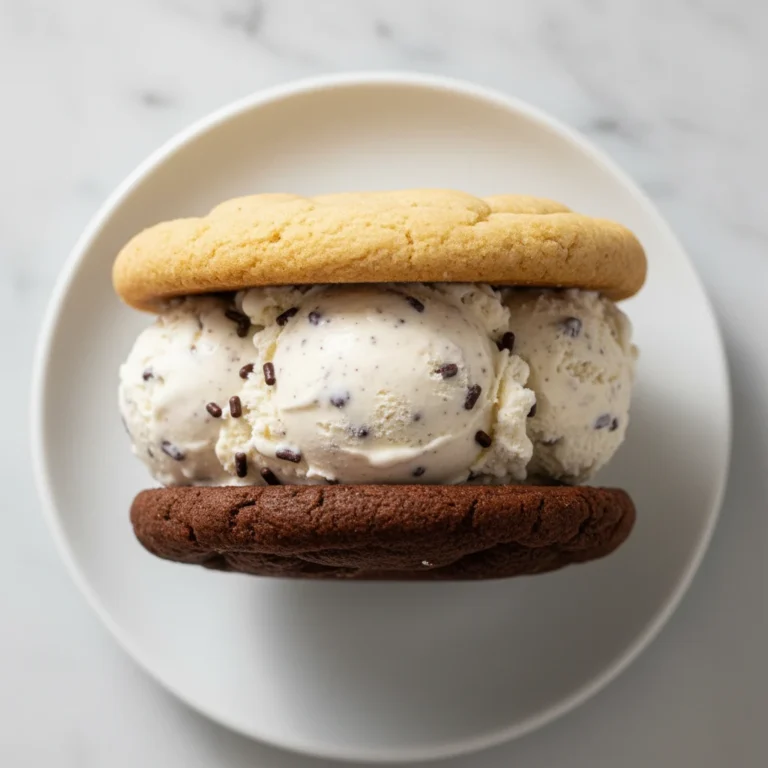
There’s nothing quite like the simple pleasure of biting into a homemade ice cream sandwich on a warm summer day. This beloved treat combines soft, chewy cookies with creamy ice cream for the perfect handheld dessert. Making your own ice cream sandwiches at home is easier than you might think, requiring just basic pantry ingredients and a little patience. The result is infinitely better than store-bought versions, with fresher flavors and the perfect texture every time.
Reasons to Try Homemade Ice Cream Sandwich
Creating your own ice cream sandwich at home opens up a world of customization possibilities. Unlike commercial versions, you control every ingredient, from the cookie base to the ice cream flavor. The cookies are soft and chewy—not hard and stale—because they’re made fresh. You can pair classic vanilla with chocolate cookies, or experiment with fun combinations like mint chip with brown sugar cookies, or strawberry with shortbread. Homemade ice cream sandwiches also make impressive gifts and memorable treats for family gatherings. Plus, the nostalgic appeal of this childhood favorite never fades, making it a crowd-pleasing dessert for any age.
 Save
SaveIngredients Notes
- All-purpose flour provides structure to the cookies
- Baking powder creates a light, tender crumb
- Unsalted butter allows you to control the salt content
- Granulated sugar adds sweetness and helps create chewy edges
- Egg acts as a binder and adds moisture
- Vanilla extract and almond extract enhance the cookie flavor
- Ice cream should be your favorite brand or homemade variety
- Cocoa powder and espresso powder deepen the chocolate flavor in optional chocolate cookies
- Chocolate sprinkles or mini chocolate chips add texture to the ice cream filling
- Honey adds a subtle sweetness to the ice cream mixture
How to Make Homemade Ice Cream Sandwich
- Preheat oven to 350°F and line baking sheets with parchment paper.
- Whisk together flour, baking powder, and salt in a small bowl.
- Cream softened butter and sugar together until light and fluffy, about 3 minutes.
- Beat in egg, vanilla extract, and almond extract until combined.
- Gradually stir in flour mixture until dough comes together.
- Divide dough in half. Keep one half plain and mix cocoa powder and espresso powder into the other half for chocolate cookies.
- Drop rounded tablespoons of dough onto prepared baking sheets, spacing them 2 inches apart.
- Bake for 10-12 minutes until edges are set but centers are still soft.
- Cool on baking sheet for 5 minutes, then transfer to wire rack.
- Once cookies are completely cool, stir chocolate sprinkles into softened ice cream.
- Spoon ice cream onto flat side of one cookie and press another cookie on top, flat side down.
- Wrap each sandwich in parchment and freeze for at least 2 hours before serving.
What You Must Know About Homemade Ice Cream Sandwich
The most critical factor in successful ice cream sandwiches is timing. Your cookies must be completely cool before assembly, and your ice cream must be the right consistency—soft enough to scoop and spread, but not so warm that it melts. Work quickly and keep everything as cold as possible.
Don’t skip the resting period after baking. Cookies continue to cook on the hot pan even after removal from the oven. Leaving them on the sheet for exactly 5 minutes ensures they’re chewy, not hard. Removing them too early can cause them to crack.
The cookie-to-ice-cream ratio matters. Use roughly 2-3 tablespoons of ice cream per sandwich. Too much and it will squeeze out; too little and the sandwich falls apart. The ice cream acts as an edible glue.
For best results, assemble and freeze your sandwiches at least 2 hours ahead. This allows the ice cream to refreeze solid, creating a stable, easy-to-eat treat. Overnight freezing is even better.
Helpful Tips
Make a double batch of cookies and freeze extras unfilled. Unfilled cookies keep in the freezer for up to 2 weeks, letting you assemble fresh sandwiches anytime without baking.
For faster assembly, scoop ice cream into uniform portions on parchment before starting, freeze them briefly, then press onto cookies.
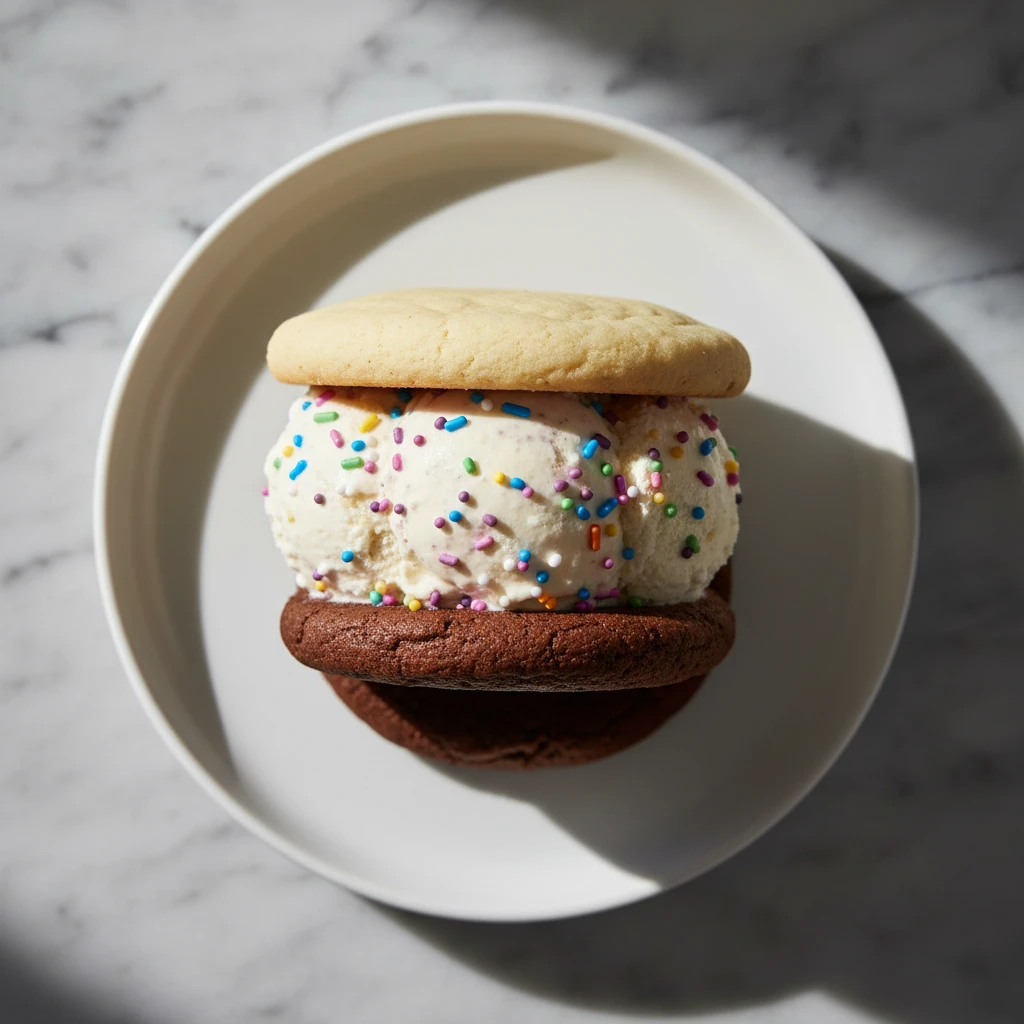
Dip the edges of assembled sandwiches in melted chocolate, toasted nuts, or colorful sprinkles for a fancy presentation.
Swap ice cream flavors freely—chocolate, strawberry, mint chip, cookie dough, butter pecan, and salted caramel all work beautifully between these cookies.
Variations and Substitutions
Cookie Variations: Skip the chocolate dough and make all cookies plain vanilla for classic sandwiches. Or make half the batch with brown sugar (instead of granulated) for a deeper, molasses-forward flavor. For funnel-shaped sandwiches, press the plain dough into small tartlet pans instead of drop cookies.
Ice Cream Combinations: Pair vanilla cookies with chocolate ice cream, mint chip, or salted caramel. Chocolate cookies work beautifully with vanilla, coffee, or raspberry ice cream. Try swirling two ice cream flavors together for a marbled effect.
Mix-In Additions: Stir crushed Oreos, brownie chunks, cookie crumbles, or toffee bits into softened ice cream. Add a splash of vanilla, almond, or mint extract to the ice cream base for extra flavor.
Gluten-Free Option: Replace all-purpose flour with a 1:1 gluten-free flour blend and bake for 12-14 minutes (cookies take slightly longer to set).
Dairy-Free Version: Use dairy-free butter and coconut ice cream, or any dairy-free ice cream alternative. The texture will be slightly different but equally delicious.
Fancy Edge Coating: Roll the edges of assembled (but not yet frozen) sandwiches in melted chocolate, then sprinkles, chopped nuts, or toasted coconut. Freeze immediately.
Serving Suggestions for Homemade Ice Cream Sandwich
Serve ice cream sandwiches straight from the freezer on a hot summer day, allowing guests 2-3 minutes to let the cookies soften slightly for easier eating. Arrange on a platter lined with parchment paper to prevent sticking.
For a fun presentation, place each sandwich in a paper ice cream cone sleeve or on a small wooden stick for easy handling and a playful, carnival vibe.
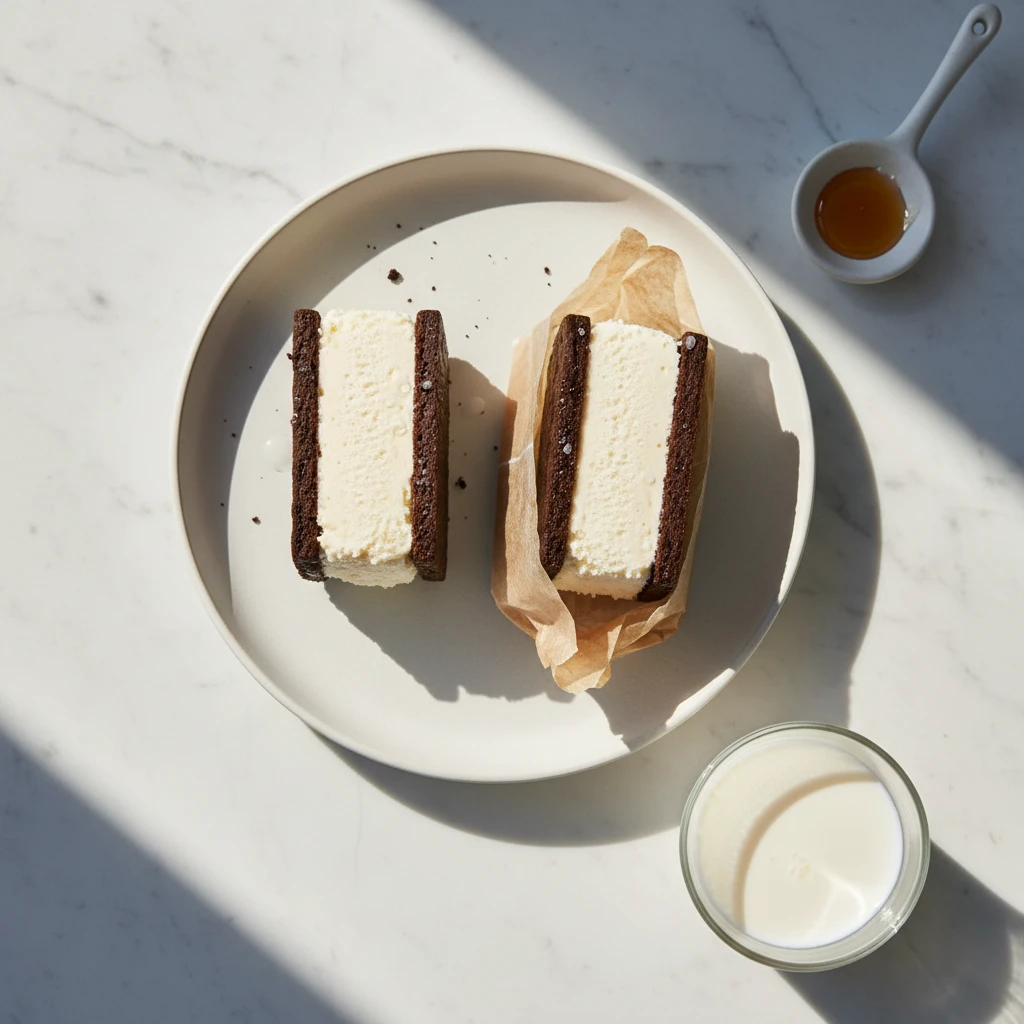
Serve alongside a small cup of hot fudge sauce for dunking, or a drizzle of caramel sauce on the plate beneath each sandwich. A cold glass of milk is the perfect pairing.
For a party, set up an ice cream sandwich bar with multiple cookie flavors, ice cream varieties, and topping options so guests can create their own combinations.
Plate with a simple garnish of fresh berries, a light dusting of cocoa powder, or a sprinkle of sea salt to add elegance and flavor balance.
 Save
SaveStorage and Reheating
Store assembled ice cream sandwiches in an airtight container or wrapped individually in parchment paper in the freezer for up to 5 days. They keep best when stored in the coldest part of your freezer, away from the door.
Unfilled cookies can be stored in an airtight container at room temperature for up to 3 days, or frozen for up to 2 weeks. Thaw frozen cookies at room temperature for 10-15 minutes before using, or assemble sandwiches directly from frozen for a slightly firmer treat.
Ice cream sandwiches don’t require reheating. Remove them from the freezer 2-3 minutes before serving to allow the cookies to soften slightly, making them easier and more enjoyable to bite through. Serve immediately while still cold.
If your sandwiches have been stored in the freezer for more than 3 days, they may develop slight freezer burn or ice crystals. While still safe to eat, the texture may be less optimal. For best quality, enjoy within 2-3 days of assembly.
Frequently Asked Questions about Homemade Ice Cream Sandwich
Can I make ice cream sandwiches ahead of time?
Yes! Ice cream sandwiches are perfect for advance preparation. Assemble them up to 5 days ahead and store in the freezer in an airtight container or wrapped individually in parchment paper. This actually allows the flavors to meld beautifully. For best texture, use within 2-3 days, though they remain safe to eat up to 5 days.
What ice cream flavors work best?
Vanilla, chocolate, mint chip, salted caramel, and cookie dough are classic choices. Vanilla cookies pair beautifully with almost any ice cream flavor. Chocolate cookies work well with vanilla, coffee, raspberry, or strawberry ice cream. Experiment with your favorites—there’s no wrong combination!
Why are my cookies spreading too much?
Spreading usually indicates your dough was too warm, your baking sheet was too hot, or your oven temperature was too high. Chill your dough for 15 minutes before baking, ensure your baking sheet is at room temperature, and use an oven thermometer to verify your temperature. Baking powder can also cause excessive spreading—make sure it’s fresh.
Can I use store-bought cookies instead?
Absolutely! Use soft cookies like sugar cookies, snickerdoodles, or oatmeal cookies. Hard cookies like biscotti won’t work well as they’ll be unpleasant to bite through. Homemade cookies are preferable because you control the texture and thickness, but quality store-bought cookies work in a pinch.
How do I prevent ice cream from melting during assembly?
Work quickly and keep everything cold. Assemble only 2-3 sandwiches at a time, then return the ice cream to the freezer between batches. Have all cookies completely cool and ready before you start. You can also pre-scoop ice cream into portions on parchment, freeze them briefly, and transfer them directly to cookies for faster assembly.
Can I make these without eggs?
You can substitute one egg with 1/4 cup unsweetened applesauce or 1/4 cup mashed banana, though the cookies will be slightly more cakey and less chewy. Alternatively, use a commercial egg replacer according to package directions. The flavor will remain delicious, but the texture may vary slightly.
How soft should the cookies be?
Cookies should be soft and chewy, with slightly set edges but a still-soft center when they come out of the oven. This happens at 10-12 minutes at 350°F. They’ll continue cooking on the warm pan for 5 minutes. Don’t bake until they’re completely hard—they’ll be too crispy. If you prefer your ice cream sandwiches to have sturdier cookies, bake for the full 12 minutes, but still pull them out before they’re completely hard.
Nutrition Facts (Per Serving)
| Nutrient | Amount |
|---|---|
| Calories | 285 |
| Total Fat | 12g |
| Saturated Fat | 7g |
| Cholesterol | 38mg |
| Sodium | 165mg |
| Total Carbohydrates | 38g |
| Dietary Fiber | 0.5g |
| Sugars | 28g |
| Protein | 4g |
| Calcium | 120mg |
| Iron | 1.2mg |
Note: Nutrition facts are estimates based on standard ingredient values and assume one sandwich per serving. Actual values may vary based on specific brands and portion sizes used. Recipes with mix-ins like chocolate chips or nuts will have slightly different nutritional profiles.

Homemade Ice Cream Sandwich
Ingredients
- 2 cups all-purpose flour
- 1 teaspoon baking powder
- 1/2 teaspoon salt
- 1/2 cup unsalted butter softened
- 3/4 cup granulated sugar
- 1 large egg
- 1 teaspoon vanilla extract
- 1/4 teaspoon almond extract
- 1 quart vanilla ice cream softened for 10 minutes
- 2 tablespoons cocoa powder
- 1 tablespoon instant espresso powder
- 2 tablespoons chocolate sprinkles or mini chocolate chips
- 1 tablespoon honey
Instructions
- Preheat your oven to 350°F (175°C). Line two large baking sheets with parchment paper. Checkpoint: Oven should be preheated and sheets ready before you start mixing.
- In a small bowl, whisk together 2 cups all-purpose flour, 1 teaspoon baking powder, and 1/2 teaspoon salt. Set aside. Checkpoint: All dry ingredients should be combined and there should be no lumps in the flour mixture.
- In a large bowl, beat 1/2 cup softened unsalted butter and 3/4 cup granulated sugar together using an electric mixer on medium speed for 3 minutes. The mixture should look pale, fluffy, and light in color. Checkpoint: The butter-sugar mixture should have doubled in volume and look creamy.
- Add 1 large egg to the butter mixture and beat for 1 minute until fully incorporated. Checkpoint: No streaks of egg should be visible.
- Add 1 teaspoon vanilla extract and 1/4 teaspoon almond extract, and beat for another 30 seconds. Checkpoint: The mixture should smell fragrant and the extracts should be evenly distributed.
- Reduce mixer speed to low. Gradually add the flour mixture to the wet ingredients, stirring just until a dough forms. Do not overmix. Checkpoint: Dough should hold together when squeezed but shouldn't be sticky or tough.
- Divide the dough in half. Leave one portion plain vanilla. Into the second half, stir 2 tablespoons cocoa powder and 1 tablespoon instant espresso powder until the dough is evenly chocolate brown. Checkpoint: You should have two distinct dough colors with no streaks.
- Drop rounded tablespoons of plain vanilla dough onto the first prepared baking sheet, spacing them about 2 inches apart (dough will spread slightly). You should have about 12-14 cookies. Checkpoint: Dough portions should be evenly sized and have space between them.
- Drop rounded tablespoons of chocolate dough onto the second baking sheet the same way, spacing 2 inches apart. Checkpoint: Both sheets should have evenly spaced dough portions of similar size.
- Place both baking sheets into the preheated 350°F oven. Bake for 10-12 minutes. The cookies are done when the edges look set and slightly golden, but the centers still look slightly soft to the touch—they should not be hard or dark brown. Checkpoint: Cookies should be light golden at edges with soft centers. Bake a full 12 minutes for chewier cookies, 10 minutes for slightly firmer ones.
- Remove baking sheets from the oven and let cookies cool on the pan for exactly 5 minutes. They will continue to cook slightly from residual heat. Checkpoint: Cookies should be cool enough to handle but still slightly warm.
- Using a thin spatula, carefully transfer each cookie to a wire cooling rack. Let them cool completely at room temperature for 15-20 minutes. Checkpoint: Cookies should be completely firm and at room temperature before assembling sandwiches.
- While cookies cool, remove 1 quart of your favorite ice cream from the freezer and let it sit at room temperature for about 10 minutes until it's soft enough to scoop easily but not melted. Checkpoint: Ice cream should be soft but still hold its shape when scooped.
- In a small bowl, stir together the softened ice cream with 2 tablespoons chocolate sprinkles or mini chocolate chips and 1 tablespoon honey. Mix until the mix-ins are evenly distributed throughout. Checkpoint: Ice cream should be uniformly mixed with no white streaks, and should still be spreadable.
- Quickly work with one pair of cookies at a time (keep remaining ice cream in freezer). Place one vanilla cookie flat side up on a clean surface. Checkpoint: Cookie should be at room temperature and completely hard.
- Spoon about 2-3 tablespoons of the chocolate chip-honey ice cream mixture onto the flat side of the vanilla cookie. Checkpoint: Ice cream should be centered and about 1/4 inch thick.
- Take one chocolate cookie and press its flat side directly onto the ice cream. Press gently to create an even sandwich—ice cream should squeeze slightly at the edges. Checkpoint: Sandwich should hold together, with ice cream visible at the edges.
- Immediately wrap the assembled sandwich in parchment paper or plastic wrap. Place on a baking sheet and transfer to the freezer. Checkpoint: Sandwich should be securely wrapped.
- Repeat steps 14-18 with remaining cookies and ice cream. Work quickly so ice cream doesn't melt. Checkpoint: All sandwiches should be wrapped and on the freezer sheet.
- Freeze all assembled ice cream sandwiches for at least 2-3 hours, or until the ice cream is very firm and the sandwich holds together easily. For best texture, freeze overnight or up to 5 days. Checkpoint: When you unwrap a sandwich, the ice cream should be hard enough that it doesn't squish out immediately when bitten.
- To serve, remove sandwiches from freezer 2-3 minutes before eating so the cookies soften slightly and are easier to bite through. Enjoy immediately or return to freezer between bites.