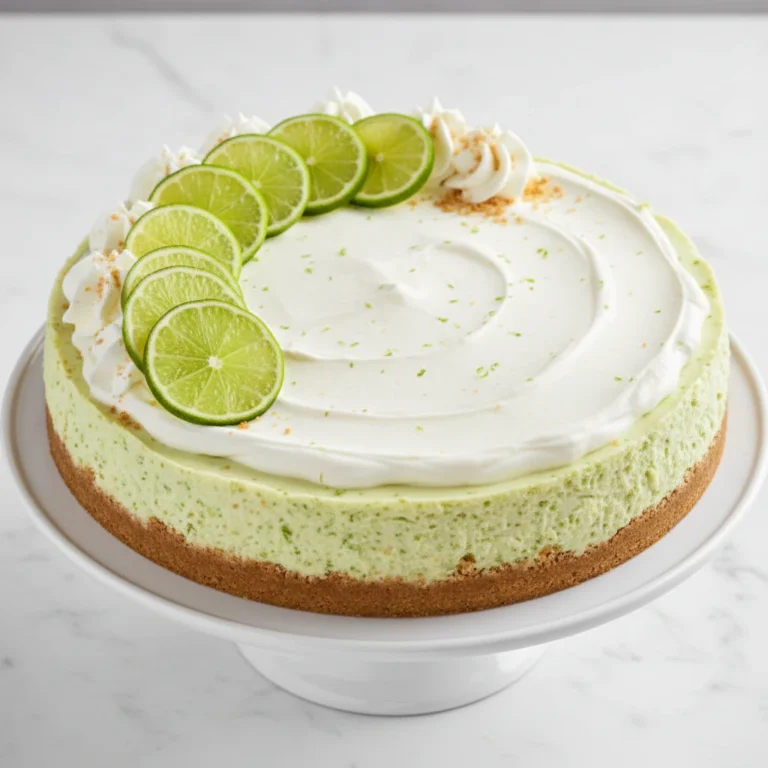
There’s something undeniably tropical and luxurious about key lime cheesecake, a dessert that captures the bright, tangy essence of the Florida Keys in creamy, dreamy form. This showstopping cheesecake combines a buttery graham cracker crust with a silky-smooth filling infused with tart key lime juice and zest, all topped with a subtle sour cream layer. Perfect for special occasions or when you want to impress guests, this dessert delivers restaurant-quality results that taste far more complex than the straightforward ingredient list suggests.
Reasons to Try Key Lime Cheesecake
Bright, Balanced Flavor — The key lime juice and zest create a sophisticated tartness that cuts through the richness of the cream cheese, preventing the dessert from feeling heavy or one-dimensional. Unlike regular limes, key limes offer a unique floral complexity that elevates this cheesecake beyond typical cheesecake fare.
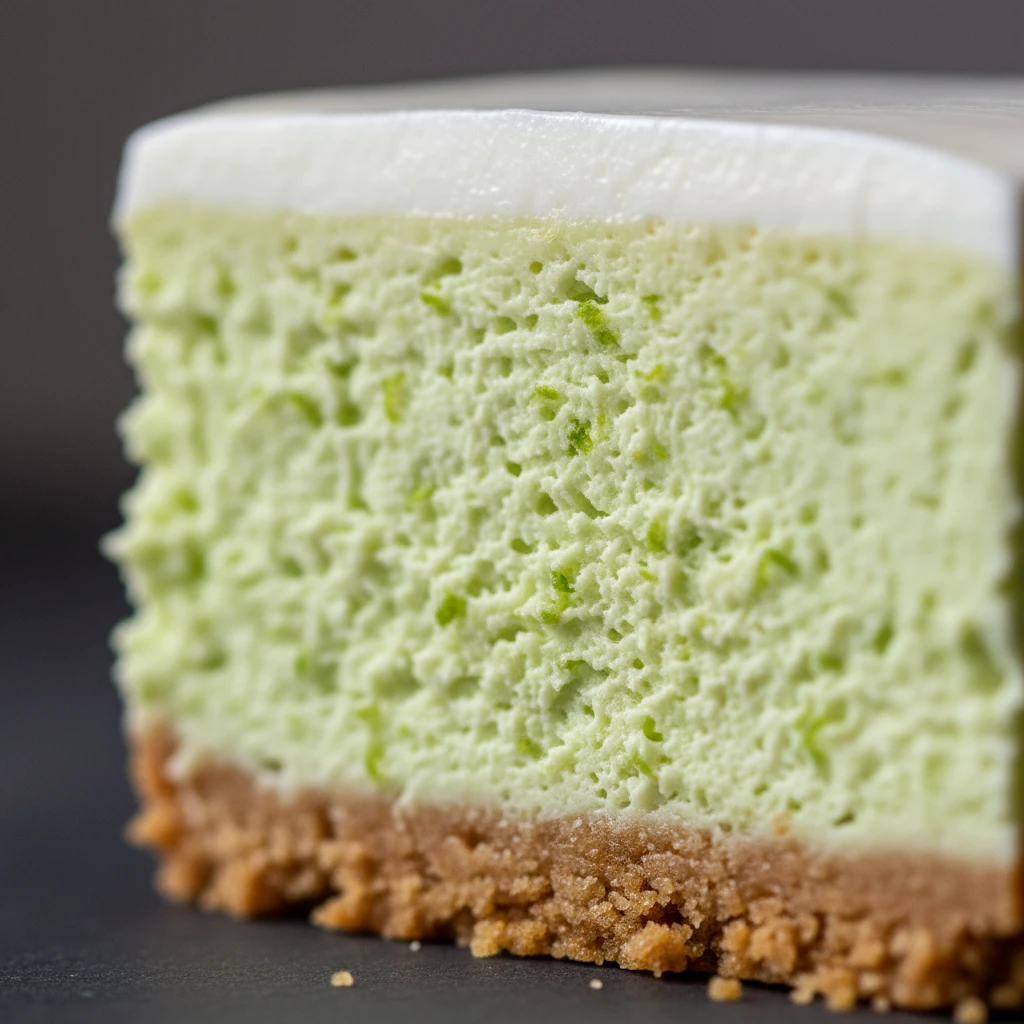
Creamy, Luscious Texture — When baked low and slow with the water bath method, this cheesecake develops a silky, almost mousse-like crumb that melts on your tongue. The addition of sweetened condensed milk adds subtle sweetness and velvety smoothness.
Show-Stopping Presentation — With its pale green hue from the lime and a pristine white sour cream topping, this cheesecake is as beautiful as it is delicious. It’s the kind of dessert that makes people stop mid-conversation.
Tropical Escape — Serving this dessert instantly transports your guests to a warm, beachy paradise. It’s perfect for summer entertaining, holiday gatherings, or any time you want to add a touch of tropical sophistication to your table.
Make-Ahead Friendly — Cheesecake actually improves after a day in the refrigerator as flavors meld and set. You can bake it up to three days ahead, taking stress out of entertaining.
 Save
SaveIngredients Notes
For the Crust
- Graham cracker crumbs
- Granulated sugar
- Unsalted butter, melted
For the Filling
- Cream cheese, room temperature
- Granulated sugar
- Sweetened condensed milk
- Fresh key lime juice
- Key lime zest
- Eggs, room temperature
- Cornstarch
- Vanilla extract
- Salt
For the Sour Cream Topping
- Sour cream, room temperature
- Granulated sugar
- Vanilla extract
For Garnish and Serving
- Whipped cream
- Fresh lime slices
- Graham cracker crumbs
How to Make Key Lime Cheesecake
For the Crust
- Preheat oven to 325°F and position rack in the lower third.
- Mix graham cracker crumbs, sugar, and melted butter until combined, resembling wet sand.
- Press firmly into a 9-inch springform pan covering the bottom and slightly up the sides.
- Bake crust for 8 minutes until lightly golden, then remove and set aside.
For the Filling
- Beat room-temperature cream cheese on low speed for 2 minutes until smooth and creamy.
- Gradually add sugar while mixing, scraping bowl often to prevent lumps.
- Add sweetened condensed milk and mix until fully incorporated.
- Combine key lime juice, zest, eggs, cornstarch, vanilla, and salt in a separate bowl.
- Gently fold the lime mixture into the cream cheese mixture until just combined; do not overmix.
For Baking
- Pour filling over crust in springform pan.
- Wrap the outside of the pan with heavy-duty foil to prevent water from entering.
- Place cheesecake in a large roasting pan filled with hot water halfway up the sides of the springform.
- Bake for 45–50 minutes until the edges are set but the center still jiggles slightly when gently shaken (about a 2-inch circle in the middle).
- Remove cheesecake from oven but leave in water bath.
For the Sour Cream Topping
- Whisk together sour cream, sugar, and vanilla extract.
- Spread evenly over the warm cheesecake.
- Return to oven for 8 minutes until the topping is set but not browned.
- Remove from oven and water bath; cool at room temperature for 1 hour.
- Refrigerate for at least 6 hours or overnight before serving.
What You Must Know About Key Lime Cheesecake
Room Temperature is Critical — This cannot be overstated. All ingredients, especially cream cheese, eggs, and sour cream, must be at room temperature. Cold ingredients won’t blend smoothly, resulting in a lumpy filling with a grainy texture. Remove cream cheese from the refrigerator at least 30 minutes before starting, or place it on the counter for 1 hour.
The Water Bath is Non-Negotiable — The water bath (also called a bain-marie) is what creates the cheesecake’s signature creamy texture. It surrounds the pan with gentle, humid heat, ensuring even cooking and preventing cracks. Never skip this step. Make sure the springform pan is wrapped completely in foil to keep water out.
Don’t Overmix the Filling — Overmixing incorporates too much air, which can cause cracks and an airy, mousse-like texture rather than the desired dense creaminess. Mix on low speed and stop as soon as ingredients are combined. Use a rubber spatula to fold final additions gently by hand if needed.
Slightly Underbaked is Better Than Overbaked — The cheesecake should jiggle slightly in the center when you gently shake the pan. It will continue to cook with residual heat even after you remove it from the oven. If it looks completely firm and set, it’s overbaked and will likely crack as it cools and contracts.
Fresh Key Lime Juice Makes a Difference — While bottled key lime juice is convenient and works perfectly fine, fresh squeezed key lime juice offers a more vibrant, complex flavor. Key limes are smaller and more aromatic than regular Persian limes. If you can’t find fresh key limes, bottled unsweetened key lime juice is an acceptable substitute. Avoid regular lime juice, which tastes distinctly different.
Helpful Tips
Make It Ahead — Cheesecake actually tastes better the next day as flavors meld and the texture sets further. Bake it up to 3 days ahead and store it covered in the refrigerator. On the day you plan to serve it, remove it from the refrigerator 15 minutes before slicing for the best texture.
Prevent the Topping from Browning — If your oven runs hot, the sour cream topping can brown too quickly. If you notice browning after 6 minutes instead of 8, remove it immediately. The topping should look matte and white, not golden or browned.
Use a Hot Knife for Slicing — Dip your knife in hot water and wipe it dry before each cut. This creates clean slices instead of dragging the creamy filling. A bench scraper or offset spatula also works beautifully for transferring slices to plates.
Store the Cheesecake Properly — After cooling completely, cover the entire springform pan (still in the pan) with plastic wrap or transfer it to an airtight container. It will keep for up to 5 days in the refrigerator. Do not freeze; the texture becomes grainy and icy.
Variations and Substitutions
No-Bake Version — For a simpler version, substitute the filling with a no-bake mixture: blend softened cream cheese with sweetened condensed milk, key lime juice, and zest, then fold in whipped cream (instead of eggs). Pour over the baked crust and chill for 4 hours. The texture will be lighter and more mousse-like but still delicious.
Coconut Crust — Replace half the graham cracker crumbs with shredded coconut for a tropical twist. Use 1 cup graham cracker crumbs, 1 cup shredded unsweetened coconut, 0.5 cup sugar, and 6 tablespoons melted butter. This adds subtle coconut flavor without overpowering the lime.
Regular Lime Version — If key limes are unavailable, substitute with fresh Persian (regular) lime juice and zest. You’ll need about 0.25 cup fresh lime juice and 1 tablespoon zest. The flavor will be slightly less complex and floral, but still delicious.
Sweetened Condensed Milk Substitute — If you prefer a less sweet cheesecake, replace the sweetened condensed milk with evaporated milk and reduce the added sugar to 0.75 cup. The texture will be slightly less rich but the lime flavor will shine more brightly.
Lime-Coconut Filling — Add 0.5 cup cream of coconut (like Coco López) along with the sweetened condensed milk for a Caribbean-inspired version. Reduce the sweetened condensed milk to 0.25 cup to keep it balanced.
Chocolate Ganache Topping — After the sour cream layer sets, drizzle 0.5 cup melted dark chocolate over the top for added richness and visual appeal. Let it set before serving.
Gingersnap Crust — For a spiced twist, replace the graham cracker crust with crushed gingersnaps (about 2 cups crumbs). Mix with 0.5 cup sugar and 6 tablespoons melted butter, then bake as directed. The ginger adds depth and pairs beautifully with the tartness of key lime.
Serving Suggestions for Key Lime Cheesecake
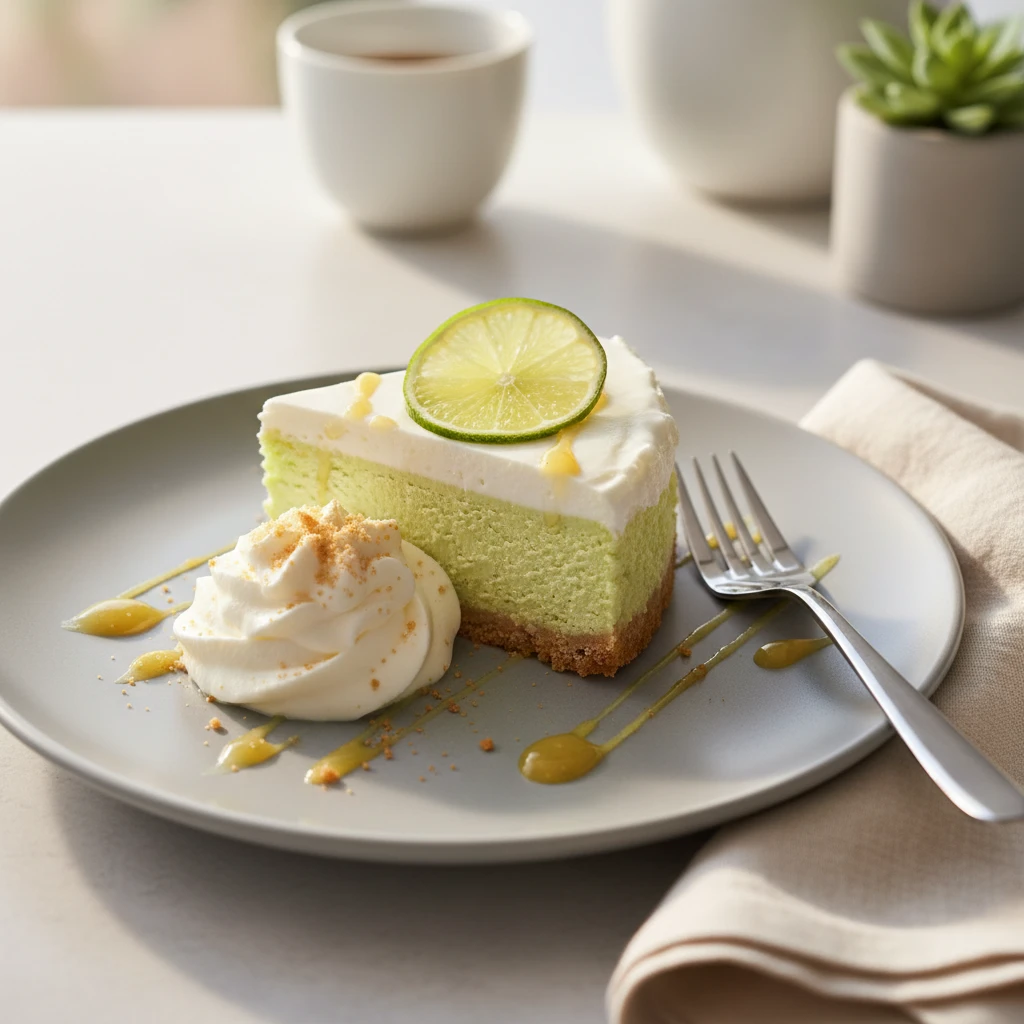
Classic Plating — Serve each slice on a chilled dessert plate with a generous dollop of freshly whipped cream, a thin wheel of fresh key lime or regular lime, and a light sprinkle of graham cracker crumbs for texture contrast. The white cream against the pale green filling creates an elegant presentation.
Tropical Plate — Arrange a slice of cheesecake on the plate and surround it with fresh fruit such as fresh raspberries, blueberries, or diced fresh mango. A small mint leaf adds a pop of color and freshness.
Drizzle with Lime Curd — Make a simple lime curd (or use store-bought) and drizzle it artfully around the plate for a burst of intense lime flavor and visual sophistication.
Coconut Whipped Cream — Instead of plain whipped cream, top with coconut whipped cream (whipped cream mixed with a splash of coconut milk and a touch of coconut extract) for reinforced tropical flavor.
Graham Cracker Crumb Border — Create a ring of graham cracker crumbs around the plate’s edge to echo the crust and add textural interest.
Serve with Iced Tea or Coffee — This dessert pairs beautifully with a glass of cold sweet tea, iced lemon tea, or a strong espresso. The tartness of the lime cuts through the richness of the cheesecake perfectly.
Picnic or Buffet Setting — Cut the entire cheesecake into smaller squares (2-inch) and serve as petit fours on a platter alongside fresh lime slices, candied lime peel, and small spoons. This works beautifully for parties and allows guests to serve themselves.
 Save
SaveStorage and Reheating
Refrigerator Storage — Once the cheesecake has cooled completely, cover it with plastic wrap or transfer it to an airtight container. Store it in the refrigerator for up to 5 days. The flavors actually improve after 1 day as the filling sets and flavors meld. If storing in the springform pan, wrap the entire pan tightly with plastic wrap to prevent the cheesecake from absorbing odors from the refrigerator.
Do Not Freeze — Freezing is not recommended for this cheesecake. The texture becomes grainy and icy upon thawing, and the creamy, smooth mouthfeel is compromised. Cheesecake is best served fresh or within a few days of baking.
Individual Portions — If you plan to serve slices over several days, slice the cheesecake once it’s completely chilled and wrap individual slices tightly in plastic wrap before refrigerating. This prevents the cut surfaces from drying out. Unwrap slices 15 minutes before serving to bring them to optimal temperature.
Serving Temperature — This cheesecake is best served cold or at cool room temperature. Remove it from the refrigerator 10–15 minutes before serving for the creamiest texture. If it’s too cold (straight from a very cold refrigerator), the filling will be slightly dense and less pleasant to eat.
Frequently Asked Questions about Key Lime Cheesecake
Can I use regular limes instead of key limes?
Yes, you can substitute regular Persian limes for key limes if key limes are unavailable. You’ll need about 0.25 cup fresh lime juice and 1 tablespoon of zest. The flavor will be slightly less complex and floral than authentic key limes, but the cheesecake will still taste delicious. Avoid bottled regular lime juice, which has a noticeably different taste profile.
Why is my cheesecake cracking?
Cheesecake cracks occur when the filling overbakes or cools too rapidly. To prevent cracks: ensure the center is still slightly jiggly when you remove it from the oven (not completely firm), keep it in the water bath for the full 30 minutes, and allow it to cool at room temperature for 1 hour before refrigerating. Avoid opening the oven door during baking, as sudden temperature changes can also cause cracks. Minor cracks can be hidden with whipped cream or graham cracker topping.
Do I have to use a water bath?
The water bath is highly recommended and not truly optional if you want the signature creamy texture of a professional cheesecake. The water bath provides gentle, humid heat that prevents the filling from overbaking on the outside while the inside cooks. Without it, you’re likely to end up with a drier, cracked, or unevenly cooked cheesecake. However, if you absolutely cannot use a water bath, bake at a lower temperature (300°F) and reduce the baking time, checking frequently. The result will likely not be ideal.
Can I make this cheesecake ahead?
Absolutely! Cheesecake is one of the best make-ahead desserts. Bake it up to 3 days ahead and store it covered in the refrigerator. The flavor actually improves after 1 day as the filling sets and flavors meld. This also takes the stress out of entertaining since your dessert is already complete. Simply remove it from the refrigerator 10–15 minutes before serving, slice, and plate.
What if I don’t have sweetened condensed milk?
Sweetened condensed milk adds sweetness and creaminess to the filling. If you don’t have it, you can substitute it with evaporated milk (not sweetened). If you use evaporated milk, increase the added sugar from 1 cup to 1.25 cups to compensate for the lack of sweetness. The texture will be very slightly different, but the cheesecake will still taste delicious. Alternatively, you can use 0.75 cup heavy cream mixed with 0.25 cup powdered sugar.
How do I know when the cheesecake is done baking?
The cheesecake is properly baked when the edges are set and no longer jiggly, but the very center (about a 2-inch circle in the middle) still jiggles slightly like soft Jell-O when you gently shake the pan. Do not bake until the entire cheesecake is firm—this indicates overbaking. If you use a thermometer, insert it into the center; it should read 150°F. The cheesecake will continue to cook with residual heat after you remove it from the oven.
Can I use bottled key lime juice instead of fresh?
Yes, bottled unsweetened key lime juice works perfectly fine and is much more convenient, especially if fresh key limes aren’t available in your area. Use 0.5 cup bottled key lime juice as directed. The flavor will be just as bright and authentic. However, avoid lime-flavored syrups or juices with added sugar, as these will throw off the balance of the filling. Look specifically for unsweetened bottled key lime juice in the baking or beverage section of your grocery store.
Nutrition Facts (Per Serving)
| Nutrient | Amount |
| Calories | 385 kcal |
| Total Fat | 26g |
| Saturated Fat | 16g |
| Trans Fat | 0.5g |
| Cholesterol | 108mg |
| Sodium | 312mg |
| Total Carbohydrates | 38g |
| Dietary Fiber | 0g |
| Sugars | 32g |
| Protein | 6g |
| Vitamin C | 8mg |
Key Lime Cheesecake
Ingredients
- 2 cups graham cracker crumbs
- 0.5 cup granulated sugar
- 6 tablespoons unsalted butter melted
- 32 ounces cream cheese room temperature
- 1 cup granulated sugar
- 0.75 cup sweetened condensed milk
- 0.5 cup fresh key lime juice
- 2 tablespoons key lime zest
- 3 large eggs room temperature
- 1 tablespoon cornstarch
- 0.5 teaspoon vanilla extract
- 0.25 teaspoon salt
- 1 cup sour cream room temperature
- 2 tablespoons granulated sugar
- 0.5 teaspoon vanilla extract
- Whipped cream for serving
- Fresh lime slices for garnish
- Graham cracker crumbs for garnish
Instructions
- Prep the pan (5 minutes): Preheat your oven to 325°F and position the rack in the lower third of the oven. Get a 9-inch springform pan and set it aside. You'll need to wrap it later, so have heavy-duty foil ready.
- Make the crust (10 minutes, then 8 minutes bake): Combine 2 cups graham cracker crumbs, 0.5 cup granulated sugar, and 6 tablespoons melted unsalted butter in a bowl. Mix with a fork until the mixture looks like wet sand with no dry crumbs. Press this mixture firmly into the bottom of your springform pan and slightly up the sides, using the bottom of a measuring cup to pack it tightly. Bake for 8 minutes until the crust is lightly golden and fragrant. Checkpoint: The crust should smell toasted and feel firm when you press it. Remove from oven and let cool for 5 minutes.
- Bring cream cheese to room temperature (30 minutes if needed, or 5 minutes if starting with room temp): If your cream cheese is cold, let it sit on the counter. Cold cream cheese will not mix properly and create a lumpy filling. Checkpoint: The cream cheese should feel soft to the touch, not firm or cold.
- Blend the cream cheese (3 minutes at low speed): Using an electric mixer on LOW speed, beat 32 ounces (four 8-oz packages) of room-temperature cream cheese for about 2 minutes. Stop the mixer and scrape down the sides and bottom of the bowl with a rubber spatula. This removes any unblended chunks. Checkpoint: Your cream cheese should look smooth and creamy with no visible lumps.
- Add sugar (2 minutes at low speed): Slowly sprinkle 1 cup granulated sugar into the mixer while it runs on low speed. Beat for about 1 minute, then scrape down the bowl again. The mixture should look pale and fluffy. Checkpoint: No grits or sugar crystals should be visible between your fingers when you rub the mixture.
- Add sweetened condensed milk (1 minute at low speed): Pour in 0.75 cup sweetened condensed milk and mix on low speed until fully blended. Scrape the bowl again. The filling will start to look smoother and more spreadable.
- Combine lime juice and zest separately (2 minutes): In a separate mixing bowl, whisk together 0.5 cup fresh key lime juice (about 12–15 key limes, or bottled key lime juice), 2 tablespoons of key lime zest (the colored part of the lime skin only, not the white pith), 3 large room-temperature eggs, 1 tablespoon cornstarch, 0.5 teaspoon vanilla extract, and 0.25 teaspoon salt. Whisk by hand until the eggs are fully mixed and no streaks of egg white remain visible. The cornstarch will help thicken the filling. Checkpoint: The lime mixture should smell bright and zesty, and look uniform in color with no visible chunks of egg white.
- Gently combine the two mixtures (2 minutes at low speed): Pour the lime mixture into the cream cheese mixture SLOWLY while the mixer runs on low speed. As soon as the ingredients are no longer visibly separate, STOP THE MIXER. Do not overmix, as this can add too much air and cause cracks. Scrape down the bowl one final time. Checkpoint: The filling should be pale green, smooth, and pourable but not thin like milk.
- Prepare the water bath setup (5 minutes): Tear off a large sheet of heavy-duty aluminum foil (about 18 inches long). Wrap it tightly around the outside and bottom of your cooled springform pan, making sure there are no gaps or holes where water could seep in. You want the pan to be completely sealed. Place the wrapped pan inside a larger roasting pan (at least 2 inches taller than the springform).
- Pour filling and set up water bath (3 minutes): Pour the green filling mixture into the crust-lined springform pan and smooth the top gently with a spatula. Place the roasting pan (with the springform inside) on the oven rack in the lower third. Pour hot water from a kettle into the roasting pan until it comes halfway up the outside of the springform pan (about 1–1.5 inches of water). The water bath keeps the cheesecake moist and prevents cracks. Checkpoint: You should not see any water inside the springform pan, only around it.
- Bake the cheesecake (45–50 minutes at 325°F): Close the oven door gently and set a timer for 45 minutes. After 45 minutes, check the cheesecake by looking at the edges and gently shaking the pan. The edges should be set and no longer jiggly, but the very center (about a 2-inch circle in the middle) should still jiggle slightly like soft Jell-O when you gently move the pan. Checkpoint: If the center is completely firm, it's overbaked and may crack. If it's too jiggly (more than 3 inches of movement), bake for 2–3 more minutes. If your oven runs hot, it may finish closer to 45 minutes; if it runs cool, it might need 50 minutes.
- Make sour cream topping while cheesecake finishes (2 minutes): While the cheesecake is in the oven during the last 5 minutes, whisk together 1 cup room-temperature sour cream, 2 tablespoons granulated sugar, and 0.5 teaspoon vanilla extract in a small bowl. Whisk until smooth and completely combined with no lumps. Checkpoint: The topping should be thick but spreadable, like yogurt, with no sugar grains visible.
- Add sour cream topping (3 minutes): Remove the cheesecake from the oven but leave it in the hot water bath. Using a spatula, spread the sour cream topping evenly over the surface of the warm cheesecake, starting from the center and working outward. You don't need to cover the very edges completely. Checkpoint: The topping should be smooth and white, covering about 80% of the top surface.
- Bake with topping (8 minutes at 325°F): Return the cheesecake to the oven for exactly 8 minutes. The topping should look set and matte (not shiny) when you remove it. Do not overbake the topping, or it may curdle or brown slightly. Checkpoint: The topping should not jiggle when you gently shake the pan, and it should look smooth and matte.
- Cool in water bath (30 minutes): Remove the cheesecake from the oven and leave it sitting in the hot water bath for 30 minutes. This gradual cooling prevents cracks from forming as the cheesecake contracts. Do not remove the cheesecake from the water bath yet.
- Cool at room temperature (1 hour): After 30 minutes, carefully remove the springform pan from the roasting pan and set it on the counter. Cool the cheesecake at room temperature for about 1 hour. The residual heat will continue to set the filling. Checkpoint: The cheesecake should feel cool to the touch but not cold.
- Chill completely (6 hours or overnight): Once the cheesecake has cooled to room temperature, place it in the refrigerator for at least 6 hours, or preferably overnight. Chilling allows the flavors to develop and the texture to become perfectly creamy. The cheesecake will taste much better cold. Checkpoint: The cheesecake should be completely cold and firm before slicing.
- Remove from springform pan and slice (5 minutes): When ready to serve, run a thin, hot knife around the inside edge of the springform pan, wiping the knife clean between each pass to prevent dragging. Unlatch and remove the springform collar carefully. Using a clean, hot knife (dipped in hot water and wiped dry after each cut), slice the cheesecake into 8–12 pieces, depending on your preferred serving size. The knife should glide smoothly through the creamy filling. Checkpoint: Each slice should have clean edges and a uniform pale green color with no cracks.
- Garnish and serve (2 minutes): Transfer each slice to a serving plate using a thin spatula or cake server. Top with a dollop of freshly whipped cream, a thin slice or wheel of fresh lime, and a small sprinkle of graham cracker crumbs for texture. Serve immediately. Checkpoint: The cheesecake should slice cleanly without crumbling, and the whipped cream should sit proudly on top.