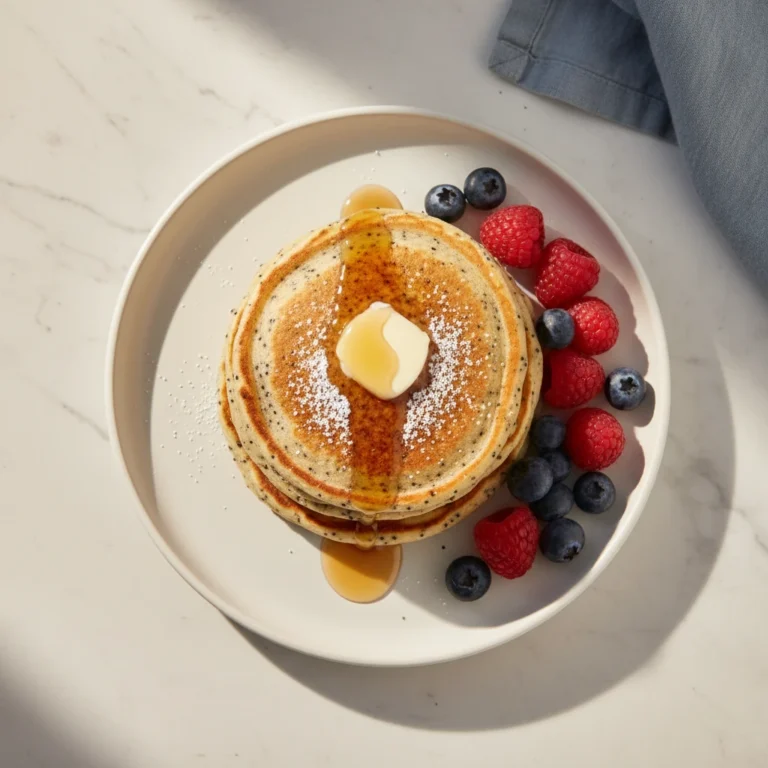
When breakfast inspiration strikes, poppy seed yogurt pancakes deliver a delightful twist on a classic favorite. These tender, fluffy pancakes blend the subtle earthiness of poppy seeds with the tangy richness of Greek yogurt, creating a sophisticated yet comforting morning meal. The bright citrus notes from lemon zest and juice add freshness that elevates every bite, making these pancakes far more interesting than ordinary versions. Perfect for weekend brunches or special breakfast occasions.
Reasons to Try Poppy Seed Yogurt Pancakes
- Incredibly Tender Texture: Greek yogurt creates a moist, tender crumb that stays fluffy even as the pancakes cool. The acidic yogurt reacts with baking soda to produce extra lift and a delicate crumb structure that regular buttermilk pancakes can’t match.
- Subtle, Sophisticated Flavor: Poppy seeds add a gentle nutty undertone with a unique peppery finish. Combined with lemon zest and juice, these pancakes taste elegant enough for brunch guests but simple enough for family weekday breakfasts.
- Protein-Packed: Greek yogurt provides nearly double the protein of regular yogurt or milk, making these pancakes more satisfying and keeping you fuller longer throughout the morning.
- Naturally Brightened: Lemon juice and zest add complexity without extra sugar, giving these pancakes a fresh, almost Scandinavian quality that pairs beautifully with fresh berries or honey.
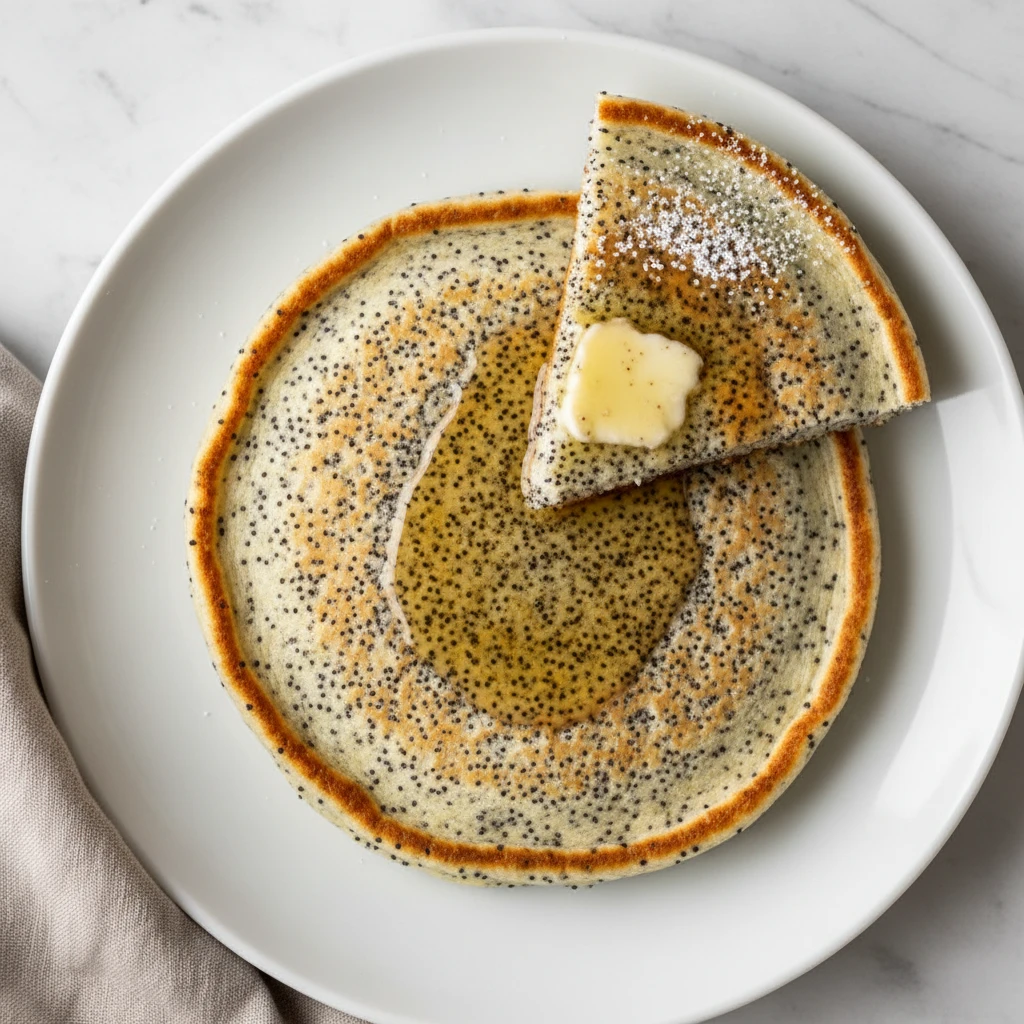
- Stunning Presentation: The poppy seed specks create a beautiful speckled appearance when cooked, making these pancakes automatically photogenic without any extra effort.
- Versatile Topping Options: From classic maple syrup to Greek yogurt drizzles, lemon curd, honey, or fresh fruit compote, these pancakes complement numerous topping combinations.
 Save
SaveIngredients Notes
- All-purpose flour – provides structure; do not substitute with cake flour as it will make pancakes too soft
- Poppy seeds – buy fresh from bulk sections or spice shops; old seeds taste bitter and unpleasant
- Granulated sugar – balances the tartness of yogurt and lemon
- Baking powder and baking soda – both are necessary; the soda reacts with yogurt’s acidity for extra lift
- Salt – essential for flavor balance and brings out sweetness
- Plain Greek yogurt – full-fat Greek yogurt yields the best texture; non-fat versions work but produce slightly denser pancakes
- Whole milk – adds moisture; low-fat milk can be used but reduces richness
- Large eggs – act as binder and add richness; room temperature eggs mix more smoothly
- Unsalted butter – melted butter incorporates evenly; use quality butter for better flavor
- Vanilla extract – enhances subtle sweetness
- Lemon zest – use a microplane grater for the finest, most aromatic zest; avoid the bitter white pith
- Fresh lemon juice – freshly squeezed yields superior tang and brightness; bottled is acceptable in a pinch
- Vegetable oil or butter for cooking – vegetable oil creates crispier edges; butter browns faster but tastes richer
- Powdered sugar – for dusting; optional but adds visual appeal and subtle sweetness
- Fresh berries – blueberries, raspberries, or strawberries complement the lemon and poppy seed flavors beautifully
- Maple syrup – pure maple syrup recommended; pancake syrup lacks depth
How to Make Poppy Seed Yogurt Pancakes
- In a large bowl, whisk together flour, poppy seeds, sugar, baking powder, baking soda, and salt until evenly combined.
- In another bowl, whisk together Greek yogurt, milk, eggs, melted butter, vanilla extract, lemon zest, and lemon juice until smooth.
- Pour the wet ingredients into the dry ingredients and fold together gently until just combined; the batter should be slightly lumpy with some flour streaks visible.
- Heat a griddle or non-stick skillet over medium heat and lightly grease with oil or butter.
- Pour batter in quarter-cup portions onto the hot griddle and cook until edges look set and the bottom is golden brown, about 2–3 minutes.
- Flip carefully and cook the other side until golden and cooked through, about 1–2 minutes.
- Transfer cooked pancakes to a warm plate and repeat with remaining batter.
- Serve warm topped with fresh berries, a dusting of powdered sugar, and drizzle of maple syrup.
What You Must Know About Poppy Seed Yogurt Pancakes
Room Temperature Ingredients are Essential: Cold eggs, yogurt, and milk won’t blend smoothly and can cause lumpy batter with uneven texture. Remove Greek yogurt and eggs from the refrigerator 15–20 minutes before mixing for best results.
Don’t Overmix the Batter: This is the most common mistake with all pancakes, but especially with yogurt pancakes. The acid in yogurt already creates structure; overmixing develops gluten and makes pancakes tough and rubbery instead of tender and fluffy. Fold gently and stop as soon as you see no flour streaks.
Poppy Seeds Settle: Stir the dry mixture thoroughly to distribute poppy seeds evenly, or some pancakes may have no poppy seeds while others have too many.
Lemon Brightness Matters: Use freshly squeezed lemon juice, not bottled. The difference in flavor is dramatic, and bottled juice tastes metallic and flat in contrast to fresh zest.
Timing is Critical for Perfect Golden Bottoms: Don’t flip too early or pancakes will be pale and gummy. Wait for the edges to look dry and set, and bubbles to form on the surface. This usually takes 2–3 minutes on medium heat.
Helpful Tip: Make-Ahead Option: You can prepare the dry ingredients the night before in a sealed container. Store lemon zest separately in a small container. In the morning, quickly mix wet ingredients and fold together. This saves time and ensures pancakes are as fresh as possible.
Helpful Tip: Preventing Soggy Pancakes: Don’t stack warm pancakes on top of each other, as steam gets trapped and makes them soggy. Place finished pancakes on a wire rack or single plate in a 200°F oven to keep warm while you finish cooking the batch.
Variations and Substitutions
- Blueberry Poppy Seed Pancakes: Fold ¾ cup fresh or frozen blueberries gently into the batter at the end. If using frozen blueberries, don’t thaw them—they’ll bleed less. Reduce lemon zest to ½ tablespoon if you prefer less tartness with berries.
- Almond Poppy Seed Pancakes: Add ½ teaspoon almond extract to the wet ingredients and ¼ cup finely ground almond flour to the dry mix, reducing all-purpose flour to 1.75 cups. This creates a nuttier flavor that complements poppy seeds beautifully.
- Honey Sweetened Version: Replace granulated sugar with 2 tablespoons honey added to the wet ingredients. The pancakes will be slightly sweeter and more tender.
- Gluten-Free Poppy Seed Pancakes: Substitute all-purpose flour with a high-quality gluten-free 1-to-1 baking flour. Results are slightly more delicate, so handle carefully when flipping. You may need to add 1–2 tablespoons extra milk if the batter seems too thick.
- Dairy-Free Version: Replace Greek yogurt with coconut yogurt (plain, unsweetened) and use unsweetened almond or oat milk instead of whole milk. Use vegan butter, melted. The flavor will be slightly different but still delicious.
- Poppy Seed Pancakes with Lemon Curd Filling: Prepare basic recipe but place a small spoonful of store-bought or homemade lemon curd in the center of each pancake before flipping. The curd will soften and create a delicious surprise center.
- Orange Poppy Seed Variation: Replace lemon with equal amounts of fresh orange zest and juice. This creates a warmer, slightly less tart flavor profile.
- Coconut Poppy Seed Pancakes: Add ⅓ cup unsweetened shredded coconut to the dry ingredients and ½ teaspoon coconut extract to the wet ingredients. Top with toasted coconut flakes.
Serving Suggestions for Poppy Seed Yogurt Pancakes
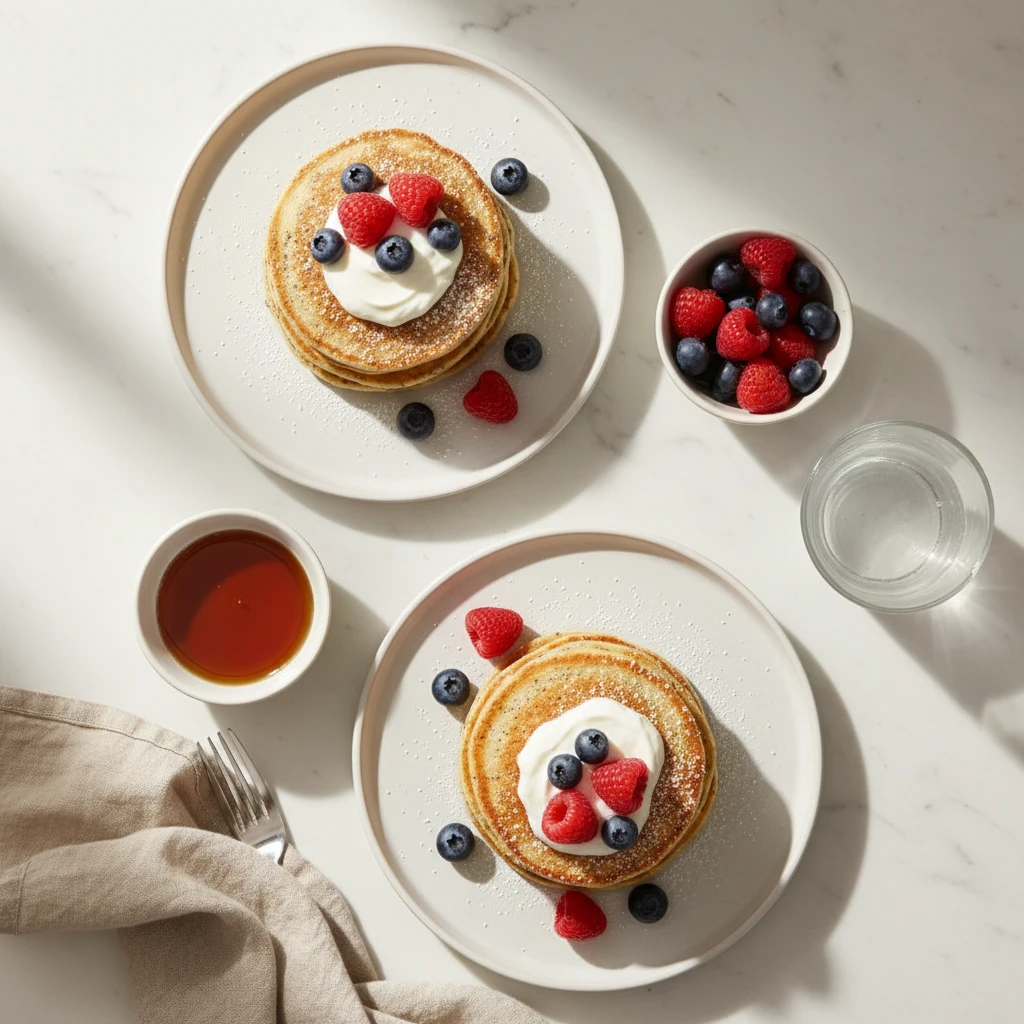
- Classic Brunch Presentation: Stack three pancakes slightly offset on a white or neutral plate. Top with a generous dollop of Greek yogurt or whipped cream, fresh raspberries and blueberries, a dusting of powdered sugar, and a light drizzle of pure maple syrup down the center. Garnish with a small sprig of fresh mint.
- Lemon Curd Elegance: Arrange pancakes slightly overlapping on a plate. Spread a thin layer of premium lemon curd between each pancake and on top of the stack. Dot with fresh berries and finish with a whisper of powdered sugar and candied lemon peel.
- Berry Compote Topping: Serve pancakes with a warm berry compote made from equal parts raspberries, blueberries, and blackberries simmered briefly with honey and a squeeze of fresh lemon juice. The warm fruit sauce soaks slightly into the warm pancakes.
- Greek Yogurt and Honey Bowl: Serve pancakes with a bowl of creamy Greek yogurt on the side (drizzled with honey and sprinkled with poppy seeds) for guests to dollop on their plates. This allows customizable portion control.
- Citrus Syrup Variation: Instead of plain maple syrup, serve with a simple syrup infused with lemon zest and a splash of orange juice. Warm the syrup gently before serving.
- Breakfast Sandwich Style: Place a pancake, spread with Greek yogurt, add fresh berries and a thin layer of almond butter, top with another pancake for an indulgent breakfast sandwich.
- Café-Style Service: Serve two or three pancakes slightly stacked on a warm plate with a small ramekin of maple syrup on the side, a pat of cultured butter melting on top, and a small handful of mixed fresh berries artfully arranged around the plate.
- Make It a Brunch Board: Arrange pancakes on a wooden board alongside small bowls of Greek yogurt, fresh berries, honey, lemon curd, and toasted nuts. Include small plates and utensils for guests to assemble their own perfect bite.
 Save
SaveStorage and Reheating
Room Temperature Storage (0–2 hours): Layer cooked pancakes between parchment paper on a plate and cover loosely with foil to keep warm without creating excess steam. Consume within 2 hours for best texture.
Refrigerator Storage (up to 3 days): Allow pancakes to cool completely to room temperature, then stack them between sheets of parchment paper and place in an airtight container. Store in the refrigerator for up to 3 days. Leftover pancakes taste best eaten the next morning while still slightly tender.
Freezing (up to 3 months): Cool pancakes completely. Layer between parchment paper, stack in a freezer-safe container or resealable freezer bag, and freeze for up to 3 months. Label with the date.
Reheating from Refrigerator (Best Method): Place refrigerated pancakes directly on a toaster oven rack set to 350°F for 5–7 minutes until warmed through. The dry heat restores crispiness to the edges while keeping the inside tender. Avoid microwaving if possible, as it makes pancakes rubbery.
Reheating from Frozen: Place frozen pancakes on a toaster oven rack set to 375°F for 8–10 minutes until warmed through and edges are slightly crispy. Alternatively, thaw pancakes in the refrigerator overnight and reheat using the refrigerator method above.
Microwave Reheating (If Necessary): Wrap 2–3 pancakes in a damp paper towel and microwave on 50% power for 20–30 seconds. Microwaving causes some texture loss, so use this method only when other options aren’t available.
Do Not Store Topped Pancakes: Never store pancakes topped with maple syrup, berries, or other toppings, as this will make them soggy and unappetizing. Store plain pancakes and add toppings fresh when serving.
Frequently Asked Questions about Poppy Seed Yogurt Pancakes
Why do my pancakes come out dense and heavy instead of fluffy?
Dense pancakes usually result from overmixing the batter. When you overwork the batter, you develop gluten strands that create a tough, rubbery texture. Fold the wet and dry ingredients together gently using just 8–10 folds, and stop as soon as you see no flour streaks. It’s okay if the batter looks slightly lumpy. Additionally, make sure your baking soda and baking powder haven’t expired, as old leavening agents won’t provide enough rise.
Can I use sour cream instead of Greek yogurt?
Yes, but with modifications. Sour cream is tangier than Greek yogurt, so reduce lemon juice to 1 tablespoon and lemon zest to ½ tablespoon to avoid overpowering sourness. Also use full-fat sour cream, not low-fat, to maintain pancake moisture. The texture will be slightly creamier but equally delicious. The ratio is 1:1—use 1.5 cups sour cream in place of Greek yogurt.
What’s the best way to know when to flip the pancakes?
Flip when the bottom is golden brown and the top surface looks set with visible bubbles forming and starting to pop. This typically takes 2–3 minutes on medium heat. You can peek under one pancake using a thin spatula—the bottom should be golden with crispy edges. If it’s still pale, cook 30 more seconds before flipping. Don’t flip too early or the pancakes will be gummy inside.
Can I make the batter ahead of time?
You can prepare the dry ingredients the night before in a sealed container and store them at room temperature. However, don’t mix the wet and dry ingredients until just before cooking. Mixing them in advance causes the baking soda and baking powder to activate prematurely, reducing lift and creating dense pancakes. In the morning, quickly combine wet and dry ingredients and cook immediately.
What if I don’t have fresh lemon juice—can I use bottled?
Bottled lemon juice works in a pinch, but fresh lemon juice is strongly recommended. Bottled juice often contains preservatives and lacks the bright, fresh flavor of freshly squeezed juice. The flavor difference is noticeable—bottled juice tastes slightly metallic in contrast. If using bottled, reduce the amount to 1.5 tablespoons since it’s more concentrated in flavor.
Can I add poppy seeds directly into the pancake batter or should I mix them into dry ingredients?
Always mix poppy seeds into the dry flour mixture before combining with wet ingredients. This ensures they’re distributed evenly throughout all the pancakes. If you add poppy seeds to wet ingredients, they’ll sink to the bottom of the batter, and you’ll end up with some pancakes that have too many seeds and others with barely any.
How do I prevent my pancakes from sticking to the griddle?
Proper heat and greasing are key. Preheat your griddle over medium heat for 2–3 minutes until it’s evenly hot. Test by flicking a drop of water on the surface—it should sizzle gently without smoking. Lightly coat with vegetable oil or butter before each batch. You don’t need a heavy coating; too much oil makes pancakes greasy and slippery. Non-stick skillets require less grease than cast iron or stainless steel.
Nutrition Facts (Per Serving)
| Nutrient | Amount | % Daily Value |
|---|---|---|
| Calories | 285 | — |
| Total Fat | 8.5g | 11% |
| Saturated Fat | 3.2g | 16% |
| Cholesterol | 42mg | 14% |
| Sodium | 365mg | 16% |
| Total Carbohydrates | 42g | 15% |
| Dietary Fiber | 1.2g | 5% |
| Sugars | 5.8g | — |
| Protein | 10.2g | 20% |
| Calcium | 142mg | 11% |
| Iron | 1.8mg | 10% |
Dietary Notes: These pancakes are an excellent source of protein thanks to the Greek yogurt, making them more satisfying than traditional pancakes. The poppy seeds add fiber, minerals, and healthy omega-3 fatty acids. The lemon provides vitamin C. Each serving (approximately 2–3 pancakes without toppings) contains approximately 285 calories. Adding maple syrup, butter, or cream toppings will increase the calorie content. These pancakes are vegetarian and can be made vegan with dairy-free substitutions.
Poppy Seed Yogurt Pancakes
Ingredients
- 2 cups all-purpose flour
- 3 tablespoons poppy seeds
- 2 tablespoons granulated sugar
- 2 teaspoons baking powder
- 1 teaspoon baking soda
- 1 teaspoon salt
- 1.5 cups plain Greek yogurt
- 1 cup whole milk
- 2 large eggs
- 3 tablespoons unsalted butter melted
- 1 teaspoon vanilla extract
- 1 tablespoon lemon zest
- 2 tablespoons fresh lemon juice
- Vegetable oil or butter for cooking
- Powdered sugar for dusting
- Fresh berries for topping
- Maple syrup for serving
Instructions
- Preheat a griddle or large non-stick skillet over medium heat for 2–3 minutes until evenly heated. Lightly coat with vegetable oil or butter. Test heat by flicking a drop of water on the surface—it should sizzle gently without smoking.
- In a large mixing bowl, whisk together 2 cups all-purpose flour, 3 tablespoons poppy seeds, 2 tablespoons granulated sugar, 2 teaspoons baking powder, 1 teaspoon baking soda, and 1 teaspoon salt. Whisk for 15–20 seconds until the poppy seeds are evenly distributed throughout the flour mixture with no lumps of baking soda visible.
- In a separate medium bowl, whisk together 1.5 cups plain Greek yogurt, 1 cup whole milk, 2 large eggs, 3 tablespoons melted unsalted butter, 1 teaspoon vanilla extract, 1 tablespoon fresh lemon zest, and 2 tablespoons fresh lemon juice. Whisk vigorously for 30–45 seconds until completely smooth and no yogurt clumps remain; the mixture should look creamy and uniform.
- Pour the wet ingredient mixture into the dry ingredients. Using a rubber spatula, fold gently 8–10 times until just combined. Stop when you still see a few streaks of flour—do not overmix. The batter should look slightly lumpy and thick; overmixing creates tough, dense pancakes.
- Checkpoint: The batter should be thick enough that it holds its shape briefly when scooped but still pours slowly onto the griddle. If too thick, add 1–2 tablespoons milk. If too thin, add 1 tablespoon flour.
- Pour or scoop the batter onto the preheated griddle in quarter-cup portions, spacing pancakes 2–3 inches apart so they don't touch. Cook undisturbed for 2–3 minutes until the bottom turns golden brown and edges look set and slightly dry; you should see tiny bubbles forming and popping on the surface.
- Checkpoint: Peek under one pancake using a thin spatula. The bottom should be golden-brown with crispy edges. If it's still pale, cook 30 seconds longer.
- Using a thin, flat spatula, slide underneath each pancake and flip in one confident motion. Cook the second side for 1–2 minutes until golden brown and cooked through. The pancake should spring back slightly when gently pressed with the spatula.
- Checkpoint: The pancake should feel firm to the touch, not jiggly or soft in the center.
- Transfer finished pancakes to a warm plate or wire rack. Keep warm in a 200°F oven while cooking remaining batches if making ahead, up to 15 minutes.
- Repeat steps 6–9 with remaining batter, greasing the griddle lightly between each batch.
- Serve pancakes warm within 5 minutes of cooking. Top with fresh berries, a light dusting of powdered sugar, and a generous drizzle of pure maple syrup. Optional: add a dollop of Greek yogurt or lemon curd on top.
- Troubleshooting: If pancakes are too dense, you likely overmixed the batter—fold gently next time and stop at the first sign of combined ingredients.
- If pancakes spread too thin and cook too fast, your griddle is too hot—reduce heat to medium-low and test with a drop of water first.
- If bottoms burn but centers stay pale, griddle is too hot—lower heat and grease more lightly.
- If pancakes don't rise or stay flat, your baking soda or baking powder may be old—check expiration dates and replace if expired.
- If pancakes taste too sour, reduce lemon juice by ½ tablespoon or zest by ½ teaspoon next time.