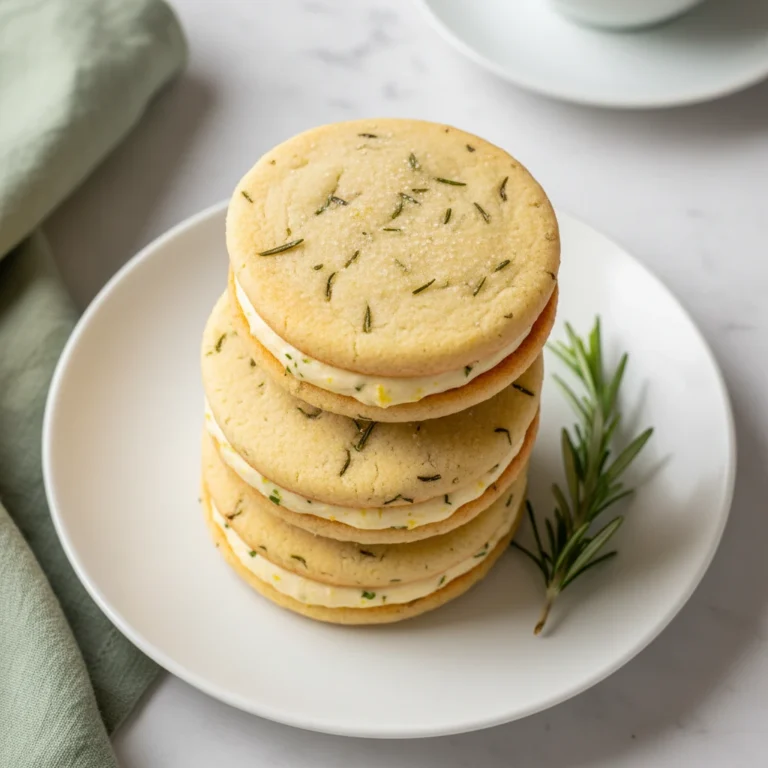
These rosemary-lemon sandwich cookies combine the brightness of citrus with the earthy warmth of herbs for a sophisticated treat that feels both elegant and approachable. Delicate butter cookies are sandwiched with a silky lemon-rosemary buttercream, creating layers of flavor that dance on the palate. Perfect for tea time, special occasions, or when you want to impress with homemade refinement.
Reasons to Try Rosemary-Lemon Sandwich Cookies
Sophisticated Flavor Profile: The combination of fresh rosemary and bright lemon creates an herbaceous-citrus complexity that elevates these beyond ordinary cookies. This pairing is often found in fine pastry, bringing restaurant-quality taste to your home kitchen.
Tender, Buttery Texture: These cookies strike the perfect balance—crispy on the edges, tender in the center, and utterly melt-in-your-mouth. The high butter content ensures a luxurious crumb that feels indulgent without being heavy.
Beautiful Presentation: Sandwich cookies naturally look impressive when displayed on a tiered stand or packaged as gifts. The golden rounds stacked with creamy filling are Instagram-worthy and perfect for entertaining.
Adaptable for Any Season: Fresh rosemary and lemon are available year-round, making these ideal for spring tea parties, summer gatherings, or winter holiday platters. They pair beautifully with coffee, tea, or champagne.
Make-Ahead Friendly: Both the cookie dough and baked cookies freeze exceptionally well, allowing you to prepare in advance and assemble fresh just before serving for maximum flavor impact.
 Save
SaveIngredients Notes
For the Cookies
- All-purpose flour
- Baking powder
- Salt
- Fresh rosemary
- Unsalted butter, softened
- Granulated sugar
- Large egg
- Fresh lemon juice
- Lemon zest
- Vanilla extract
For the Lemon-Rosemary Filling
- Unsalted butter, softened
- Powdered sugar
- Fresh lemon juice
- Lemon zest
- Fresh rosemary, finely minced
How to Make Rosemary-Lemon Sandwich Cookies
For the Cookies
- Preheat oven to 350°F. Line baking sheets with parchment paper.
- Whisk together flour, baking powder, salt, and chopped rosemary in a small bowl.
- Beat softened butter and granulated sugar together until light and fluffy, about 3 minutes.
- Add egg, lemon juice, lemon zest, and vanilla extract to the butter mixture, beating until well combined.
- Gradually add the flour mixture, mixing just until a dough forms.
- Roll dough between two sheets of parchment paper to about 1/8 inch thickness.
- Refrigerate for 20 minutes until firm.
- Cut out cookies using a 1.5-inch round cutter and place on prepared baking sheets.
- Bake for 10 to 12 minutes until pale golden at edges.
- Cool on baking sheet for 5 minutes, then transfer to wire racks to cool completely.
For the Filling and Assembly
- Beat softened butter until creamy, about 2 minutes.
- Gradually add powdered sugar, mixing on low speed to avoid dust.
- Add lemon juice, lemon zest, and minced rosemary, beating until light and fluffy.
- Pipe or spread a generous teaspoon of filling on the flat side of one cookie.
- Top with a second cookie, flat side down, pressing gently to adhere.
- Repeat with remaining cookies and filling.
What You Must Know About Rosemary-Lemon Sandwich Cookies
Fresh Rosemary is Essential: Dried rosemary will overpower the cookies with a dusty, bitter note. Use only fresh rosemary, finely chopped to avoid large woody bits. If fresh is unavailable, reduce the amount by half and pulse it in a food processor with the sugar before adding to the butter to break down the texture.
Lemon Zest, Not Juice, for Flavor Intensity: While lemon juice adds moisture and subtle flavor, lemon zest provides the concentrated citrus essence. Always zest before juicing, and use a microplane grater for the finest, most evenly distributed zest.
Temperature Control is Critical: Chilling the dough before cutting ensures uniform cookie sizes and prevents spreading during baking. If your kitchen is warm, chill dough for 30 minutes instead of 20. Soft or warm dough will produce thick, cake-like cookies instead of tender, delicate ones.
Don’t Overbake: These cookies should look slightly underbaked when you remove them from the oven. They continue cooking on the hot baking sheet for 5 minutes. Overbaking will make them crispy and dry instead of tender.
Softened Butter Matters: For the filling especially, softened butter should be soft enough to leave an indent when pressed, but not greasy or melted. Leave it at room temperature for 30 to 60 minutes. If too warm, refrigerate for 15 minutes and try again.
Helpful Tips: If you don’t have a 1.5-inch cutter, any round cutter between 1.25 and 1.5 inches works—just adjust baking time slightly for larger cookies (add 1 to 2 minutes). To prevent the rosemary from browning and becoming bitter during baking, make sure your oven is calibrated correctly; an oven running 25°F hot can scorch herbs quickly. For a less herbaceous flavor, reduce rosemary to 1/4 teaspoon in the dough; the filling’s smaller amount will provide subtle herbal notes.
Variations and Substitutions
Lavender-Lemon Version: Replace rosemary with 1/4 teaspoon dried culinary lavender (very potent—use sparingly). Lavender brings a floral, delicate note that pairs beautifully with lemon for a more dessert-forward cookie.
Thyme Instead of Rosemary: Fresh thyme offers a slightly softer, more subtle herbaceous flavor than rosemary. Use the same amount (1/2 teaspoon in dough, 1/4 teaspoon in filling) for a gentler herb profile.
Orange-Rosemary: Substitute lemon zest and juice with orange zest and juice for a warmer citrus flavor. Orange pairs beautifully with rosemary for a slightly less sharp taste.
Honey-Sweetened Filling: Replace 1/4 cup of the powdered sugar with 3 tablespoons honey for a more complex sweetness and softer filling texture. Reduce lemon juice by 1 tablespoon to compensate for the honey’s moisture.
Cream Cheese Filling: Use 1/2 cup softened cream cheese combined with 1/2 cup softened butter and reduce powdered sugar to 1.5 cups. This creates a tangier, slightly less sweet filling that complements the herbal notes.
Edible Flower Garnish: After assembly, place a single candied lemon slice, candied rosemary leaf, or edible flower on top of each sandwich cookie for a dramatic presentation.
Gluten-Free Version: Replace all-purpose flour with a 1:1 gluten-free flour blend. Reduce rosemary slightly (to 1/4 teaspoon in dough) as gluten-free flour can amplify herb flavors. The texture will be slightly more delicate but equally delicious.
Serving Suggestions for Rosemary-Lemon Sandwich Cookies
Elegant Tea Service: Arrange cookies on a tiered cake stand alongside loose-leaf herbal tea, Earl Grey, or chamomile. The cookies’ herbaceous notes pair beautifully with floral or citrus teas.
Champagne Pairings: Serve with chilled champagne or sparkling wine for an elevated appetizer or after-dinner treat. The butter and lemon flavors complement the bubbles perfectly.
Dessert Platter: Arrange on a marble board with other citrus-forward desserts like lemon bars, shortbread, or candied lemon peels. Add sprigs of fresh rosemary between cookies for visual interest and to reinforce the flavor profile.
Gift Packaging: Stack pairs of cookies in a clear cellophane bag tied with twine and a fresh rosemary sprig. These look stunning as gifts and hold well for up to 5 days at room temperature in an airtight container.
Afternoon Snack: Serve at room temperature with cold milk, coffee, or hot chocolate. The delicate cookies won’t overpower these beverages and provide a subtle, sophisticated break from your day.
Garnish Ideas: Before serving, lightly dust with coarse sugar, edible gold leaf, or a tiny pinch of fleur de sel to add visual texture and highlight their refined nature.
 Save
SaveStorage and Reheating
Unfilled Cookies: Store baked cookies in an airtight container at room temperature for up to 7 days. Layer with parchment paper between rows to prevent breakage. These cookies remain tender for several days due to their high butter content.
Filled Cookies: Assemble just before serving for the best flavor and texture, as the filling can gradually soften the cookies. If you must assemble in advance, store filled cookies in an airtight container at room temperature for up to 3 days, or refrigerate for up to 5 days for a firmer, longer-lasting filling.
Freezing Cookie Dough: Wrap rolled dough tightly in plastic wrap and freeze for up to 2 weeks. Thaw slightly at room temperature for 5 minutes before cutting to prevent cracking. Bake as directed.
Freezing Baked Cookies: Freeze unfilled baked cookies in a freezer-safe container with parchment between layers for up to 3 months. Thaw at room temperature for 15 minutes before filling.
Freezing Buttercream: Transfer cooled buttercream to an airtight container and freeze for up to 1 month. Thaw in the refrigerator overnight, then re-whip with a hand mixer for 1 to 2 minutes to restore fluffy texture before using.
No Reheating Needed: These cookies are best enjoyed at room temperature. If refrigerated, let them sit on the counter for 10 to 15 minutes before serving so the filling softens slightly and the cookies regain their tender texture.
Frequently Asked Questions about Rosemary-Lemon Sandwich Cookies
Can I make these cookies without fresh rosemary?
Fresh rosemary is strongly recommended for the best flavor, but if unavailable, dried culinary rosemary can work in a pinch. Use only 1/4 teaspoon dried rosemary in the dough and 1/8 teaspoon in the filling, as dried herbs are more potent. Alternatively, try fresh thyme, lavender, or omit the herb entirely for a plain lemon cookie. The herbaceous element is what makes these unique, so substituting with another herb is better than skipping it altogether.
How do I know when the cookies are fully baked?
The edges of the cookies should be lightly golden (not dark brown), and the centers should still look pale and slightly underbaked. When you gently press the center of a cookie on the baking sheet, it should spring back slowly. They will firm up as they cool on the baking sheet for 5 minutes. If the center still feels very soft after cooling, the cookies need a few more minutes. Overbaking results in crispy, dry cookies instead of the desired tender texture.
Can I use bottled lemon juice instead of fresh?
Fresh lemon juice is ideal for the most vibrant, natural flavor. Bottled lemon juice can work in the filling (it’s already processed and won’t affect texture much), but for the cookie dough, fresh juice is preferable because it carries more nuanced flavor. If using bottled, reduce the amount slightly by 1/2 teaspoon as it’s sometimes more concentrated. Never skip the zest—that’s where the true lemon flavor lives, and there’s no good substitute.
Why are my cookies spreading too much during baking?
Spreading usually indicates either warm dough or an oven running hot. Always chill rolled dough for at least 20 minutes before cutting and baking. Use an oven thermometer to verify your oven temperature—many run 15 to 25°F hot or cold. If spreading occurs, chill your dough longer (30 to 45 minutes) and reduce the oven temperature by 10°F. Also ensure your baking sheets are cool before placing dough on them; warm sheets will soften the dough immediately.
How can I make the filling less sweet?
Reduce the powdered sugar from 2 cups to 1.5 cups and add an extra 1/2 teaspoon of lemon zest or fresh lemon juice to balance the flavor. You can also replace 1/4 cup of the powdered sugar with 3 tablespoons honey or 2 tablespoons of Greek yogurt for a tangier, less sugary filling. The consistency may be slightly softer, so chill for 10 minutes before piping if needed.
Can these cookies be made dairy-free?
Yes. Use high-quality vegan butter (ensure it’s soft and creamy, not one meant solely for vegan baking that may be too greasy) in both the dough and filling. The cookies will be slightly more delicate but still delicious. Alternatively, use a combination of dairy-free butter and coconut oil for better texture. Ensure all other ingredients are dairy-free. The baking time may need to be reduced by 1 to 2 minutes as vegan butter can brown faster.
How long do these cookies last?
Unfilled baked cookies keep in an airtight container at room temperature for up to 7 days. Filled cookies are best within 3 days at room temperature or 5 days refrigerated, as the filling gradually softens the cookies. For the longest shelf life, assemble cookies just before serving. Frozen unfilled cookies last up to 3 months, and dough lasts up to 2 weeks.
What’s the best way to cut the dough without it cracking?
Ensure your dough is thoroughly chilled (20 to 30 minutes minimum) and rolled to a uniform 1/8-inch thickness between two sheets of parchment paper. Use a sharp cookie cutter and press straight down with a quick motion, lifting straight up without twisting—twisting can seal the edges and trap dough in the cutter. If dough warms up while cutting, return it to the refrigerator for 5 minutes. You can also flour your cutter lightly to prevent sticking.
Nutrition Facts (Per Serving)
| Nutrient | Amount Per Serving |
|---|---|
| Calories | 185 kcal |
| Total Fat | 11g |
| Saturated Fat | 7g |
| Cholesterol | 32mg |
| Sodium | 95mg |
| Total Carbohydrate | 23g |
| Dietary Fiber | 0.1g |
| Sugars | 16g |
| Protein | 1.5g |
| Vitamin C | 3mg (5% of Daily Value) |
| Calcium | 22mg (2% of Daily Value) |
Nutritional values are estimates based on standard USDA ingredients. One serving equals one filled sandwich cookie. Actual values may vary based on specific brands and preparation methods. These cookies are a treat to be enjoyed in moderation as part of a balanced diet.

Rosemary-Lemon Sandwich Cookies
Ingredients
- 2 and 1/4 cups all-purpose flour
- 1 teaspoon baking powder
- 1/2 teaspoon salt
- 1/2 teaspoon finely chopped fresh rosemary
- 3/4 cup unsalted butter softened
- 3/4 cup granulated sugar
- 1 large egg
- 2 tablespoons fresh lemon juice
- 1 tablespoon lemon zest
- 1 teaspoon vanilla extract
- 1 cup unsalted butter softened (for filling)
- 2 cups powdered sugar
- 2 tablespoons fresh lemon juice for filling
- 1 tablespoon lemon zest for filling
- 1/4 teaspoon fresh rosemary finely minced (for filling)
Instructions
- Preheat your oven to 350°F for 10 minutes. Line two baking sheets with parchment paper.
- In a small bowl, whisk together 2 and 1/4 cups all-purpose flour, 1 teaspoon baking powder, 1/2 teaspoon salt, and 1/2 teaspoon finely chopped fresh rosemary. Set aside. Checkpoint: Your dry ingredients should be evenly mixed with tiny specks of rosemary throughout.
- In a large bowl using a hand mixer or standing mixer, beat 3/4 cup softened unsalted butter and 3/4 cup granulated sugar together on medium speed for 3 to 4 minutes until the mixture looks pale, fluffy, and light—like clouds. Scrape down the bowl occasionally. Checkpoint: You should see a noticeable increase in volume and the mixture should be lighter in color.
- Add 1 large egg to the butter mixture. Beat on medium speed for 1 minute until fully combined and no streaks of egg remain.
- Add 2 tablespoons fresh lemon juice, 1 tablespoon lemon zest, and 1 teaspoon vanilla extract. Beat on medium speed for 30 seconds until the filling is smooth and the lemon zest is evenly distributed. The mixture should smell strongly of lemon and butter.
- With the mixer on low speed, add the flour mixture in three additions, mixing just until the dough comes together. Do not overmix or your cookies will be tough. Stop as soon as no dry flour streaks remain. Checkpoint: Your dough should be cohesive but still soft—not sticky.
- Divide the dough in half. Place each half between two sheets of parchment paper. Using a rolling pin, gently roll each half to about 1/8 inch thick (thin, even thickness is key for uniform cookies). Refrigerate both rolled doughs for 20 minutes until firm and easy to cut.
- Remove one sheet of dough from the refrigerator and carefully peel off the top parchment. Using a 1.5-inch round cookie cutter, cut out cookies by pressing straight down and lifting out. Place cookies 1 inch apart on prepared baking sheets. Repeat with the second sheet of dough. Gather dough scraps, re-roll, and cut additional cookies if desired.
- Place both baking sheets in the preheated 350°F oven on the middle and upper-middle racks (rotate halfway through). Bake for 10 to 12 minutes until the edges of the cookies are barely golden and the centers still look slightly pale. The cookies will continue to set as they cool. Checkpoint: The edges should feel firm but the centers should still be tender when you gently press them. You should smell warm lemon and butter.
- Remove baking sheets from the oven. Let cookies cool on the baking sheets for 5 minutes—they will firm up during this time. Using a spatula, carefully transfer cookies to a wire cooling rack. Let cool for at least 20 minutes at room temperature before filling. Checkpoint: Cookies should be completely cool and firm to the touch before you assemble them.
- While cookies cool, prepare the filling. In a large bowl using a hand mixer or standing mixer, beat 1 cup softened unsalted butter on medium speed for 2 to 3 minutes until it is pale, creamy, and increased in volume.
- Gradually add 2 cups powdered sugar while mixing on low speed. This prevents a cloud of sugar powder. Once the sugar is mostly combined, increase speed to medium and beat for 1 minute until the filling is light and fluffy. Scrape down the bowl occasionally.
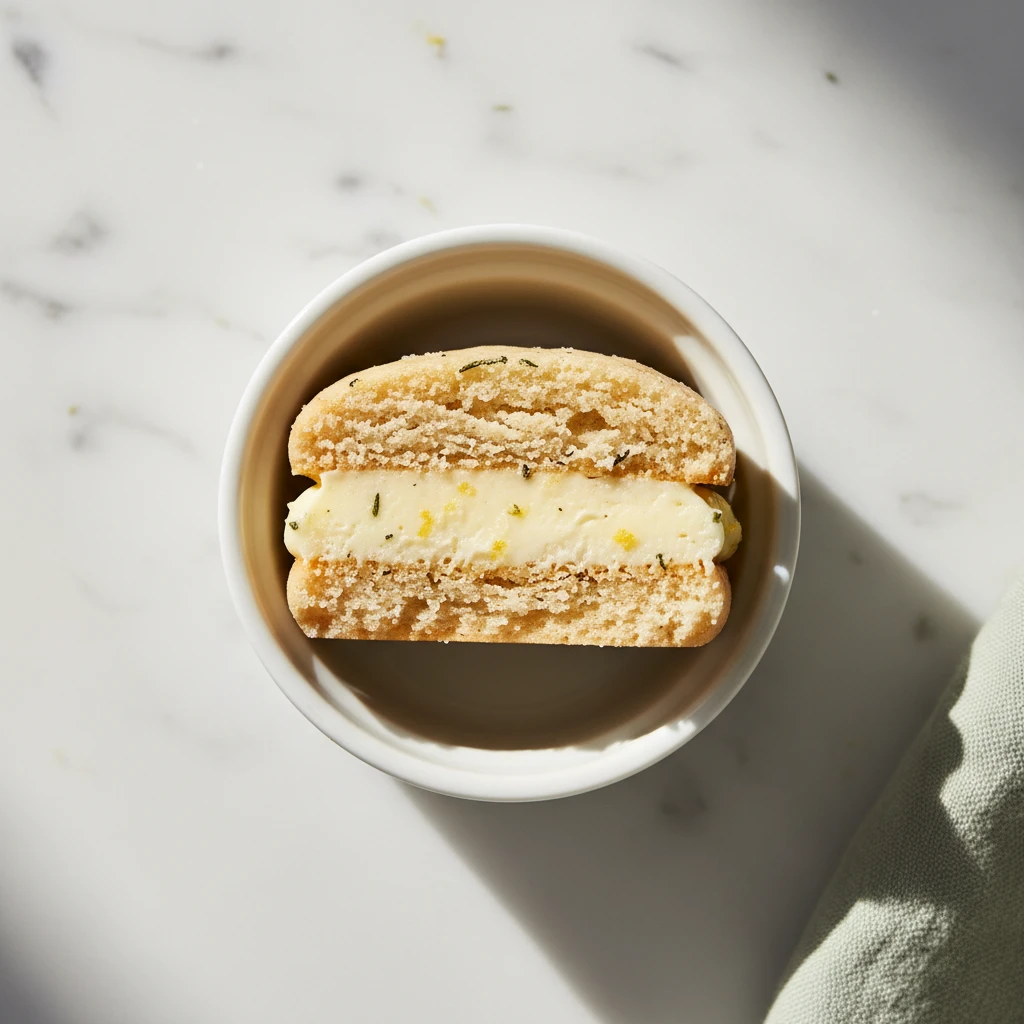
- Add 2 tablespoons fresh lemon juice, 1 tablespoon lemon zest, and 1/4 teaspoon finely minced fresh rosemary to the buttercream. Beat on low speed for 30 seconds, then on medium speed for 30 seconds more until everything is evenly incorporated. The filling should be pale yellow with visible specks of zest and rosemary. Checkpoint: Your filling should be spreadable but hold its shape—not runny or too stiff.
- Transfer the filling to a piping bag fitted with a 1/2-inch round tip, or use a small spoon to portion. Match up cookie pairs by size and shape.
- Holding one cookie flat side up, pipe or spread about 1 teaspoon of filling onto the flat side. Do not overfill or the filling will squish out the sides.
- Press a second cookie flat side down onto the filling, gently pressing so the filling spreads to the edges. Repeat with all remaining cookies and filling.
- Serve immediately or allow filled cookies to rest at room temperature for 30 minutes so the filling sets slightly. Checkpoint: The filling should feel set but still tender when you bite into it—not hard.
- Troubleshooting bullet points:If your dough is too sticky to cut: refrigerate longer—cold dough is much easier to work with. You can also freeze rolled dough for up to 2 weeks and cut directly from frozen.
- If your cookies spread too much during baking: your oven may be running hot. Lower the temperature by 10°F and check with an oven thermometer. Chill dough for 30 minutes before baking next time.
- If your buttercream is too soft: refrigerate it for 10 minutes, then re-whip. Ensure all your butter was softened, not melted. Cold butter requires beating longer to become fluffy.
- If your cookies taste too rosemary-forward: use only 1/4 teaspoon in the dough next time. Rosemary is potent; less is often better. You can always add more to the filling if desired.
- If your filled cookies feel greasy: this means the filling has too much butter or your kitchen is very warm. Use the cookies within 1 hour or refrigerate. They taste best when the filling is cool and slightly set.