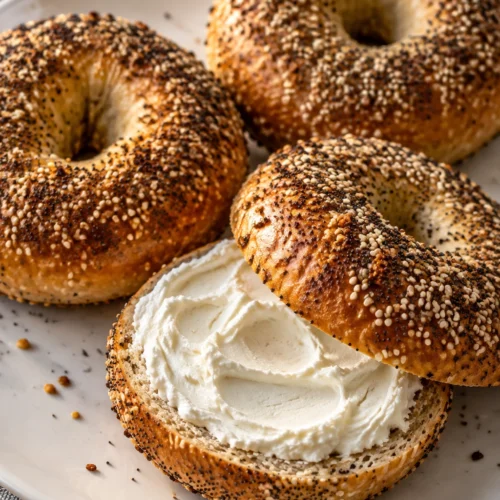
Sourdough Bagels
Make authentic sourdough bagels at home with this step-by-step recipe. Chewy, golden, and naturally leavened — better than any bakery.
Ingredients
- 500 –840 g Bread Flour high-protein, 12–14%
- 100 –227 g Active Sourdough Starter 100% hydration
- 250 –425 g Water lukewarm, ~90°F
- 9 –18 g Salt
- 21 –63 g Honey or Barley Malt Syrup dough
- 20 –63 g Honey or Barley Malt Syrup boiling water
- 1 –2 tsp Baking Soda boiling water
- 24 –40 g Sugar dough
- 1 egg white Egg White Wash
- 2 –4 tbsp Everything Bagel Seasoning / Sesame / Poppy Seeds
- 1 –2 tbsp Cornmeal pan prep
Instructions
- Feed your starter: Feed your sourdough starter 4–8 hours before you plan to mix your dough. Keep it at 75–80°F. It is ready when it has doubled in size, looks domed and bubbly on top, smells yeasty and slightly sweet, and a small spoonful floats in water. Checkpoint: You are ready to move on when your starter has clearly doubled and passes the float test.
- Mix the wet base: In the bowl of a stand mixer, combine 227g active starter, 425g lukewarm water (~90°F), and 42g honey. Stir together for about 2 minutes until the mixture looks slightly cloudy and uniform with no starter clumps.
- Add flour and salt: Add 840g bread flour and 18g salt to the bowl. Mix on low speed for 2 minutes until the ingredients just come together.
- Knead the dough: Switch to the dough hook and knead on medium-low speed for 8–10 minutes. The dough should clear the sides of the bowl, feel firm and stiff like clay — not sticky — and pass the windowpane test (stretch a small piece thin without tearing). This should take 10–12 minutes total. Checkpoint: You are ready to move on when the dough is smooth, stiff, and elastic.
- Bulk ferment: Transfer the dough to a lightly oiled bowl and cover it. Let it ferment at room temperature (75–78°F) for 6–8 hours. During the first 2 hours, perform 3–4 sets of stretch-and-folds every 30 minutes: grab one side of the dough, stretch it up, and fold it over the center. Rotate the bowl and repeat on all four sides. After the folds are done, leave the dough undisturbed. Checkpoint: You are ready to move on when the dough has risen 50–75%, feels airy and jiggly, and you can see bubbles on the surface and sides.
- Divide and pre-shape: Turn the dough out onto an unfloured surface. Using a bench scraper and kitchen scale, divide it into 12 equal pieces of about 105g each. Roll each piece into a tight, smooth ball by cupping your hand over the dough and rolling in a circular motion against the surface. Leave the balls uncovered to bench rest for 10–15 minutes at room temperature. Checkpoint: You are ready to move on when the balls hold their round shape without spreading and have a taut, smooth surface.
- Shape the bagels: Poke your thumb through the center of each dough ball. Gently stretch the hole to about 2 inches in diameter using both index fingers, rotating the dough as you go. Place each shaped bagel on a parchment-lined baking sheet dusted with 1–2 tbsp cornmeal. The hole will shrink during proofing and baking, so make it slightly larger than you want it to end up.
- Cold retard: Cover the shaped bagels loosely with plastic wrap and refrigerate for 12–24 hours (up to 48 hours maximum) at 38–40°F. When you remove them, they should look slightly puffed but still feel firm and cold. Checkpoint: You are ready to move on when bagels are slightly puffed but still cold and firm — not over-proofed or airy.
- Preheat oven and prepare boiling water: Remove bagels from the fridge. Preheat your oven to 450°F with racks in the upper and lower thirds. Allow 30–45 minutes for the oven to fully saturate with heat. Meanwhile, bring a large pot of water to a full rolling boil. Add 1 tbsp honey and 1 tsp baking soda to the boiling water and stir briefly.
- Boil the bagels: Working in batches of 2–3, carefully drop the cold bagels into the boiling water. Boil for 30–60 seconds on the first side. Using a slotted spoon, flip each bagel and boil for another 30–60 seconds on the second side. Remove and let drain briefly on a wire rack or clean towel. The bagels should puff slightly and float, with a slightly glossy and set surface.
- Apply toppings: While each batch of bagels is still hot and wet from the boiling water, immediately brush with egg white wash and press or sprinkle your toppings — everything bagel seasoning, sesame seeds, poppy seeds, or your choice — onto the surface. The moisture ensures maximum adhesion.
- Bake: Place topped bagels back on the cornmeal-dusted, parchment-lined baking sheets. Bake at 450°F for 25–28 minutes, rotating the pans (top to bottom, front to back) halfway through at the 13-minute mark. Bagels are done when they are deep golden brown all over and register 210°F on an instant-read thermometer inserted into the side. Checkpoint: You are ready to move on when the crust is a deep, rich golden brown and the internal temperature hits 210°F.
- Cool before slicing: Transfer bagels to a wire rack and cool for at least 20–30 minutes before slicing. The crumb needs this time to fully set. The crust should sound hollow when tapped and no steam should escape when gently pressed.