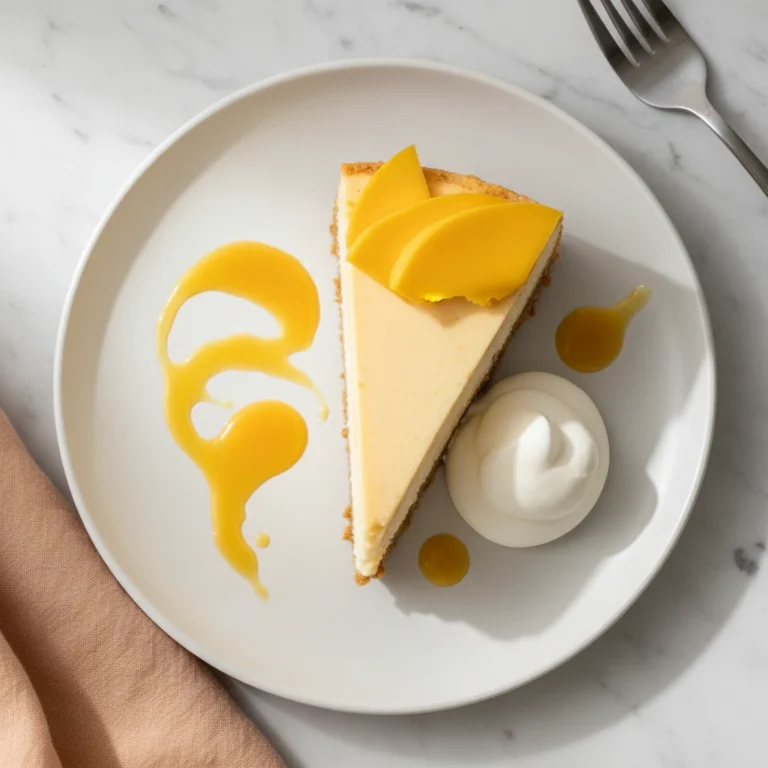
Mango cheesecake is a tropical twist on the classic dessert, combining a buttery graham cracker crust with a creamy, tangy filling infused with sweet mango flavor. This elegant no-bake style cheesecake offers the perfect balance of richness and fruity brightness, making it an impressive dessert for any occasion. Whether you’re hosting a summer dinner or craving something special, this mango cheesecake delivers restaurant-quality taste from your own kitchen.
Reasons to Try Mango Cheesecake
Tropical Flavor Profile: The bright, sweet-tart notes of mango provide a refreshing contrast to the rich, creamy cheesecake base, creating a perfectly balanced dessert that’s neither too heavy nor too sweet.
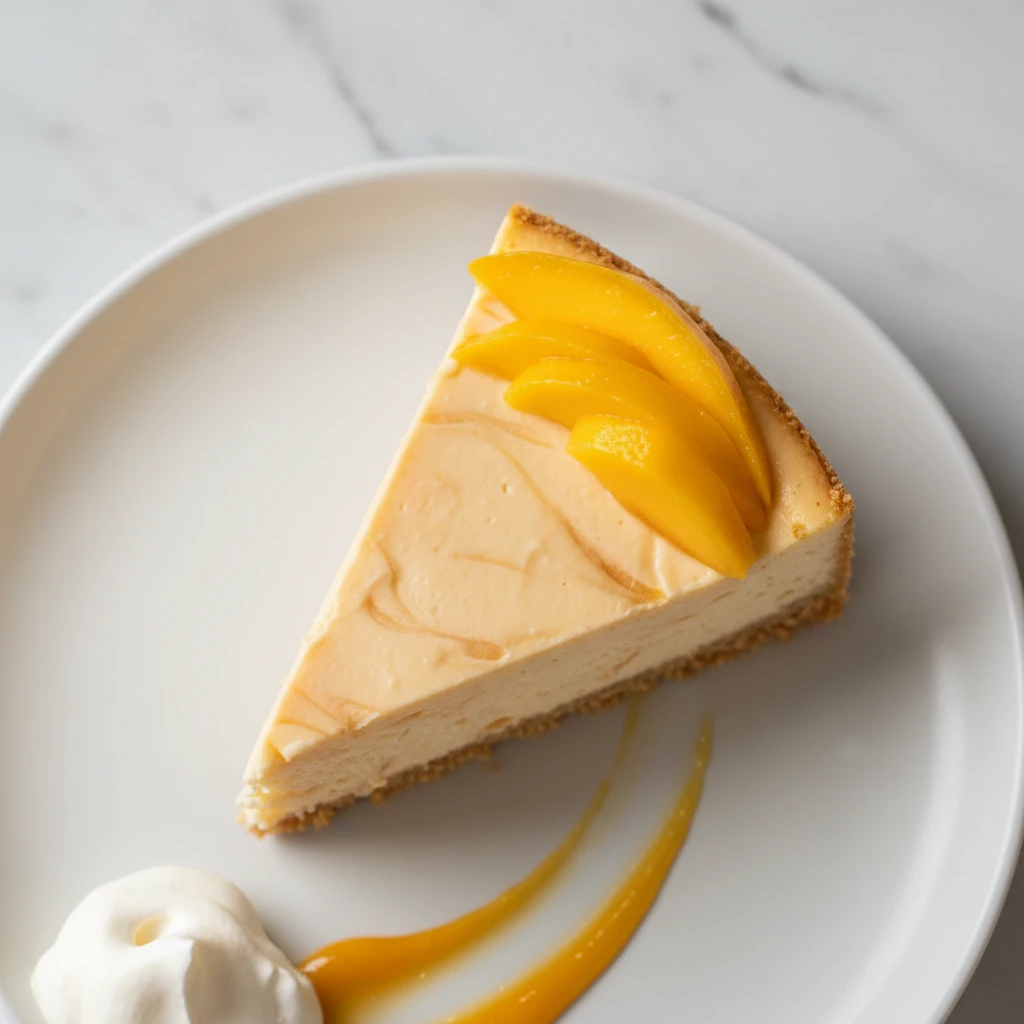
Elegant Presentation: With its golden crust, velvety filling, and stunning mango topping, this cheesecake is as beautiful to look at as it is delicious to eat—guaranteed to impress guests.
Smooth, Creamy Texture: The combination of cream cheese and sour cream creates an incredibly silky texture that melts on your tongue, while the mango adds a pleasant fruity dimension.
Make-Ahead Friendly: This dessert can be prepared a day or two in advance, making it perfect for entertaining or meal planning.
Naturally Vibrant: The natural golden-orange hue from the mango makes this cheesecake visually stunning without artificial coloring.
Summer-Ready: Perfect for warm-weather gatherings, tropical-themed parties, or whenever you want to escape to the tropics with dessert.
 Save
SaveIngredients Notes
For the Crust
- Graham cracker crumbs
- Melted butter
- Sugar
For the Filling
- Cream cheese, softened
- Sugar
- Eggs
- Sour cream
- Vanilla extract
- Fresh mango puree
- Cornstarch
- Lemon juice
- Salt
For Topping and Serving
- Fresh mango slices
- Whipped cream
How to Make Mango Cheesecake
For the Crust
- Mix graham cracker crumbs, melted butter, and sugar until combined like wet sand.
- Press firmly into the bottom of a 9-inch springform pan.
- Bake at 325°F for 8 minutes until lightly golden, then cool.
For the Filling
- Beat softened cream cheese and sugar until smooth and creamy.
- Add eggs one at a time, mixing on low speed after each addition.
- Stir in sour cream and vanilla extract until just combined.
- Fold in mango puree, cornstarch, lemon juice, and salt until evenly distributed.
- Pour filling over the cooled crust.
- Bake at 325°F for 55–65 minutes until the center is just set but still slightly jiggly.
- Cool in the oven with the door cracked for 1 hour, then refrigerate for at least 6 hours or overnight.
- Top with fresh mango slices and whipped cream before serving.
What You Must Know About Mango Cheesecake
Critical Tip: Cream Cheese Temperature: Always bring your cream cheese to room temperature before mixing. Cold cream cheese will create lumps and an uneven texture no matter how much you beat it. Take it out of the refrigerator 20–30 minutes before you start.
Water Bath is Essential: Do not skip the water bath. It ensures even, gentle heat distribution and dramatically reduces cracking. Wrap the springform pan tightly with foil to keep water out.
Don’t Overmix: Once you add eggs, keep the mixer on low speed and mix only until each ingredient is just incorporated. Overmixing adds air bubbles that collapse during baking, creating cracks and a dense texture.
Mango Quality Matters: Use fresh, ripe mangoes or high-quality frozen mango puree. Avoid canned mango in heavy syrup, which can be too watery and overly sweet. If using frozen mango, thaw it completely and drain off excess liquid before pureeing.
Baking Doneness Cue: The cheesecake is done when the outer 2 inches are set and firm, but the center still jiggles slightly (about 1/2 inch of movement). This slight underbaking is intentional—it prevents the center from becoming rubbery and allows for a creamy texture as it cools.
Helpful Tip: Make-Ahead Advantage: Prepare this cheesecake up to 2 days in advance. The flavors actually improve and meld after a day or two in the refrigerator. Add fresh mango slices and whipped cream just before serving to prevent the toppings from getting soggy.
Helpful Tip: Clean Slices: For the cleanest slices, use a long, thin knife (a serrated bread knife works great). Dip the knife in hot water, wipe it clean with a damp cloth, and cut through with a smooth downward motion. Repeat this process for each slice.
Helpful Tip: Mango Puree Ratio: The 2 cups of mango puree gives a balanced tropical flavor without overpowering the cheesecake. If you prefer a stronger mango flavor, add up to 2 1/2 cups puree, but reduce the sour cream to 3/4 cup to maintain proper texture.
Variations and Substitutions
Coconut-Mango Fusion: Replace 1/2 cup of the sour cream with canned coconut cream (the thick part from the top of a can). Add 1/2 teaspoon coconut extract along with the vanilla. Top with toasted coconut flakes in addition to mango slices for an extra tropical touch.
Tropical No-Bake Version: For a lighter, no-bake option, reduce the eggs to 2 and add 2 cups heavy whipping cream whipped to stiff peaks. Fold the whipped cream into the mixture after adding the mango puree. Use a graham cracker crust without pre-baking. Refrigerate for at least 8 hours. This version has a mousse-like texture.
Mango-Lime Cheesecake: Add the zest of 2 limes to the cream cheese mixture and replace the lemon juice with fresh lime juice. This adds brightness and complexity to the tropical flavor profile.
Mini Cheesecake Cups: Divide the crust mixture among a muffin tin lined with cupcake liners (about 2 tablespoons per cup). Fill with the mango cheesecake batter to three-quarters full. Bake at 325°F for 20–25 minutes, then cool and refrigerate as directed. These individual portions are perfect for entertaining.
Mango Swirl Cheesecake: Pour half the basic cheesecake filling (made without mango) into the crust. Top with the remaining half mixed with the mango puree. Use a toothpick to swirl the mango into the plain filling before baking for a beautiful marble effect.
Dairy-Free Option: Substitute dairy-free cream cheese (such as Kite Hill or Cashewmilk-based brands) and use dairy-free sour cream alternative. The texture will be slightly different but still delicious.
Crust Alternatives: Replace the graham cracker crust with crushed vanilla wafers, digestive biscuits, or a combination of almonds and dates for a different flavor and texture.
Serving Suggestions for Mango Cheesecake
Classic Presentation: Slice the chilled cheesecake into 8–10 pieces and plate on white or light-colored dishes. Top each slice with fresh mango slices and a generous dollop of fresh whipped cream. Garnish with a light drizzle of mango coulis (strained mango puree) around the plate for elegance.
Tropical Plate: Serve each slice alongside grilled pineapple wedges, fresh raspberries, and a small scoop of vanilla or coconut ice cream. This combination balances the richness of the cheesecake with bright, contrasting flavors.
Afternoon Tea Setting: Cut smaller slices (about 1/4 of the whole cheesecake) and serve on dessert plates with a small fork. Accompany with hot tea, coffee, or champagne for an elegant presentation.
Dinner Party Finale: Plate a slice, add a quenelle (oval spoon of) of coconut sorbet or mango gelato beside it, and garnish with candied mango peel and fresh mint leaves for a restaurant-quality presentation.
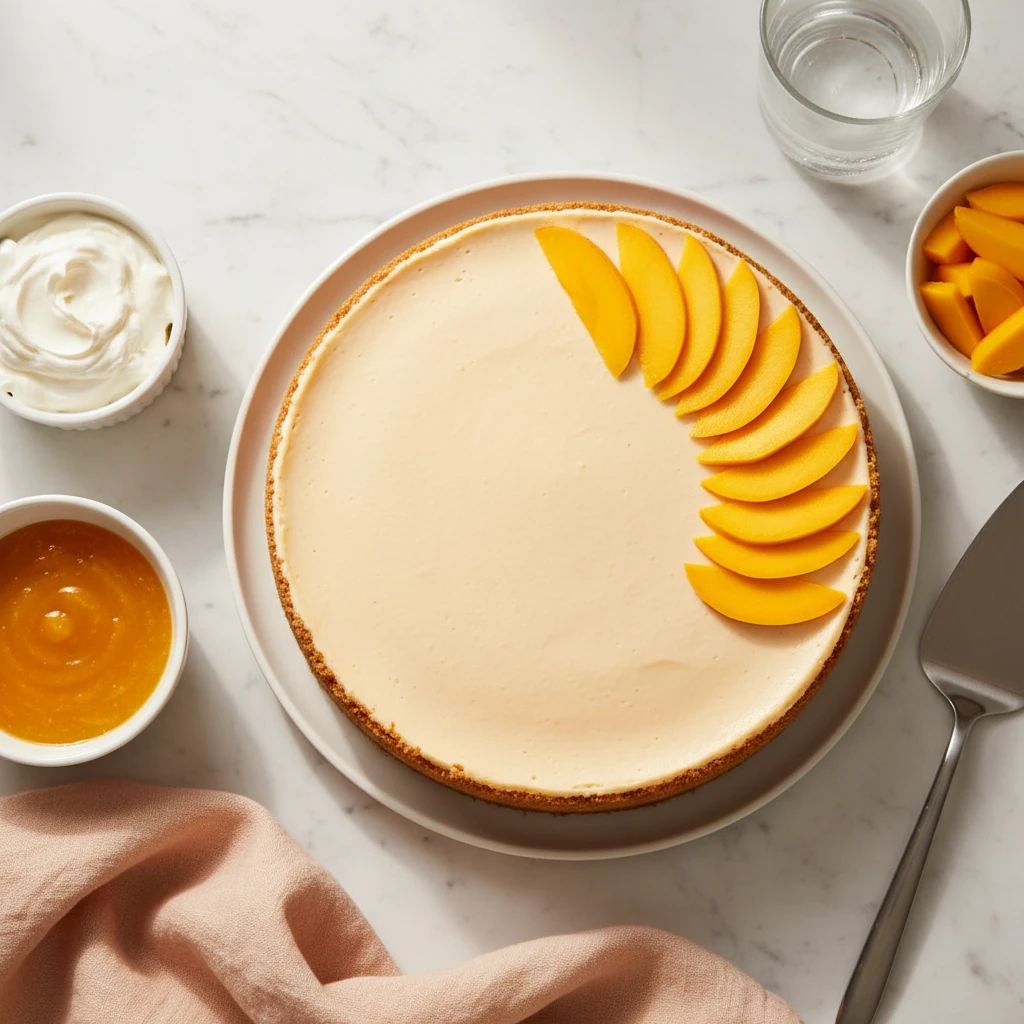
Casual Gathering: Set the whole cheesecake on a beautiful serving plate with a knife nearby and let guests slice and serve themselves. Place fresh mango slices and a bowl of whipped cream on the side for customization.
Tartness Balance: If the cheesecake seems too rich, serve with a light passion fruit coulis or a small glass of prosecco on the side to cut through the richness.
Garnish Ideas: Fresh mint leaves, edible flowers (pansies or violas), toasted coconut flakes, crushed pistachios, or a light dusting of freeze-dried mango powder all make beautiful and delicious garnishes.
 Save
SaveStorage and Reheating
Refrigerator Storage: Store the covered cheesecake in an airtight container in the refrigerator for up to 5 days. The cheesecake actually tastes better on day 2 or 3, as the flavors meld and deepen. Leave the fresh mango topping off until just before serving to prevent it from becoming soft or discolored.
Freezing: The cheesecake (without mango topping) can be frozen for up to 2 months. Wrap the whole cheesecake tightly with plastic wrap and then aluminum foil. Alternatively, slice it first, wrap individual slices in plastic wrap, and store in a freezer-safe container. Thaw in the refrigerator overnight before serving. Fresh toppings should always be added after thawing.
Reheating: Cheesecake is best served cold and does not require reheating. If you prefer it slightly less cold, let it sit at room temperature for 15–20 minutes before serving.
Leftover Slices: If you have leftover slices with toppings, you can store them in an airtight container in the refrigerator for 2–3 days. The whipped cream may lose some fluffiness, but the cheesecake itself will remain creamy and delicious.
Do Not Thaw and Refreeze: Only thaw the cheesecake when you’re ready to eat it. Do not refreeze it once thawed, as this can affect the texture and create food safety concerns.
Frequently Asked Questions about Mango Cheesecake
Can I make mango cheesecake without a water bath?
It’s not recommended. A water bath is crucial for cheesecake as it ensures even, gentle heat distribution and dramatically reduces cracking. If you absolutely cannot use a water bath, bake at a lower temperature (300°F) for a longer time (75–85 minutes) and watch carefully, but the results may be less reliable.
What type of mango should I use for the puree?
Use ripe, sweet mango varieties like Alphonso, Ataulfo, or Kent mangoes. You can use fresh mangoes (peel, pit, and blend until smooth) or high-quality frozen mango puree with no added sugar. Avoid canned mango in syrup, as it’s often too watery and overly sweet. For 2 cups of puree, you’ll need about 4–5 medium fresh mangoes.
Can I use mango juice or nectar instead of mango puree?
Mango juice or nectar will make the filling too thin and watery. The cheesecake won’t set properly. Stick with thick mango puree. If you want to use juice, reduce it by half on the stovetop first, then let it cool completely before adding it to the filling.
Why is my cheesecake cracking on top?
Cracks usually result from overbaking, too-rapid cooling, or overmixing. Overbaked cheesecake shrinks and pulls, creating cracks. Cool it slowly by leaving it in the oven with the door cracked open for 1 hour. Avoid overmixing the batter, especially once eggs are added. Also, ensure your cream cheese was room temperature before mixing.
How long should I refrigerate the cheesecake before serving?
Refrigerate for at least 6 hours, but overnight (12–24 hours) is ideal. The cheesecake needs time to set completely and the flavors need to meld. If you slice it too early, it will be soft and crumbly. Cold cheesecake is also much easier to slice cleanly.
Can I make this cheesecake without eggs?
Traditional baked cheesecake requires eggs for structure and texture. However, you can make a no-bake mousse-style mango cheesecake using whipped cream instead (see Variations). The texture and flavor will be different—lighter and airier—but still delicious.
What’s the difference between using fresh sour cream and Greek yogurt?
Sour cream provides tanginess and a creamy texture. Greek yogurt will make the cheesecake tangier and slightly denser. You can use Greek yogurt as a 1:1 substitute if you prefer a more tart flavor, but add 1 tablespoon of cornstarch to compensate for the extra moisture.
Can I make individual mini cheesecakes instead of one large cake?
Absolutely! Make mini cheesecakes in muffin tins lined with cupcake liners. Use about 2 tablespoons of crust mixture per cup and fill three-quarters with batter. Bake at 325°F for 20–25 minutes. They’ll cook faster and are perfect for entertaining. Store in the refrigerator in an airtight container for up to 5 days.
Nutrition Facts (Per Serving)
Nutrition Facts (Per Serving)
| Nutrient | Amount per Serving | % Daily Value* |
|---|---|---|
| Calories | 485 | — |
| Total Fat | 32g | 41% |
| Saturated Fat | 19g | 95% |
| Trans Fat | 1.2g | — |
| Cholesterol | 145mg | 48% |
| Sodium | 385mg | 17% |
| Total Carbohydrate | 38g | 13% |
| Dietary Fiber | 0.8g | 3% |
| Total Sugars | 31g | — |
| Includes 0g Added Sugars | — | 0% |
| Protein | 7.2g | 14% |
| Vitamin A | 85 mcg | 10% |
| Vitamin C | 18mg | 20% |
| Calcium | 142mg | 11% |
| Iron | 0.5mg | 3% |
* Percent Daily Values are based on a 2000 calorie diet. Your daily values may be higher or lower depending on your calorie needs. These calculations are estimates based on standard ingredient data and serving size of 1/8 cheesecake (approximately 180g). Actual values may vary based on specific ingredient brands and preparation methods.
Mango Cheesecake
Ingredients
- 2 cups graham cracker crumbs
- 1/2 cup melted butter
- 3 tablespoons sugar
- 32 ounces cream cheese softened
- 1 cup sugar
- 4 large eggs
- 1 cup sour cream
- 1 teaspoon vanilla extract
- 2 cups fresh mango puree
- 2 tablespoons cornstarch
- 1 tablespoon lemon juice
- 1/4 teaspoon salt
- Fresh mango slices for topping
- Whipped cream for serving
Instructions
- Prepare the pan: Preheat your oven to 325°F. Line the outside of a 9-inch springform pan with aluminum foil to prevent water from leaking (you'll use a water bath). Have a baking dish large enough to fit the springform pan ready. Time: 5 minutes.
- Make the crust: In a medium bowl, combine 2 cups graham cracker crumbs, 1/2 cup melted butter, and 3 tablespoons sugar. Stir with a fork until the mixture resembles wet sand. Press this mixture firmly and evenly into the bottom of your prepared springform pan, using the bottom of a measuring cup to create a smooth, compact layer. Time: 5 minutes. Checkpoint: You are ready to move on when the crust is firmly packed and covers the entire bottom with no gaps.
- Pre-bake the crust: Place the springform pan in the oven and bake at 325°F for 8 minutes until the crust is lightly golden and fragrant. Remove and let cool while you prepare the filling. Time: 8 minutes.
- Soften the cream cheese: Remove 32 ounces of cream cheese from the refrigerator and let it sit at room temperature for 15–20 minutes until it's very soft and pliable. This step is critical—cold cream cheese will create lumps. Time: 15–20 minutes. Checkpoint: The cream cheese should feel soft when you press it gently with your finger.
- Beat cream cheese and sugar: In a large bowl, using an electric mixer on medium speed, beat the softened cream cheese and 1 cup sugar together for 2–3 minutes until the mixture is smooth, creamy, and pale. Scrape down the sides of the bowl with a rubber spatula every 30 seconds to ensure everything is combined. Time: 2–3 minutes. Checkpoint: The mixture should look light and fluffy with no lumps of cream cheese visible.
- Add eggs carefully: With the mixer on low speed, add 4 large eggs one at a time, mixing for about 15 seconds after each egg is added. Do not overmix—mix only until each egg is incorporated. Overmixing adds too much air and can cause cracks. Time: 1–2 minutes total. Checkpoint: The batter should be smooth and homogeneous with no streaks of egg white visible.
- Add sour cream and vanilla: Add 1 cup sour cream and 1 teaspoon vanilla extract to the batter. Mix on low speed for 20–30 seconds just until combined. Do not overmix. Time: 30 seconds. Checkpoint: The sour cream should be fully incorporated with no white streaks.
- Fold in mango puree: Using a rubber spatula (not the mixer), gently fold 2 cups fresh mango puree into the cheesecake batter. Fold slowly and carefully for about 1 minute until the mango is evenly distributed throughout and the filling has a beautiful peachy-gold color. Overmixing can incorporate too much air. Time: 1 minute. Checkpoint: The filling should be a uniform mango color with no white streaks of cream cheese visible.
- Add thickening agent and seasoning: Sprinkle 2 tablespoons cornstarch, 1 tablespoon lemon juice, and 1/4 teaspoon salt over the filling. Fold these in gently for 20 seconds until fully incorporated. The cornstarch helps set the filling and prevents excessive cracking. Time: 20 seconds.
- Pour filling into crust: Carefully pour the mango cheesecake filling over the cooled graham cracker crust, smoothing the top gently with a spatula. Time: 2 minutes.
- Prepare water bath: Place the foil-wrapped springform pan inside a larger baking dish. Pour hot water into the larger baking dish until it reaches halfway up the sides of the springform pan. The water bath ensures gentle, even cooking and prevents cracking. If the water level is below halfway, add more hot water now. Time: 2 minutes.
- Bake the cheesecake: Carefully place the water bath in the preheated 325°F oven on the middle rack. Bake for 55–65 minutes. The cheesecake is done when the outer 2 inches are set and no longer jiggly, but the center 3-inch circle in the very middle still wobbles slightly when you gently shake the pan (about 1/2 inch of jiggle). Do not overbake—a slightly underbaked center prevents cracks as the cheesecake cools. Time: 55–65 minutes. Checkpoint: The top should look creamy and set around the edges. If you insert a knife 2 inches from the edge, it should come out clean; the very center should still be slightly wet.
- Cool slowly in oven: Turn off the oven and crack the door open about 4 inches. Leave the cheesecake in the oven for 1 hour. This gradual cooling prevents thermal shock and significantly reduces cracking. Time: 60 minutes.
- Remove from oven and water bath: Carefully remove the springform pan from the water bath and peel away the aluminum foil. Place the cheesecake on a wire rack at room temperature for 15 minutes. Time: 15 minutes.
- Chill thoroughly: Cover the cheesecake loosely with plastic wrap and refrigerate for at least 6 hours, preferably overnight (12–24 hours). Cold cheesecake is much easier to slice and has the best flavor and texture. Time: 6–24 hours.
- Top and serve: Just before serving, run a thin, hot knife around the inside edge of the springform pan to loosen the cheesecake, then carefully release and remove the springform sides. If desired, also run the knife under the bottom to release the cheesecake from the base, and carefully transfer to a serving plate. Top with fresh mango slices and a dollop of whipped cream. Slice with a hot, wet knife, wiping between cuts for clean slices. Time: 10 minutes.