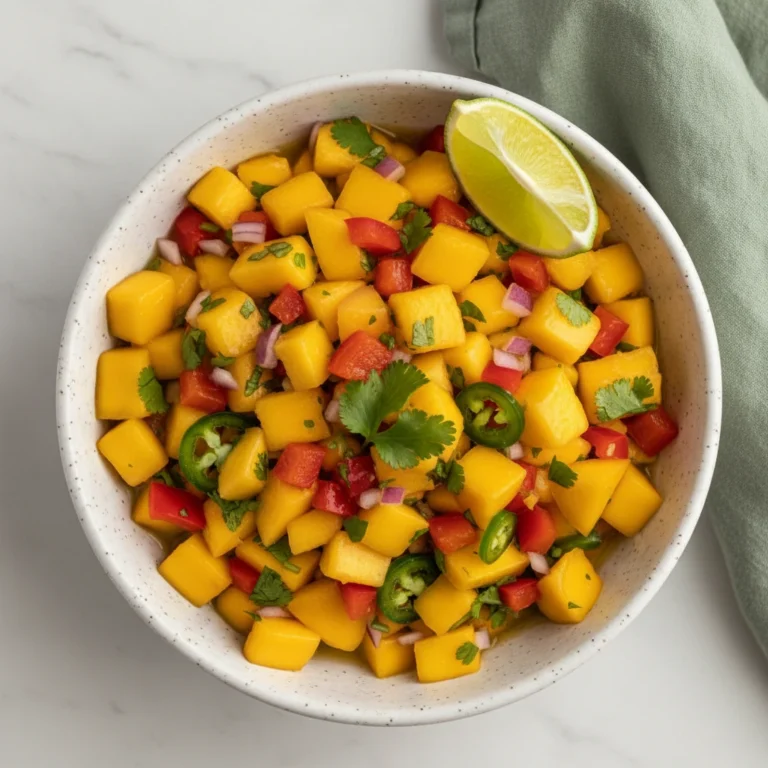
Bright, refreshing, and bursting with tropical flavor, mango salsa is the perfect companion to grilled fish, chicken, or crispy tortilla chips. This vibrant condiment combines sweet mango with savory spices and a hint of heat for a versatile topping that elevates everything from casual weeknight dinners to elegant summer entertaining. Whether you’re hosting a gathering or simply craving something fresh and flavorful, this easy-to-make salsa is sure to become a favorite.
Reasons to Try Mango Salsa
Tropical Sweetness Meets Savory Spice — Mango salsa offers a perfect balance of natural sweetness from ripe mangoes with the heat of jalapeño and earthiness of cumin, creating a complex flavor profile that keeps you coming back for more.
Incredibly Versatile — Beyond pairing with seafood and poultry, this salsa works beautifully as a topping for tacos, grilled shrimp, black bean bowls, avocado toast, or fresh goat cheese. It’s equally at home at a casual taco night or an upscale dinner party.
Naturally Nutritious — Packed with vitamin C, fiber, and antioxidants, mango salsa is a healthier topping choice that doesn’t sacrifice flavor. Fresh cilantro and lime add additional phytonutrients and digestive benefits.
Light and Refreshing — Perfect for warm weather entertaining, this chilled salsa has a bright, clean taste that won’t weigh you down. It’s ideal for summer gatherings and al fresco dining.
Comes Together in Minutes — With no cooking required, you can prepare this salsa in about 15 minutes, making it perfect for last-minute entertaining or busy weeknights.
 Save
SaveIngredients Notes
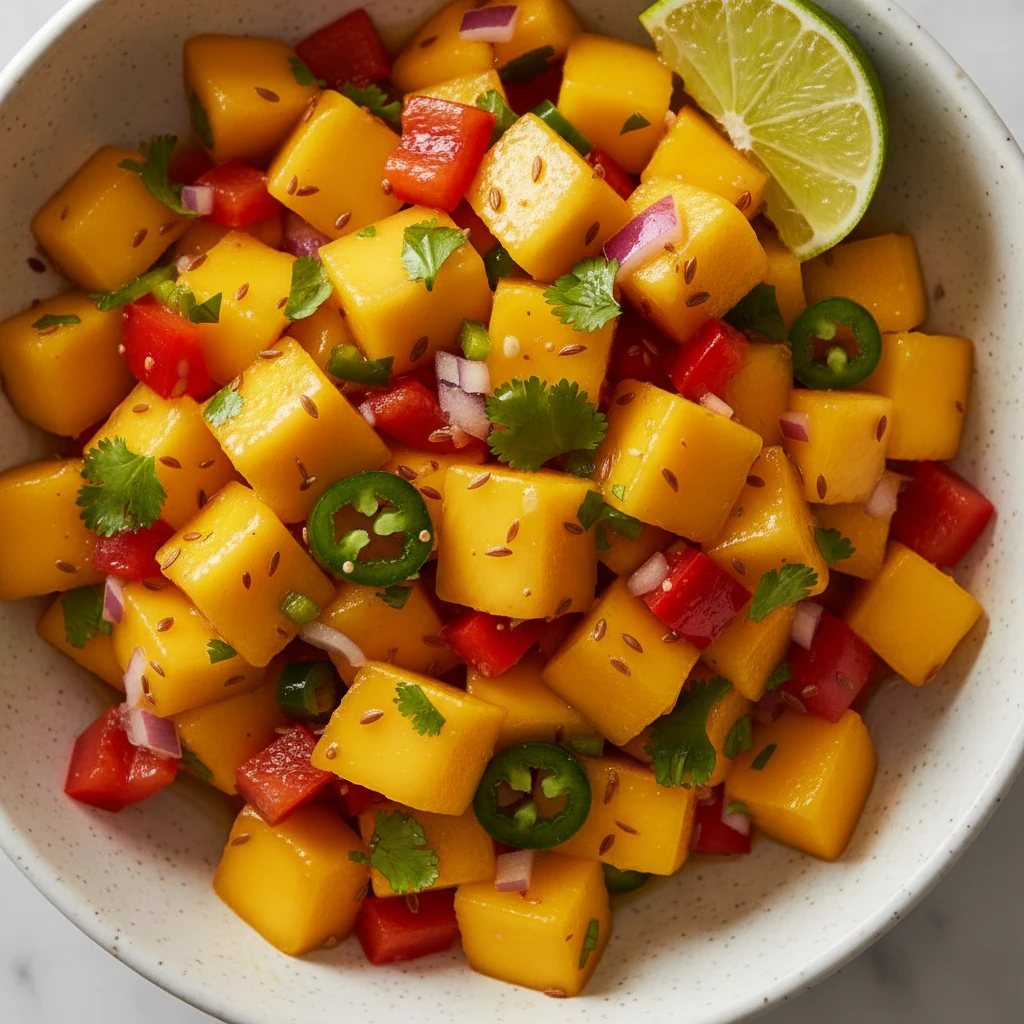
- Ripe mangoes – Choose mangoes that yield slightly to gentle pressure and have a sweet aroma at the stem end. Ataulfo or champagne mangoes work beautifully.
- Red bell pepper – Adds sweetness, color, and crunch. Yellow or orange peppers are good alternatives.
- Red onion – Provides sharpness and visual appeal. White onion can substitute but has less color.
- Jalapeño pepper – Adjust quantity based on your heat preference. Remove seeds for less heat.
- Fresh cilantro – Essential for authentic flavor. Some people have a genetic variation that makes cilantro taste soapy; use parsley instead if needed.
- Fresh lime juice – Always use fresh-squeezed for best flavor; bottled juice lacks brightness.
- Honey – Balances the heat and enhances mango sweetness. Agave nectar works as a substitute.
- Cumin – A pinch adds depth and warmth without overwhelming the tropical flavors.
How to Make Mango Salsa
- Peel and dice the mangoes into small, bite-sized cubes, removing all flesh from the pit.
- Finely dice the red bell pepper into pieces similar in size to the mango.
- Mince the red onion into small pieces.
- Seed the jalapeño and mince it finely.
- Combine all prepared vegetables in a medium bowl.
- Add fresh cilantro, lime juice, honey, salt, pepper, and cumin to the bowl.
- Gently toss everything together until well combined, being careful not to crush the mango.
- Taste and adjust seasonings as needed.
- Chill for at least 30 minutes before serving to allow flavors to meld.
What You Must Know About Mango Salsa
Choose Ripe Mangoes Carefully — The success of this salsa depends entirely on ripe, flavorful mangoes. Unripe mangoes will taste fibrous and bland. A ripe mango should yield to gentle finger pressure and smell fragrant at the stem end. If your mangoes are hard, let them sit at room temperature for 1–2 days before using.
Fresh Lime Juice is Non-Negotiable — Bottled lime juice lacks the brightness and complexity of fresh-squeezed juice and will result in a dull-tasting salsa. Take the extra minute to squeeze fresh limes.
Don’t Over-Mix — Gently fold ingredients together rather than vigorously stirring. Over-mixing will break down the mango and create a mushy texture instead of a chunky, vibrant salsa.
Timing Matters for Temperature — Serve the salsa cold for maximum refreshment. If it sits at room temperature for more than 30 minutes, the mango will begin to oxidize and darken, and the flavors will become less bright.
Customize Heat Level — If you’re serving a crowd with varying spice tolerances, start with half a jalapeño and add more seeds if needed. It’s easier to add heat than remove it.
Helpful Tips
Make It Ahead — Prepare this salsa up to 4 hours in advance and store it covered in the refrigerator. The flavors actually improve slightly as they meld, but don’t make it more than half a day ahead as the mango can begin to oxidize.
Stabilize Watery Salsa — If your mango is particularly juicy, drain some liquid before serving by placing the salsa in a fine-mesh strainer for 1–2 minutes. This prevents a soggy chip or soggy plate when serving.
Add Protein for Substance — For a more substantial dish, add diced cooked shrimp, grilled chicken, or crumbled queso fresco to this salsa to create a complete meal or appetizer.
Boost Texture — For extra crunch, add diced pineapple or a few corn kernels just before serving. These additions enhance the tropical profile and add visual interest.
Variations and Substitutions
Tropical Mango Salsa — Add ½ cup fresh diced pineapple and ¼ cup shredded coconut for a more tropical bent. This variation pairs beautifully with grilled fish and coconut rice.
Corn and Black Bean Version — Stir in ½ cup cooked black beans and ½ cup fresh or frozen corn kernels for a heartier salsa that works wonderfully with pulled pork tacos or as a bowl base.
Spicy Mango Salsa — Double the jalapeño or add a pinch of cayenne pepper and a dash of hot sauce for heat lovers. This version is perfect with milder proteins like white fish.
Mango Avocado Salsa — Gently fold in 1 diced avocado just before serving. This creates a creamier texture that’s exceptional with grilled shrimp or as a guacamole alternative.
Cilantro-Free Option — If cilantro tastes soapy to you, substitute equal amounts of fresh mint or Italian parsley. Both provide herbal freshness without the soap-like taste some experience with cilantro.
Habanero Heat — Replace the jalapeño with one habanero pepper, seeded and minced. Habanero brings fruity heat that complements mango beautifully, though it’s significantly spicier than jalapeño.
Mango Pico de Gallo — Reduce the mango to 1 cup and increase the tomato (add 1 cup diced fresh tomato), red onion, and cilantro for a salsa that bridges tropical and classic Mexican flavors.
Serving Suggestions for Mango Salsa
With Grilled Fish — Serve alongside mahi-mahi, grouper, or sea bass. The bright acidity and sweetness cut through the richness of fish oils and enhance its delicate flavor.
Fish Tacos — Fill warm corn tortillas with grilled fish, shredded cabbage, and a generous dollop of mango salsa. Top with a drizzle of crema or Greek yogurt for creaminess.
Grilled Chicken — Spoon over grilled chicken breasts or thighs. The tropical notes elevate simple grilled chicken into something special.
Shrimp Appetizer — Top large grilled shrimp with a spoonful of mango salsa and serve on crispy tortilla chips or crackers as an elegant appetizer.
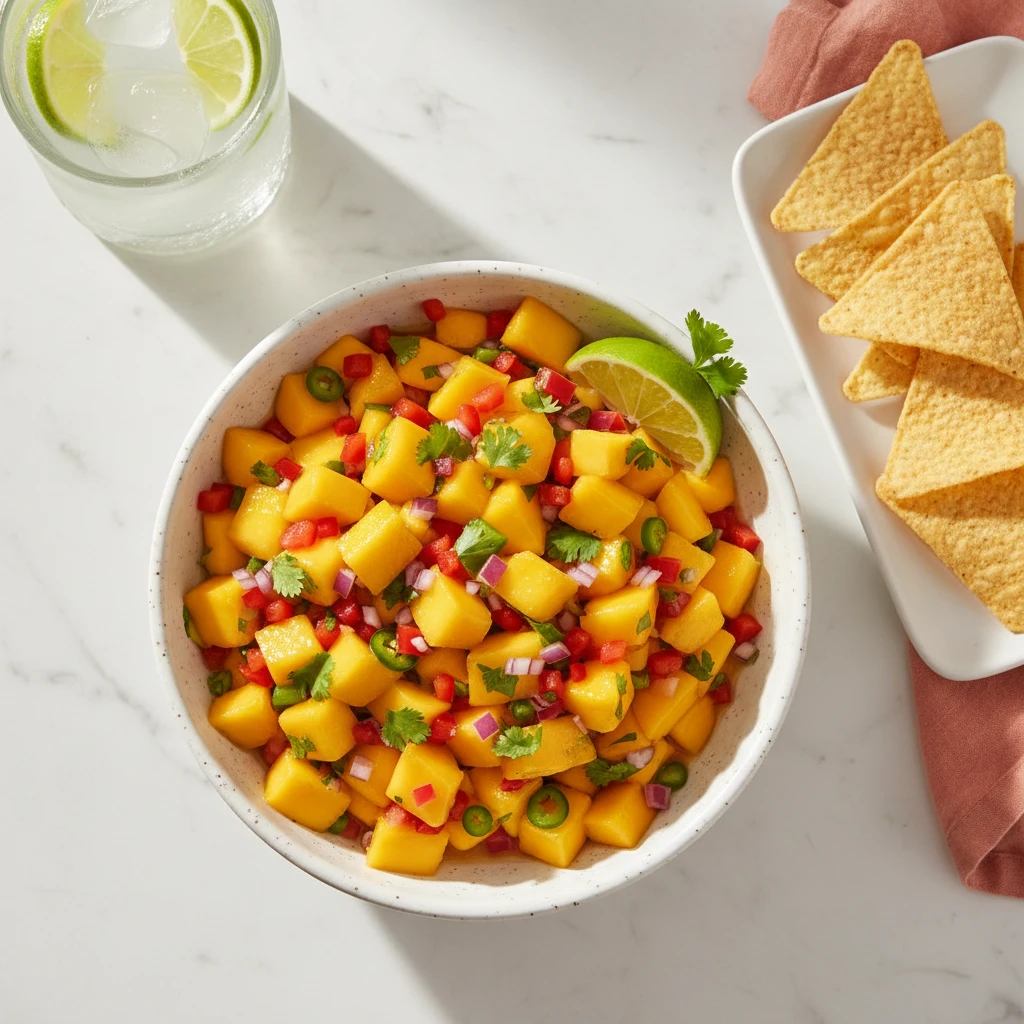
Tortilla Chips and Guacamole — Serve alongside warm tortilla chips and fresh guacamole for a tropical twist on the classic combination.
Black Bean Bowls — Create a grain bowl with cilantro lime rice, black beans, corn, and top with mango salsa for a vegetarian-friendly meal.
Quesadillas — Fill quesadillas with cheese and serve with mango salsa on the side for dipping, or spoon it directly onto the finished quesadilla.
Grilled Pork — Pair with grilled pork tenderloin, carnitas, or pulled pork for a sweet-savory combination that’s absolutely delicious.
Garnish Ideas — Finish bowls and plates with a sprinkle of toasted pepitas (pumpkin seeds), crumbled cotija cheese, fresh lime wedge, or a cilantro sprig for visual appeal and texture contrast.
 Save
SaveStorage and Reheating
Refrigerator Storage — Store mango salsa in an airtight glass container or bowl covered with plastic wrap in the refrigerator for up to 2 days. The mango will begin to oxidize and darken after 24 hours, though it remains safe and delicious to eat. For best flavor and appearance, consume within 1 day of making.
Freezing — While technically you can freeze mango salsa, the texture of the mango will become mushy upon thawing due to ice crystal formation. Freezing is not recommended if you value the chunky texture. However, if you’ve already made more than you can use within 2 days, you can freeze it in ice cube trays and use it as a smoothie base or in cooking applications where texture is less critical.
Make-Ahead Tip — Prepare all ingredients separately up to 24 hours in advance and store in individual airtight containers. Combine just before serving for maximum freshness and vibrant color. This method preserves the best texture and flavor.
Reheating — Mango salsa is best served cold straight from the refrigerator. Do not heat this salsa, as cooking will compromise the fresh, bright flavors and destroy the delicate texture of the mango.
Frequently Asked Questions about Mango Salsa
Can I make mango salsa without jalapeño?
Yes, absolutely. Simply omit the jalapeño if you prefer a salsa without heat. The salsa will still be delicious with all the other bright flavors. If you want some complexity without spice, try adding a tiny pinch of cumin or a dash of white pepper instead.
How far in advance can I make mango salsa?
You can prepare mango salsa up to 2 days in advance and store it covered in the refrigerator. However, for the best flavor, color, and texture, make it no more than 24 hours before serving. The mango will begin to oxidize and brown slightly after the first day, though it remains perfectly safe to eat.
What if my mangoes are too firm?
Firm mangoes will result in a bland, fibrous salsa. Let them sit at room temperature for 1–2 days until they yield to gentle finger pressure and smell fragrant at the stem end. You can also place them in a paper bag to speed ripening. Never use an unripe mango, as the flavor will be disappointing.
Can I use bottled lime juice instead of fresh?
While it’s possible, bottled lime juice lacks the brightness and complexity of fresh-squeezed juice and will result in a noticeably flatter-tasting salsa. Fresh lime juice takes just a minute to squeeze and makes a significant difference in the final dish. It’s worth the small effort.
Is cilantro really necessary, or can I substitute it?
Cilantro provides authentic flavor, but about 10% of people have a genetic variation that makes cilantro taste soapy. If this applies to you, substitute equal amounts of fresh mint, Italian parsley, or even fresh basil. Each will provide herbal freshness with slightly different flavor notes.
What proteins pair best with mango salsa?
Mango salsa pairs beautifully with grilled fish (especially mahi-mahi, grouper, or sea bass), shrimp, grilled chicken, and pork. The tropical sweetness and bright acidity complement lighter proteins particularly well. It also works wonderfully with vegetarian options like black beans and grilled tofu.
Can I make this salsa spicier?
Yes. Double the jalapeño, use a habanero pepper instead, or add a small pinch of cayenne pepper for more heat. Start with small adjustments and taste as you go, since it’s easier to add heat than to remove it.
Why is my mango salsa watery?
Very ripe or juicy mangoes can release liquid, especially if the salsa sits for a while. To prevent this, drain excess liquid through a fine-mesh strainer for 1–2 minutes before serving. You can also prepare the salsa closer to serving time rather than making it several hours in advance.
Nutrition Facts (Per Serving)
| Nutrient | Per Serving |
|---|---|
| Calories | 68 |
| Total Fat | 0.3g |
| Saturated Fat | 0.1g |
| Trans Fat | 0g |
| Cholesterol | 0mg |
| Sodium | 98mg |
| Total Carbohydrates | 17.2g |
| Dietary Fiber | 1.8g |
| Total Sugars | 14.3g |
| Protein | 0.8g |
| Vitamin C | 32% DV |
| Vitamin A | 18% DV |
| Potassium | 168mg (5% DV) |
Dietary Notes: This recipe is naturally vegan, gluten-free, dairy-free, and nut-free, making it suitable for most dietary restrictions. It’s low in calories and fat while being rich in vitamins and antioxidants. One serving is approximately ⅔ cup of salsa.
Mango Salsa
Ingredients
- 2 large ripe mangoes peeled and diced
- 1 red bell pepper finely diced
- 1 small red onion minced
- 1 jalapeño pepper seeded and minced
- 1/4 cup fresh cilantro chopped
- 2 tablespoons fresh lime juice
- 1 tablespoon honey
- 1/4 teaspoon salt
- 1/8 teaspoon black pepper
- 1/8 teaspoon ground cumin
Instructions
- Wash 2 large ripe mangoes under cold water for 1 minute. Feel for slight give when gently squeezed — this means they're ripe. Ripe mangoes should smell sweet and fragrant at the stem end.
- Peel the first mango using a vegetable peeler, working from top to bottom for 3–4 minutes. Remove any remaining skin with a knife.
- Stand the peeled mango upright. Carefully cut along both sides of the flat pit in the center, making 2 long cuts to create two large cheeks. You should have about 12 ounces of mango flesh. Dice the mango cheeks into ½-inch cubes on a cutting board for 3–4 minutes. You want uniform, bite-sized pieces. Checkpoint: You are ready to move on when you have about 2 cups of diced mango with no large chunks.
- Repeat step 2–3 with the second mango. Place all diced mango into a medium mixing bowl for 1 minute.
- Rinse 1 red bell pepper under cold water for 30 seconds. Cut the pepper in half lengthwise and remove seeds and white membrane with a small knife for 2 minutes. Dice the pepper into ¼-inch pieces to match mango size for 2–3 minutes. Add to the bowl.
- Peel and rinse 1 small red onion under cold water for 30 seconds. Cut onion in half. Finely mince the onion into tiny pieces for 2–3 minutes. Add to the bowl.
- Rinse 1 jalapeño pepper under cold water for 20 seconds. Carefully cut the jalapeño in half lengthwise for 1 minute. Use a small spoon to scrape out the white seeds and membranes — this is where most of the heat lives. If you want more heat, leave some seeds in. Finely mince the jalapeño for 2 minutes. Add to the bowl.
- Wash fresh cilantro leaves under cold water and pat dry with paper towels for 2 minutes. Chop the cilantro leaves into small pieces (about ¼ inch) for 2–3 minutes. Add to the bowl.
- Cut 2 fresh limes in half. Squeeze each half over a small bowl for 1 minute total, using a citrus reamer or your hands to extract juice. Strain out seeds through a fine-mesh sieve for 30 seconds. You should have about 3 tablespoons of fresh lime juice. Add to the mango mixture.
- Add 1 tablespoon honey, ¼ teaspoon salt, ⅛ teaspoon black pepper, and ⅛ teaspoon ground cumin to the bowl for 30 seconds.
- Using a large spoon or rubber spatula, gently fold all ingredients together for 2–3 minutes, being careful not to crush or over-mix the mango. The salsa should look chunky and colorful, not mushy.
- Taste the salsa on a spoon for 10 seconds. Adjust seasonings: if too bland, add more lime juice or salt; if too spicy, add a bit more honey; if flat-tasting, add a pinch more cumin.
- Transfer the salsa to a serving bowl or glass container for 1 minute. Cover with plastic wrap or a lid.
- Refrigerate for at least 30 minutes (or up to 2 hours) before serving. This resting time allows the flavors to meld and the salsa to chill throughout. The cold temperature enhances the refreshing tropical flavors. You can tell it's ready when you open the container and smell the bright cilantro and lime aroma.
- Remove from refrigerator 5 minutes before serving for 5 minutes. Give the salsa a gentle stir for 30 seconds to redistribute any liquid that may have settled at the bottom.